Brands
Red Wing vs Ariat
One brand tells you everything about the boot. The other keeps the water out.
Disclosure: product links on this page go to Amazon. As an Amazon Associate we earn from qualifying purchases, at no extra cost to you. It does not change which boots we recommend or the order they appear in — here is the full disclosure.
Quick picks
| # | Product | Best for | Toe & rating | Price |
|---|---|---|---|---|
| 1 |  Red Wing King Toe 6-inch Waterproof Safety Toe Boot (#2240) Red Wing publishes 44% more toe room than a standard work boot and stocks four widths — the clearest answer on this list for a foot that fights every other last. | Red Wing: four widths and a published spec sheet | Non-metallic safety toeASTM F2413-24, I/C, EH | |
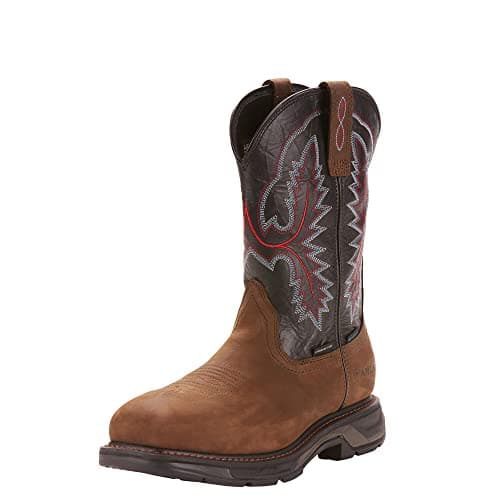
| 2 | Ariat WorkHog XT Waterproof Carbon Toe Work Boot Ariat builds the WorkHog XT around lateral stability and a wide midfoot platform — the pull-on answer for outdoor work on ground that never sits level. | Ariat: waterproof with a carbon toe | Carbon safety toe, non-metallicASTM F2413 I/C EH SRO on the WorkHog XT Incognito carbon toe, per Ariat's published specification | |
| 3 | 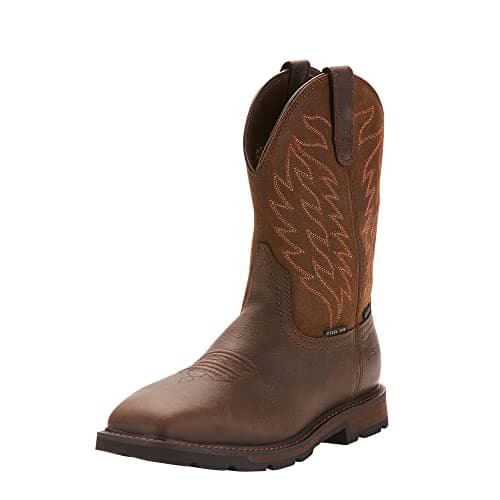 Ariat Groundbreaker H2O EH Steel Toe Wellington Work Boot Waterproof, EH-rated, steel-toe pull-on at the bottom of Ariat's range — the low-cost way into a lace-free waterproof boot. | Ariat: the waterproof pull-on | Steel safety toeEH rated with steel safety toe |
Tap a row to jump to that boot's full write-up. The price column goes straight to Amazon.
What each brand is actually selling
Red Wing Shoes runs two businesses under one name: the Heritage line of welted, resoleable boots that built the reputation, and a modern occupational line that shares the name and very little of the construction. The King Toe 2240 is from the second group, and what it sells is fit and disclosure. Red Wing publishes a width run of B, D, EE and H, a 3 lb 7 oz weight for the pair, a toe-room figure of 44% more than a standard work boot, and a complete ASTM designation. It also states plainly on its own page that the boot is not resoleable, which is an unusually honest thing for a brand with a repair department to put in print.
Ariat came out of the western and ranch market, and the engineering still answers that ground: wet, rutted, uneven, full of things that roll an ankle. The WorkHog XT is built around the ATS Max platform — an extra-wide midfoot over dual-density EVA — sealed with DRYShield and capped with non-metallic carbon. What Ariat does not do is publish: no welt or construction method, no country of origin, no weight, and no width range on the WorkHog XT.
The comparison
| Red Wing King Toe 2240 | Ariat WorkHog XT Carbon Toe | Ariat Groundbreaker H2O ST | |
|---|---|---|---|
| Toe | Non-metallic safety toe, non-metallic shank | Carbon safety toe, non-metallic | Steel safety toe |
| ASTM disclosure | Full line published: F2413-24, I/C, EH | Safety toe with EH on the rated models | Safety toe with EH on the rated models |
| Waterproof | Yes — Red Wing waterproofing system, waxed nubuck | Yes — DRYShield waterproof breathable | Yes — Ariat PRO waterproof construction |
| Widths | Four: B, D, EE and H | Not published as a width range | A wide (EE) version is listed |
| Platform | TPU-PU Galaxy outsole, non-metallic shank | ATS Max extra-wide midfoot, dual-density EVA | 4LR footbed |
| Construction | Direct attach — Red Wing states it is not resoleable | Not published as a welt construction | Not published as a welt construction |
| Published weight | 3 lb 7 oz for the pair | Not published | Not published |
| Origin | Globally sourced, per Red Wing | Not published on the product page | Not published on the product page |
| List price | $254.99 MSRP, per Red Wing | Not published as an MSRP on the spec page we read | Not published as an MSRP on the spec page we read |
Disclosure is the real difference
Strip the branding off these two and the clearest distinction is how much you can learn before you spend the money. Red Wing tells you the widths, the weight, the standard, the outsole compound and the fact that the sole cannot be replaced. Ariat tells you the technologies by name and leaves construction, origin and weight blank.
That matters in two concrete ways. If you are shopping for a foot that does not fit standard lasts, a published width run is the difference between a boot that works and three returns. And if you are trying to cut weight because you walk or climb all shift, you cannot compare a boot with a published 3 lb 7 oz against one with no figure at all — you are comparing against nothing.
Fit: two different ways to make room
Both brands claim to solve a wide foot, and they do it differently. Red Wing adds room at the toes — the King Toe last is deliberately high-volume and square through the front, and the four widths let you pick the heel separately from the toe. Ariat widens the midfoot platform for stability on uneven ground, which is a different problem from toe crowding and does not fix it.
So the honest version is this: if your toes hit the end or the sides of every boot, Red Wing is the brand built for you, and the B width is the answer if your heel is narrow — size down and you will crowd the toes the boot exists to free. Best wide work boots covers the rest of that field, and best socks for work boots is worth reading before you order either of these, because a cushioned sock changes the effective fit by about half a size.
Ground: where Ariat wins outright
On pasture, gravel, mud and rutted yard, a wide stable base under the midfoot does something a conventional work platform does not: it keeps the ankle over the sole when the ground moves. That is the WorkHog XT's whole argument, and it is a good one. The Groundbreaker extends it to a pull-on, waterproof, EH-rated wellington with a wide version listed — genuinely useful if you are in and out of boots all day, or if laces and your work are incompatible. Pull-on vs lace-up has the full trade-off.
Red Wing's answer on wet ground is the waterproofing system and the waxed nubuck, which is a sealed boot rather than a stability platform. Both are waterproof; only one is built for ground that tries to turn your ankle.
Metal, caps and met guards
Two details worth knowing before you choose. First, the King Toe 2240 is non-metallic both at the cap and in the shank, so there is no metal underfoot at all — relevant if you pass through detectors, and relevant in cold, because steel conducts heat out of the toes. Carbon fiber toe vs composite toe covers what the non-metallic caps do and do not buy you.
Second, if your hazard assessment includes something landing on the top of your foot, Red Wing has a direct answer in the King Toe 4456 with an external metatarsal guard. Ariat does not offer an equivalent in this comparison. An external guard is visible enough for a supervisor to confirm at a glance, and awkward enough on ladders that metatarsal guard boots is worth reading before you commit to one.
Price, and what you get for it
Red Wing publishes a $254.99 list price on the King Toe 2240, which puts it at the upper end of occupational footwear and well above where Ariat positions the Groundbreaker. Ariat does not publish an MSRP on the spec pages we read for either model, so street price is the only number available — use the buy links for what either one actually costs today.
What the Red Wing premium buys is fit range and disclosure, not longevity: it is a direct-attach boot like the Ariats, so none of the three is a candidate for a rebuild. If you are spending $255 on a boot you cannot resole, the width run and the non-metallic shank need to be worth that to you — and for a foot that nothing else fits, they genuinely are. Why work boots are so expensive breaks down where the money goes in this part of the market.
Neither one resoles — and that is the headline
If a rebuildable boot is what you actually want, this is the wrong comparison — go to the USA-made brands or read resoling work boots for the arithmetic on what a welt saves over five years.
The verdict
Red Wing if fit is your constraint, if you need a width nobody else stocks, if you want no metal underfoot, or if you want to read a complete spec sheet before spending $255. The King Toe is the better-documented boot by a distance, and the toe room is real.
Ariat if your ground is wet and uneven, if you want a carbon cap, or if you want a waterproof pull-on rather than a lace-up. You will learn less about the boot before you buy it, and on rutted ground it is still the right call.
If neither settles it, Thorogood vs Ariat puts Ariat against a welted boot you can rebuild, and Red Wing vs Thorogood is the comparison to read if the resoling question is the one that actually matters to you.
The picks in full
Illustrative category photo — not this model#1 — Red Wing: four widths and a published spec sheet
Red Wing King Toe 6-inch Waterproof Safety Toe Boot (#2240)
Red Wing publishes 44% more toe room than a standard work boot and stocks four widths — the clearest answer on this list for a foot that fights every other last.
Published specifications
- Toe
- Non-metallic safety toe
- Safety rating
- ASTM F2413-24, I/C, EH
- Upper
- Waterproof waxed nubuck leather
- Outsole
- TPU-PU Galaxy outsole
- Midsole / shank
- Non-metallic shank
- Construction
- Direct attach — Red Wing states this model is not resoleable
- Waterproof
- Yes — Red Wing waterproofing system
- Insulation
- Not stated on the product page
- Widths
- Narrow (B), Regular (D), Wide (EE), Wide (H)
- Weight
- 3 lb 7 oz
- Made in
- Globally sourced
Specifications read from Red Wing Shoes product page (#2240) on 2026-09-27. We have not worn this boot.
What works
- Genuinely the widest toe box on this list, and Red Wing publishes the figure
- Four widths including an H, which almost nobody stocks
- Fully non-metallic underfoot — relevant for metal detectors
- Red Wing publishes an actual weight, which most brands do not
What doesn't
- Direct-attach construction: Red Wing states it is not resoleable
- Expensive for a boot you cannot rebuild
- The square King Toe silhouette is divisive
Who this is wrong for
Anyone buying for longevity through resoling. Red Wing's own page says no on this model — look at their welted Heritage lines instead.
Sizing
The King Toe last adds room at the toes, not at the heel. If you have a narrow heel, take the B width before you size down; sizing down to fix heel slip will crowd the toes the boot was built to free.
#2 — Ariat: waterproof with a carbon toe
Ariat WorkHog XT Waterproof Carbon Toe Work Boot
Ariat builds the WorkHog XT around lateral stability and a wide midfoot platform — the pull-on answer for outdoor work on ground that never sits level.
Published specifications
- Toe
- Carbon safety toe, non-metallic
- Safety rating
- ASTM F2413 I/C EH SRO on the WorkHog XT Incognito carbon toe, per Ariat's published specification
- Upper
- Leather upper with DRYShield waterproof breathable construction
- Outsole
- Ariat work outsole, slip-resistant (SRO on the rated models)
- Midsole / shank
- ATS Max platform with an extra-wide midfoot and a dual-density EVA midsole
- Construction
- Not published as a welt construction
- Waterproof
- Waterproof — DRYShield
- Insulation
- Not insulated
Specifications read from Ariat product page (WorkHog XT waterproof carbon toe) on 2026-09-27. We have not worn this boot.
What works
- Lateral stability is the design brief, and it shows on uneven ground
- Carries an SRO slip designation as well as EH on the rated models
- Pull-on entry with a lacing-free instep
What doesn't
- Ariat publishes the full designation on some WorkHog XT models and not others — check the exact variant
- Wide midfoot platform feels clumsy indoors
- Not resoleable
Who this is wrong for
Tight indoor work in confined spaces. The wide platform that helps on rubble is a hindrance in a crawl space.
Sizing
Ariat runs a touch long for many owners; a half size down is a common report. Because it is a pull-on, size for the instep first.
#3 — Ariat: the waterproof pull-on
Ariat Groundbreaker H2O EH Steel Toe Wellington Work Boot
Waterproof, EH-rated, steel-toe pull-on at the bottom of Ariat's range — the low-cost way into a lace-free waterproof boot.
Published specifications
- Toe
- Steel safety toe
- Safety rating
- EH rated with steel safety toe
- Upper
- Leather upper with waterproof PRO construction
- Outsole
- Ariat work outsole
- Midsole / shank
- 4LR footbed technology for cushioning and support
- Construction
- Not published as a welt construction
- Waterproof
- Waterproof — Ariat PRO construction
- Insulation
- Not insulated
- Widths
- A wide (EE) version is listed
Specifications read from Authorized retailer spec page (Academy) — Ariat Groundbreaker Wide H2O EH steel toe wellington on 2026-09-27. We have not worn this boot.
What works
- Cheapest waterproof EH pull-on here
- Wide version genuinely stocked
- No laces to deal with in mud
What doesn't
- Entry-tier materials — expect a shorter life than the WorkHog XT
- Steel toe conducts cold
- Retailer page publishes less detail than Ariat's own pages
Who this is wrong for
Anyone in real cold. A steel cap with no insulation is the worst toe-temperature combination available.
Sizing
Groundbreaker pull-ons need room at the instep to get on. If your foot is high-volume, take the EE before you take a longer size.
Frequently asked questions
Is Red Wing or Ariat better for work boots?
They solve different problems. Red Wing's King Toe 2240 is the better choice for fit and for buyers who want published specs — four widths including an H, a stated 3 lb 7 oz weight and a full ASTM F2413-24 I/C EH line. Ariat's WorkHog XT is the better choice for wet, uneven ground, with DRYShield waterproofing, a carbon toe and an extra-wide ATS Max midfoot. Neither model is resoleable.
Are Red Wing King Toe boots resoleable?
Not the 2240. Red Wing states on its own product page that this direct-attach model is not resoleable. The welted Heritage lines are a different construction and can be rebuilt, which is where Red Wing's repair reputation comes from — check the construction line on the specific model rather than assuming the brand.
Are Ariat work boots resoleable?
Ariat publishes no welt construction on the WorkHog XT or the Groundbreaker wellington, so both should be treated as replace-not-repair boots. Construction decides this, not price: a cemented or direct-attach boot cannot be rebuilt economically regardless of what it cost.
Does Ariat make wide work boots?
Ariat lists a wide (EE) version of the Groundbreaker wellington but publishes no width range on the WorkHog XT. If width is your constraint, Red Wing's King Toe is the stronger answer in this comparison — B, D, EE and H are stocked, and Red Wing publishes a 44% toe-room figure against a standard work boot.
Is the Ariat WorkHog XT or the Red Wing King Toe better for cold weather?
Neither publishes an insulation figure on the models compared here, so both are cold-weather boots only in the sense that they are waterproof. The King Toe has one real advantage: it is non-metallic at both the cap and the shank, and a steel cap conducts heat out of the toes. For genuinely cold work, buy a boot with a published insulation weight instead.
Sources
- ASTM F2413 protective footwear standard — technical summary — Label format, the mandatory I and C designations, and each optional code
- ASTM F2413 safety footwear ratings explained — The 18,000-volt / 60 Hz / one-minute EH test condition, stated in full
- Red Wing Shoes — repairs and resoling — Red Wing's own factory repair service