Trades
Best Work Boots for HVAC Technicians
Four surfaces, one pair of boots, and a ladder between every one of them.
Disclosure: product links on this page go to Amazon. As an Amazon Associate we earn from qualifying purchases, at no extra cost to you. It does not change which boots we recommend or the order they appear in — here is the full disclosure.
Quick picks
| # | Product | Best for | Toe & rating | Price |
|---|---|---|---|---|
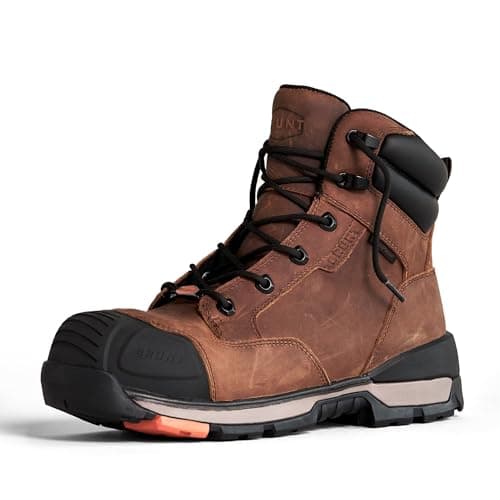
| 1 | BRUNT The Perkins Waterproof Composite Toe Work Boot The Perkins swaps the Marin's profile for a defined 90-degree heel — the version to buy if you spend the day on ladders, scaffolding or roof edges. | Ladder rungs and roof edges | Composite safety toe, non-metallicComposite safety toe with electrical hazard (EH) protection; slip- and oil-resistant | |
| 2 | 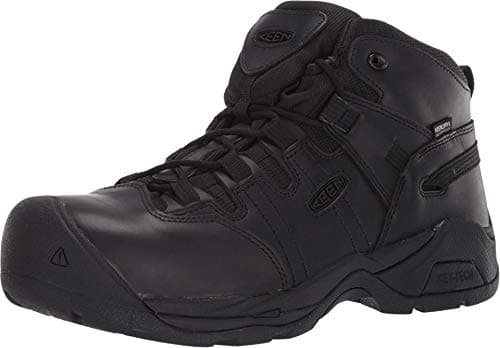 KEEN Utility Detroit XT Carbon-Fiber Toe Work Boot Carbon-fiber toe on the Detroit XT platform: the same impact and compression rating with a lighter, non-conductive cap. | The lightest rated cap, sealed | Carbon-fiber safety toe, non-metallicMeets ASTM F2412-17 and F2413-17 M I/75 C/75, EH; carbon safety toes save about 15% weight over steel, per KEEN | |
| 3 | 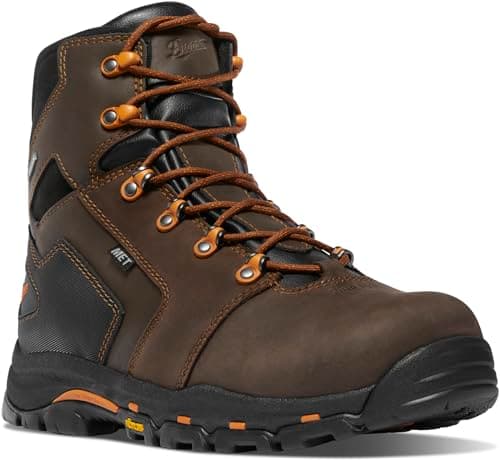 Danner Vicious 6" Composite Toe Work Boot (13879) A GORE-TEX composite-toe boot on a Vibram Vicious outsole with a 90-degree heel — the Vibram pick for anyone who needs a rung-catching heel without a logger's bulk. | Published weight and Vibram grip | Composite toe (NMT) — non-metallicASTM F2413-24 I/C EH | |
| 4 | 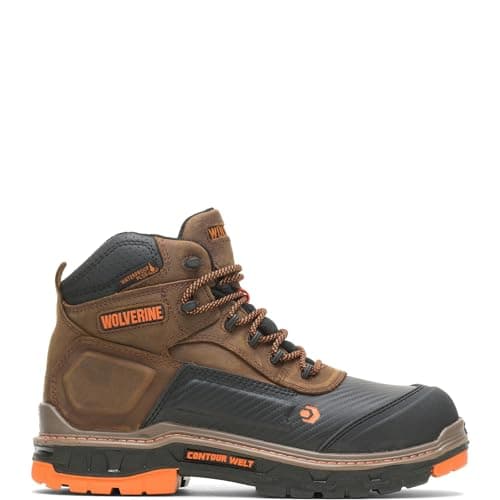 Wolverine Overpass CarbonMAX 6" Composite Toe Waterproof Boot A waterproof CarbonMAX composite toe on a flexible dual-compound outsole — the Overpass is built to move with the foot rather than brace it. | Kneeling in an attic or a crawlspace | CarbonMAX composite safety toe, non-metallicASTM F2413 M/I/C EH rated composite toe | |
| 5 | 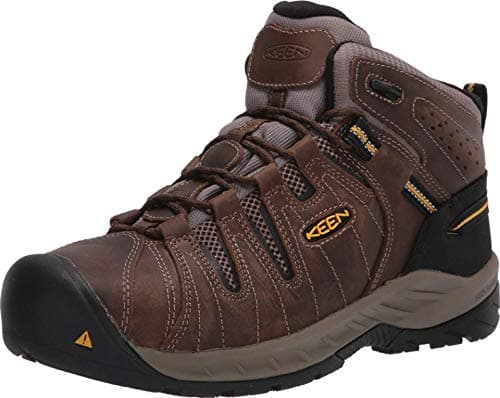 KEEN Utility Flint II Steel Toe Work Boot KEEN's work-hiker with a steel toe, EH-rated outsole and siping cut specifically for slick surfaces — a light boot for trades that walk all day. | Summer — no membrane to trap heat | Steel safety toeASTM F2413-18 M/I/75/C/75 with EH (KEEN Utility safety-toe standard); EH-rated outsole with siping for traction on slick or wet surfaces |
Tap a row to jump to that boot's full write-up. The price column goes straight to Amazon.
The heel is the spec that decides this trade
HVAC techs spend more of the day on ladders than almost any other trade — condensers on roofs, air handlers in attics, line sets run through a crawlspace. A ladder rung is carried on the shelf between the heel and the arch, and whether that shelf exists is a function of heel geometry. A wedge sole has no shelf at all: the heel is continuous with the forefoot, so the rung sits under the arch with nothing stopping your foot sliding forward.
Two boots here publish the geometry rather than leaving you to guess. BRUNT states a defined 90-degree heel on the Perkins, built for rungs and edges. Danner publishes a 90-degree heel on the Vibram Vicious outsole. Both also happen to be the lighter end of this list, which is the second thing a ladder punishes. Wedge sole vs lug sole covers why the flat-soled boots that are best on a finished floor are the worst on a rung.
| Where you are | What the boot needs | What it costs you |
|---|---|---|
| On a ladder to a rooftop unit | A defined 90° heel and low weight | A heel block is clumsy on a flat finished floor |
| In an attic in August | No waterproof membrane, real breathability | You get wet feet the first time it rains |
| Kneeling at an air handler | Forefoot flex and a six-inch shaft | Less ankle support stepping off a roof curb |
| At a live disconnect or panel | A published EH designation | Secondary protection only; degrades when wet |
| On a hot built-up roof | A heat-resistant outsole compound | Harder compounds grip less on wet metal |
| On a customer's hardwood or tile | A non-marking outsole | Pale soles show every scuff |
EH, and what it is not
HVAC work puts you at live disconnects, contactors and control boards all day, so the EH designation belongs on your list — but understand what you are buying. The test is 18,000 volts at 60 Hz for one minute in dry conditions, with leakage current under 1.0 mA. It certifies the boot as secondary protection against incidental contact. It is not a substitute for lockout, and its performance falls as the outsole wears and when the boot is wet.
A non-metallic cap is the sensible companion choice. Composite and carbon caps are non-conductive, lighter than steel and do not pull cold into the toes on a January rooftop — and they meet the identical ASTM F2413 impact and compression thresholds. If you were told steel makes a boot dangerous around electricity, it does not: are steel toe boots an electrical hazard goes through why.
Weight, because you carry everything
You climb a ladder with a recovery machine, a set of gauges and a condenser fan motor. Boot weight is the one load you can reduce without leaving a tool behind, and it is the reason a carbon or composite cap is worth the money in this trade: KEEN states its carbon-fiber toe is roughly 15% lighter than steel while meeting the same M I/75 C/75 thresholds with EH. Danner publishes 55 ounces per pair for the Vicious — a real number, which is rarer than it should be in this category.
Where makers do not publish a weight, you cannot compare on it, and nobody should invent a figure for you. Use the cap material and the shaft height as proxies instead: a six-inch non-metallic boot with a cemented athletic sole will be the lightest thing in any lineup, and an eight-inch waterproof steel-toe boot will be the heaviest. Best lightweight work boots collects the models that do publish.
The part of the job that is not technical
You work in people's houses. A boot that tracks black scuff marks across a customer's hardwood costs the company a callback, which is why non-marking outsoles are near-universal on trades that go indoors. Colour is only a clue — plenty of dark compounds are non-marking and some pale ones are not — why work boots have white soles explains what to look for on the spec sheet. Keep a second pair of slip-on covers in the van for finished-floor work and the problem goes away entirely.
The picks in full
#1 — Ladder rungs and roof edges
BRUNT The Perkins Waterproof Composite Toe Work Boot
The Perkins swaps the Marin's profile for a defined 90-degree heel — the version to buy if you spend the day on ladders, scaffolding or roof edges.
Published specifications
- Toe
- Composite safety toe, non-metallic
- Safety rating
- Composite safety toe with electrical hazard (EH) protection; slip- and oil-resistant
- Upper
- Waterproof leather upper
- Outsole
- BRUNT rubber outsole with a 90° heel — high-heat resistant to 572°F / 300°C
- Midsole / shank
- BRUNT polyurethane (PU) midsole
- Construction
- Not published as a welt construction on this model
- Waterproof
- Waterproof
- Insulation
- Not insulated
- Widths
- SWITCH-FIT adjustable between regular (D) and relaxed (EE)
Specifications read from BRUNT Workwear product page (The Perkins waterproof comp toe) on 2026-09-27. We have not worn this boot.
What works
- The 90° heel breast is the single most useful feature for climbing work
- Same width-adjustment system as the Marin
- Non-metallic toe, so no cold conduction
What doesn't
- A defined heel is less comfortable than a wedge on flat concrete
- Full ASTM designation string is not published on the page
- Not resoleable
Who this is wrong for
Flat-floor trades. If your day is spent on level concrete, the heel breast concentrates load where a wedge would spread it.
Sizing
Same last and SWITCH-FIT system as the Marin, so size the same. Check heel hold specifically — a defined heel makes heel lift more noticeable.
#2 — The lightest rated cap, sealed
KEEN Utility Detroit XT Carbon-Fiber Toe Work Boot
Carbon-fiber toe on the Detroit XT platform: the same impact and compression rating with a lighter, non-conductive cap.
Published specifications
- Toe
- Carbon-fiber safety toe, non-metallic
- Safety rating
- Meets ASTM F2412-17 and F2413-17 M I/75 C/75, EH; carbon safety toes save about 15% weight over steel, per KEEN
- Upper
- Leather upper with the KEEN.DRY waterproof breathable membrane
- Outsole
- Oil- and slip-resistant outsole with siping for wet grip
- Midsole / shank
- KEEN.ReGEN cushioning midsole
- Construction
- Not published as a welt construction
- Waterproof
- Waterproof — KEEN.DRY membrane
- Insulation
- Not insulated
Specifications read from KEEN Utility Detroit XT collection specifications on 2026-09-27. We have not worn this boot.
What works
- Same 75 ft-lb impact rating as steel at lower weight
- Non-metallic cap does not conduct cold or set off detectors
- KEEN states the weight saving as a figure rather than a vibe
What doesn't
- Costs more than the steel-toe version of the same boot
- A composite or carbon cap that takes a heavy hit must be retired, not just inspected
- Not resoleable
Who this is wrong for
Jobs with repeated heavy impact on the toe box. Steel handles repeat strikes better; a non-metallic cap is a one-serious-hit component.
Sizing
Same Detroit XT last as the steel-toe version, so size the same. If you are moving from a steel toe, expect the cap to feel slightly higher-volume.
#3 — Published weight and Vibram grip
Danner Vicious 6" Composite Toe Work Boot (13879)
A GORE-TEX composite-toe boot on a Vibram Vicious outsole with a 90-degree heel — the Vibram pick for anyone who needs a rung-catching heel without a logger's bulk.
Published specifications
- Toe
- Composite toe (NMT) — non-metallic
- Safety rating
- ASTM F2413-24 I/C EH
- Upper
- Full-grain leather
- Outsole
- Vibram Vicious — oil- and slip-resistant, low-profile, with a 90-degree heel
- Midsole / shank
- Dual-density EVA midsole with a Danner Trailguard TPU shank and a PU footbed
- Construction
- Lace-up with a speed-lace system; Danner states it is not recraftable
- Waterproof
- 100% waterproof and breathable GORE-TEX liner
- Insulation
- Not insulated
- Weight
- 55 oz per pair
- Made in
- Vietnam
Specifications read from Danner product page (Vicious 6" composite toe, 13879) on 2026-09-29. We have not worn this boot.
What works
- A 90-degree heel breast in a low-profile boot, which is unusual
- A Vibram compound on a boot at a normal work price, not a handmade one
- GORE-TEX rather than a generic membrane
- Danner publishes the weight, so you can compare it honestly
What doesn't
- Danner states it is not recraftable — the Vibram sole cannot be replaced
- An EVA midsole will pack out faster than polyurethane
- Made in Vietnam, unlike Danner's USA-built Quarry line
Who this is wrong for
Anyone buying Vibram because they intend to resole. This boot cannot be recrafted; the Thorogood logger and the handmade boots can.
Sizing
Danner's DLE-01 last holds the heel firmly with a roomier toe box. Fit the heel first — slack there is what drives toes into a composite cap.
#4 — Kneeling in an attic or a crawlspace
Wolverine Overpass CarbonMAX 6" Composite Toe Waterproof Boot
A waterproof CarbonMAX composite toe on a flexible dual-compound outsole — the Overpass is built to move with the foot rather than brace it.
Published specifications
- Toe
- CarbonMAX composite safety toe, non-metallic
- Safety rating
- ASTM F2413 M/I/C EH rated composite toe
- Upper
- Premium waterproof leather with an abrasion-resistant toe
- Outsole
- Dual-compound rubber and PU outsole
- Midsole / shank
- Advanced comfort PU midsole with a nylon shank
- Construction
- Not published as a welt construction
- Waterproof
- Waterproof leather upper
- Insulation
- Not insulated
Specifications read from Wolverine product page (Overpass CarbonMAX 6") on 2026-09-27. We have not worn this boot.
What works
- Genuinely flexible for a safety-toe boot
- Waterproof leather rather than a membrane-only claim
- Removable footbed, so an orthotic actually fits
What doesn't
- A nylon shank is not a climbing shank
- PU midsoles eventually crumble with age and disuse
- Not resoleable
Who this is wrong for
Pole and ladder work. A flexible boot with a nylon shank is the wrong platform for standing on a rung all day.
Sizing
The Overpass runs close to true. Because the footbed is removable, fit it with your orthotic in place if you use one — swapping later changes the fit by a half size in feel.
#5 — Summer — no membrane to trap heat
KEEN Utility Flint II Steel Toe Work Boot
KEEN's work-hiker with a steel toe, EH-rated outsole and siping cut specifically for slick surfaces — a light boot for trades that walk all day.
Published specifications
- Toe
- Steel safety toe
- Safety rating
- ASTM F2413-18 M/I/75/C/75 with EH (KEEN Utility safety-toe standard); EH-rated outsole with siping for traction on slick or wet surfaces
- Upper
- Leather and textile upper
- Outsole
- EH-rated outsole with strategically placed siping
- Midsole / shank
- KEEN.ReGEN cushioning with an ergonomic insole
- Construction
- Not published as a welt construction
- Waterproof
- Not waterproof in the base Flint II
- Insulation
- Not insulated
Specifications read from KEEN Utility product page (Flint II steel toe) on 2026-09-27. We have not worn this boot.
What works
- Siping is a specific traction feature, not a generic tread claim
- Light enough to walk a full shift in
- ReGEN cushioning holds up better than plain EVA
What doesn't
- Not waterproof in the base model
- Low-cut versions offer no ankle support
- Not resoleable
Who this is wrong for
Wet trades. If your feet get soaked regularly, start with a membrane boot instead — the Flint II's virtue is low weight, not water resistance.
Sizing
Standard KEEN Original Fit: generous forefoot, normal heel. Take your usual size and use the lacing to lock the heel.
Frequently asked questions
What kind of boots do HVAC techs wear?
A six-inch safety-toe boot with a defined heel for ladder rungs and a published EH designation. Most techs go non-metallic — composite or carbon — for weight and because a non-conductive cap is sensible around live equipment. Whether to take a waterproof membrane depends on your climate: it is wrong for hot attics and right for outdoor line sets in the rain.
Do HVAC boots need to be EH rated?
It is the single most relevant optional designation for the trade, because you are at live disconnects and control boards all day. Understand the limit: EH is tested dry at 18,000 volts for one minute and certified as secondary protection against incidental contact. It degrades as the outsole wears and when the boot is wet, and it never replaces lockout.
Are wedge soles good for HVAC work?
Not for the ladder half of the job. A wedge has no heel shelf, so a rung sits under the arch with nothing to stop your foot sliding forward. Wedges are excellent on flat finished floors, which is why some techs keep one pair for residential service and a heeled boot for rooftop work.
How often should HVAC techs replace their boots?
Watch the outsole rather than the calendar: the EH and slip-resistance properties you paid for live in the sole, and both degrade as it wears down. A rounded-off heel edge is the specific failure to look for, because it is what grips a rung.
Sources
- OSHA 29 CFR 1910.136 — Foot protection — The federal rule itself: when protective footwear is required, and which consensus standards it accepts
- ASTM F2413 protective footwear standard — technical summary — Label format, the mandatory I and C designations, and each optional code
- ASTM F2413 safety footwear ratings explained — The 18,000-volt / 60 Hz / one-minute EH test condition, stated in full
- KEEN Utility — aluminum toe collection and ASTM compliance — KEEN's published ASTM F2413-18 M/I/75/C/75 EH designation and the 35%-lighter aluminum claim
Read next
Best EH-Rated Work Boots
The wider EH shortlist, with what each maker publishes.
Best Lightweight Work Boots
Every boot you carry up a ladder is weight you chose.
ASTM F2413 Explained
The rating your trade actually needs, and what each code on the label certifies.
Work Boot Sizing Guide
Get the fit right before you spend money — most boot complaints are fit.
How to Break In Work Boots
What to do in the two weeks before your first full shift in a new pair.