Safety Toes
What Does EH Rated Mean on Work Boots?
A named test with a named limit — and a long list of things it does not cover.
Disclosure: product links on this page go to Amazon. As an Amazon Associate we earn from qualifying purchases, at no extra cost to you. It does not change which boots we recommend or the order they appear in — here is the full disclosure.
Quick picks
| # | Product | Best for | Toe & rating | Price |
|---|---|---|---|---|
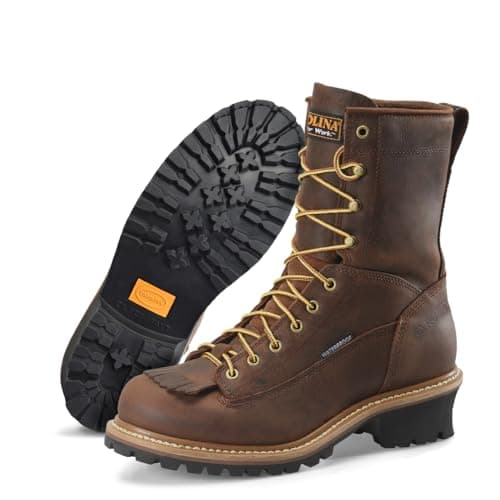
| 1 | Carolina Spruce 8" Steel Toe Waterproof Logger A waterproof 8-inch logger with a triple-bar steel shank — the stiff underfoot platform that ladder rungs and pole work actually need. | Publishes the EH test condition in full | Steel safety toe capMeets or exceeds ASTM F2413-18 for compression and impact; electrical hazard protection tested to withstand 18,000 volts at 60Hz for one minute without leakage | |
| 2 | 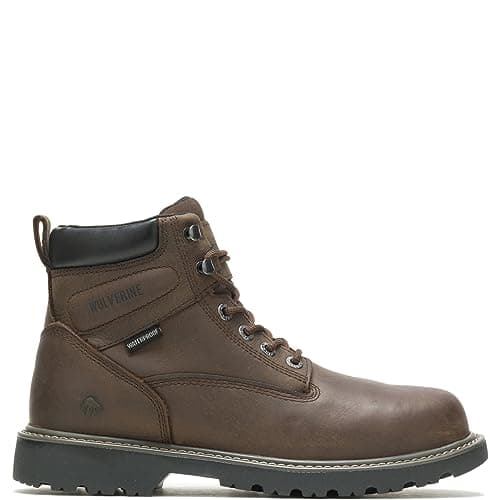 Wolverine Floorhand Waterproof Steel Toe 6" Work Boot Waterproof full-grain leather, a steel toe and an EH rating in a light cemented build — the value pick when the job is wet and the budget is fixed. | Full M/I/C EH designation, low cost | Steel safety toeASTM F2413 M/I/C EH rated steel toe | |
| 3 | 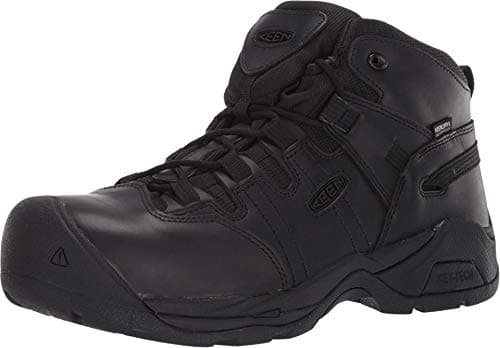 KEEN Utility Detroit XT Carbon-Fiber Toe Work Boot Carbon-fiber toe on the Detroit XT platform: the same impact and compression rating with a lighter, non-conductive cap. | EH with no metal in the cap | Carbon-fiber safety toe, non-metallicMeets ASTM F2412-17 and F2413-17 M I/75 C/75, EH; carbon safety toes save about 15% weight over steel, per KEEN |
Tap a row to jump to that boot's full write-up. The price column goes straight to Amazon.
The test behind the two letters
EH is an optional designation inside ASTM F2413, the consensus standard OSHA accepts for protective footwear under 29 CFR 1910.136. The test is specific and published: the sole and heel assembly is subjected to 18,000 volts at 60 Hz for one minute, in dry conditions, and must not allow leakage current above 1.0 milliamp. Carolina states that test condition in full on its own product pages, which is a useful habit to look for in a maker.
Two words in that sentence do most of the work. Dry — the certification says nothing about a wet outsole. And secondary — ASTM's own framing is that EH footwear is a backup to the primary safeguards, which are isolation, lockout and de-energising the circuit.
What EH does not do
| People assume | The rating actually says |
|---|---|
| The boot insulates me from a live circuit | It resists current through the sole in a dry, one-minute laboratory test — it is not an insulating barrier you can rely on |
| It works in the wet | The test is dry. Water on or in the outsole creates a conductive path the certification does not cover |
| It lasts the life of the boot | Protection degrades as the outsole wears, is cut, or embeds metal swarf and grit |
| It protects against static discharge | That is the opposite property. SD footwear is designed to drain static; EH is designed to resist current |
| Any safety boot is EH | EH is an optional designation. If the marking line does not show it, the boot does not have it |
How to read the marking line
ASTM F2413 compliant footwear carries a marking inside the boot, and the codes are stacked in a fixed order: the standard and year, then the gender code, then I for impact and C for compression — both mandatory at 75 foot-pounds and 2,500 pounds — and then any optional designations. EH is one of those optional codes, alongside Mt for metatarsal, PR for puncture resistance, SD for static dissipative and CD for conductive.
Wolverine publishes the Floorhand as ASTM F2413 M/I/C EH, which is the complete form worth looking for. Where a maker writes only “EH rated” with no designation line, you are taking their word for a test you cannot see. ASTM F2413 explained breaks every code down in order.
Who actually needs EH
Electricians are the obvious case, but the rating matters to a much wider group: HVAC technicians working on live equipment, maintenance crews, plant and factory workers around powered machinery, anyone pulling cable, and most general construction trades working near temporary power. If there is a credible route for current to reach the ground through you, EH is the designation to specify.
Linemen are the exception that proves the rule. Pole and transmission work needs dielectric overshoes and primary protective equipment, not an EH boot — the hazard is a different order of magnitude. Dielectric boots vs EH rated covers where that line falls, and the linemen page covers the rest of the kit.
The metal question
A steel toe cap does not disqualify a boot from an EH rating — plenty of EH-rated boots have steel caps, because the test is about the sole and heel assembly rather than the toe. What matters more in practice is what is underfoot: a steel shank or exposed metal in the outsole is a path, and a nail picked up in a lug is a path the maker never certified.
If you want to remove that variable entirely, buy non-metallic throughout. KEEN's carbon-fiber Detroit XT publishes ASTM F2412-17 and F2413-17 M I/75 C/75 with EH and saves about 15% of the weight of steel per KEEN's own figure. Red Wing's King Toe 2240 pairs a non-metallic toe with a non-metallic shank. Are steel toe boots an electrical hazard addresses the worry directly.
Keeping the rating meaningful
Three habits preserve what the certification tested. Inspect the outsole weekly for embedded metal — swarf, staples, wire offcuts — and pick out anything you find. Replace the boots when the tread is worn into the midsole, because the thickness of rubber is the protection. And treat wet conditions as a loss of the rating rather than a reduction in it: the test is dry, so a soaked boot is outside the envelope the maker certified.
When you need the rating and the boots, the roundup is best EH-rated work boots, and the electricians page covers the rest of the specification for that trade.
The picks in full
#1 — Publishes the EH test condition in full
Carolina Spruce 8" Steel Toe Waterproof Logger
A waterproof 8-inch logger with a triple-bar steel shank — the stiff underfoot platform that ladder rungs and pole work actually need.
Published specifications
- Toe
- Steel safety toe cap
- Safety rating
- Meets or exceeds ASTM F2413-18 for compression and impact; electrical hazard protection tested to withstand 18,000 volts at 60Hz for one minute without leakage
- Upper
- Leather upper with the SCUBALINER waterproof lining
- Outsole
- Oil- and slip-resisting rubber logger outsole
- Midsole / shank
- Triple-bar steel shank with a Pillow Cushion footbed
- Construction
- Welt construction
- Waterproof
- Waterproof — SCUBALINER
- Insulation
- Not insulated in this model; Carolina lists an insulated version
- Widths
- D, 2E and 4E
Specifications read from Carolina Shoe product page (Spruce 8" steel toe waterproof logger, CA9825) on 2026-10-01. We have not worn this boot.
What works
- States the EH test conditions, which most brands summarize away
- The triple-bar shank is the real reason to buy a logger
- Waterproof at a working price
What doesn't
- A rigid shank is punishing on flat concrete
- Heavy
- Steel shank and steel toe: fully metallic underfoot
Who this is wrong for
Warehouse and flat-floor work. A logger's stiffness is a feature on a rung and a liability on level ground.
Sizing
Loggers fit tighter through the arch because the shank does not flex. Fit it laced fully and stand on a step edge before you commit.
#2 — Full M/I/C EH designation, low cost
Wolverine Floorhand Waterproof Steel Toe 6" Work Boot
Waterproof full-grain leather, a steel toe and an EH rating in a light cemented build — the value pick when the job is wet and the budget is fixed.
Published specifications
- Toe
- Steel safety toe
- Safety rating
- ASTM F2413 M/I/C EH rated steel toe
- Upper
- Waterproof full-grain leather with a moisture-wicking mesh lining
- Outsole
- Rubber outsole
- Midsole / shank
- Rubber midsole with a nylon shank
- Construction
- Lightweight cement construction
- Waterproof
- Waterproof full-grain leather upper
- Insulation
- Not insulated
Specifications read from Wolverine product page (Floorhand waterproof steel toe 6") on 2026-09-27. We have not worn this boot.
What works
- Waterproof and EH-rated at the bottom of the price range
- Light for a waterproof steel toe
- Removable footbed
What doesn't
- Cement construction — not resoleable
- Thin outsole wears quickly on abrasive surfaces
- No published weight
Who this is wrong for
Anyone on abrasive ground — roofing grit, concrete rubble, scrap. A light cemented outsole will not survive it long.
Sizing
Runs true to size for most owners. The mesh lining means no stretch, so anything tight on day one stays tight.
#3 — EH with no metal in the cap
KEEN Utility Detroit XT Carbon-Fiber Toe Work Boot
Carbon-fiber toe on the Detroit XT platform: the same impact and compression rating with a lighter, non-conductive cap.
Published specifications
- Toe
- Carbon-fiber safety toe, non-metallic
- Safety rating
- Meets ASTM F2412-17 and F2413-17 M I/75 C/75, EH; carbon safety toes save about 15% weight over steel, per KEEN
- Upper
- Leather upper with the KEEN.DRY waterproof breathable membrane
- Outsole
- Oil- and slip-resistant outsole with siping for wet grip
- Midsole / shank
- KEEN.ReGEN cushioning midsole
- Construction
- Not published as a welt construction
- Waterproof
- Waterproof — KEEN.DRY membrane
- Insulation
- Not insulated
Specifications read from KEEN Utility Detroit XT collection specifications on 2026-09-27. We have not worn this boot.
What works
- Same 75 ft-lb impact rating as steel at lower weight
- Non-metallic cap does not conduct cold or set off detectors
- KEEN states the weight saving as a figure rather than a vibe
What doesn't
- Costs more than the steel-toe version of the same boot
- A composite or carbon cap that takes a heavy hit must be retired, not just inspected
- Not resoleable
Who this is wrong for
Jobs with repeated heavy impact on the toe box. Steel handles repeat strikes better; a non-metallic cap is a one-serious-hit component.
Sizing
Same Detroit XT last as the steel-toe version, so size the same. If you are moving from a steel toe, expect the cap to feel slightly higher-volume.
Frequently asked questions
What does EH mean on work boots?
EH means electrical hazard. Under ASTM F2413 the footwear was tested to withstand 18,000 volts at 60 Hz for one minute in dry conditions without leakage current above 1.0 milliamp. It is secondary protection against incidental contact with a live circuit, not a substitute for de-energising it.
Do EH rated boots work when wet?
No. The test condition is explicitly dry, and water on or inside the outsole creates a conductive path the certification never covered. Treat a soaked boot as outside its rating rather than as slightly less protective.
Can a steel toe boot be EH rated?
Yes. The EH test is applied to the sole and heel assembly, not to the toe cap, so a steel-toe boot can and often does carry EH. What matters more is metal underfoot — a steel shank or a nail embedded in the outsole is a path the maker did not certify.
How long does an EH rating last?
As long as the outsole does. Protection degrades as the tread wears down, gets cut, or embeds metal debris, and there is no re-test for a boot in service. Inspect the sole regularly and replace the boots once the tread is worn into the midsole.
Is EH the same as static dissipative?
No, they are opposite properties. EH resists current passing through the sole. SD (static dissipative) deliberately drains static charge from the wearer to ground at a controlled rate, which is what electronics and some chemical environments require. A boot can carry one or the other, and the marking line tells you which.
Sources
- ASTM F2413 safety footwear ratings explained — The 18,000-volt / 60 Hz / one-minute EH test condition, stated in full
- Carolina Shoe — electrical hazard test conditions — A manufacturer stating the EH test in full: 18,000 volts at 60 Hz for one minute without leakage
- ASTM F2413 protective footwear standard — technical summary — Label format, the mandatory I and C designations, and each optional code
- OSHA 29 CFR 1910.136 — Foot protection — The federal rule itself: when protective footwear is required, and which consensus standards it accepts