Weatherproof
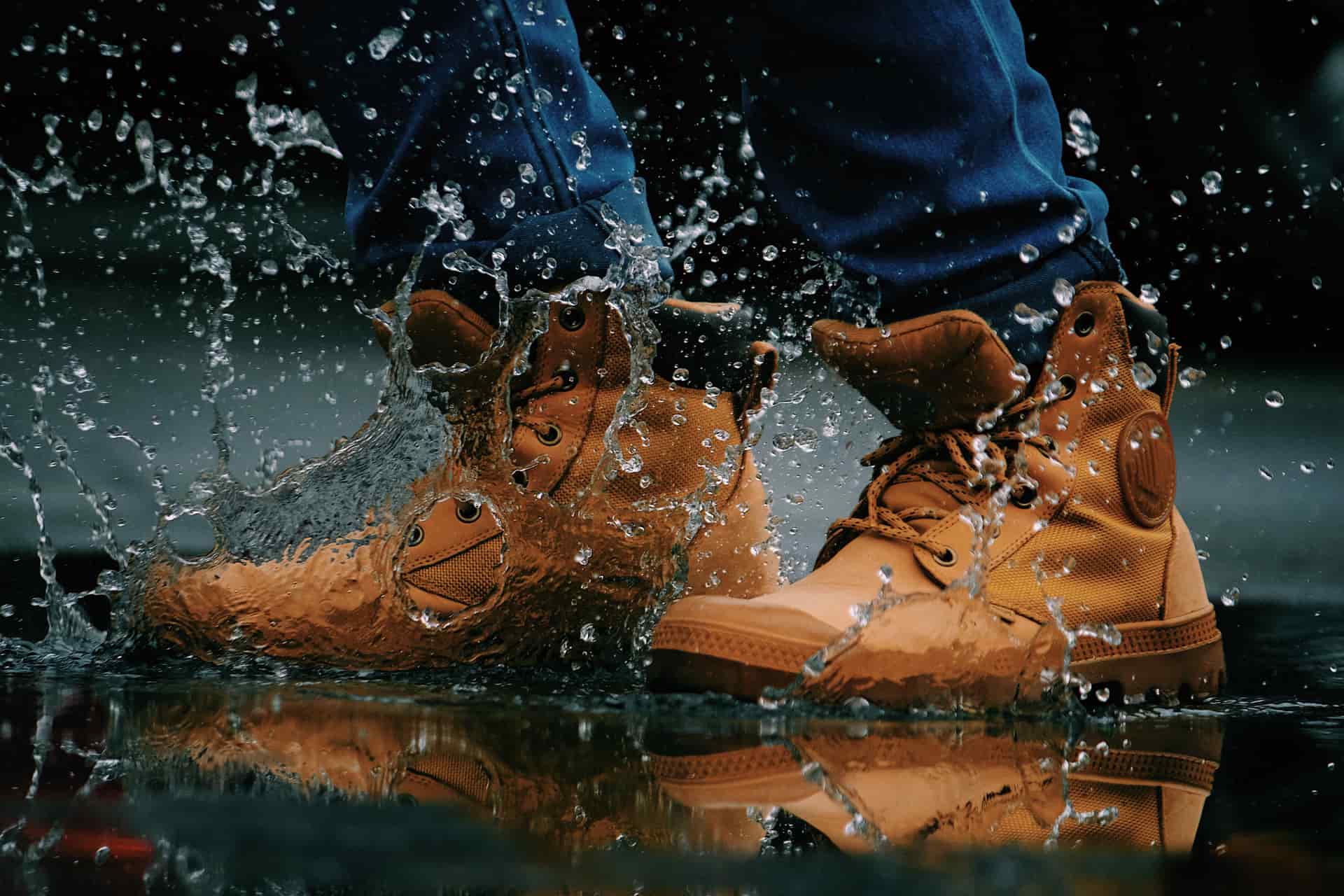
Waterproof vs Water-Resistant Work Boots
Two different claims, two different failure modes.
Disclosure: product links on this page go to Amazon. As an Amazon Associate we earn from qualifying purchases, at no extra cost to you. It does not change which boots we recommend or the order they appear in — here is the full disclosure.
Quick picks
| # | Product | Best for | Toe & rating | Price |
|---|---|---|---|---|
| 1 |  Timberland PRO Boondock 6" Composite Toe Waterproof Work Boot A waterproof composite-toe boot whose all-weather TPU outsole is specifically formulated to stay flexible when it gets cold — which is when most rubber compounds stop gripping. | Waterproof: membrane, cited standard | Asymmetrical composite safety toe, non-metallicMeets ASTM F2412-18a and ASTM F2413-18 for impact (I) and compression (C); EH protection meets ASTM F2413-18 and ASTM F2892-18; waterproof membrane meets ASTM F1671-07 | |
| 2 |  Wolverine Floorhand Waterproof Steel Toe 6" Work Boot Waterproof full-grain leather, a steel toe and an EH rating in a light cemented build — the value pick when the job is wet and the budget is fixed. | Waterproof: sealed leather | Steel safety toeASTM F2413 M/I/C EH rated steel toe | |
| 3 |  Thorogood American Heritage 6" Moc Toe Safety Toe MAXWear Wedge (804-4200) A Goodyear-welted, USA-built wedge with a steel toe and an EH rating — the default answer for anyone who stands on a flat hard floor and wants a boot that can be resoled. | Water resistant: unlined, treat it yourself | Steel safety toe, moc toe shapeASTM F2413-18, EH |
Tap a row to jump to that boot's full write-up. The price column goes straight to Amazon.
The comparison
| Waterproof | Water resistant | |
|---|---|---|
| What it is | A construction — a membrane, or leather sealed so water cannot pass | A treatment on leather that is not itself waterproof |
| How long it holds out | Sustained exposure; standing water up to the shaft | Minutes to hours depending on treatment and conditions |
| Breathability | Reduced, even where the membrane is called breathable | Better — the leather still moves vapor |
| Maintenance | None until the membrane fails | Regular re-treatment; performance decays without it |
| How it fails | Suddenly and completely, once holed or delaminated | Gradually — you notice it wetting out sooner each time |
| Drying | Slow. A membrane traps water that got in over the top | Faster — the upper can breathe moisture out |
How to tell which one you have
Read the specification rather than the hangtag. A waterproof boot names its system or cites a standard: Timberland states the Boondock membrane meets ASTM F1671-07, Carhartt names Storm Defender, KEEN names KEEN.DRY, Carolina names SCUBALINER, Red Wing names its own waterproofing system.
A water-resistant boot usually says “water resistant”, “oil-tanned”, or nothing at all. Thorogood is explicit that the American Heritage 804-4200 is non-waterproof and unlined — which is a feature for break-in and summer comfort, and a limitation in the wet.
If the boot is already yours, the sink test settles it: run water over the upper for a minute. Beading and running off means a working treatment or a sealed upper. Darkening where the water lands means the leather is absorbing it.
The failure modes are the real difference
Water resistant fails gracefully. The treatment wears off gradually, the boot starts wetting out sooner, and you notice in time to re-treat it. Worst case you have damp feet at the end of a wet day.
Waterproof fails suddenly. A membrane works completely until it does not — a puncture, an abrasion through the lining, a delamination at a flex point — and then you have a boot that is both leaking and slow to dry, because the membrane still traps water that gets in.
That asymmetry is worth weighing. A membrane boot at the end of its life is worse than a water-resistant boot at the end of its life.
Which to buy
Buy waterproof if you stand in water, work on wet ground or in mud, work outside through winter, or pour concrete. The breathability cost is worth paying when the alternative is soaked feet every day.
Buy water resistant if you work mostly indoors, in a dry climate, or in heat. An unlined boot with a wax treatment is cooler, breaks in better, dries faster and can be re-treated indefinitely.
Buy both if you work outside year-round. Two pairs rotated also last longer than one pair worn daily, because each gets a full day to dry — which offsets more of the cost than people expect.
Where both lose
Neither handles water over the top of the shaft. If you routinely step into water deeper than your boots, the answer is height — an eight-inch boot or a pull-on wellington — not a better membrane.
Neither does anything about sweat. A boot that is damp inside at the end of every shift in dry conditions has a ventilation and sock problem, not a waterproofing one.
The picks in full
Illustrative category photo — not this model#1 — Waterproof: membrane, cited standard
Timberland PRO Boondock 6" Composite Toe Waterproof Work Boot
A waterproof composite-toe boot whose all-weather TPU outsole is specifically formulated to stay flexible when it gets cold — which is when most rubber compounds stop gripping.
Published specifications
- Toe
- Asymmetrical composite safety toe, non-metallic
- Safety rating
- Meets ASTM F2412-18a and ASTM F2413-18 for impact (I) and compression (C); EH protection meets ASTM F2413-18 and ASTM F2892-18; waterproof membrane meets ASTM F1671-07
- Upper
- Leather upper with a waterproof membrane
- Outsole
- All-weather TPU outsole, formulated to stay flexible in variable weather; slip-, oil- and abrasion-resistant
- Midsole / shank
- Not published as a shank specification
- Construction
- Not published as a welt construction
- Waterproof
- Waterproof, membrane meets ASTM F1671-07
- Insulation
- Not insulated in this version; Timberland PRO also lists a 600g insulated Boondock
- Weight
- Not published on the manufacturer page
Specifications read from Timberland PRO Boondock composite toe specifications (Timberland PRO product listing) on 2026-09-27. We have not worn this boot.
What works
- The cold-weather outsole claim is specific and testable, not marketing mush
- Composite toe does not conduct cold into the toes
- Waterproofing is stated against a named ASTM test method
What doesn't
- Well known among owners as a heavy boot for its class
- A membrane plus a thick outsole is a warm combination in summer
- Not a resoleable construction
Who this is wrong for
Anyone counting grams. If weight is your first criterion, a composite-toe work hiker will be noticeably lighter.
Sizing
The Boondock's toe box is generous but the instep is snug; owners with a high instep frequently report needing a wide. Fit it with the insole you intend to use.
Illustrative category photo — not this model#2 — Waterproof: sealed leather
Wolverine Floorhand Waterproof Steel Toe 6" Work Boot
Waterproof full-grain leather, a steel toe and an EH rating in a light cemented build — the value pick when the job is wet and the budget is fixed.
Published specifications
- Toe
- Steel safety toe
- Safety rating
- ASTM F2413 M/I/C EH rated steel toe
- Upper
- Waterproof full-grain leather with a moisture-wicking mesh lining
- Outsole
- Rubber outsole
- Midsole / shank
- Rubber midsole with a nylon shank
- Construction
- Lightweight cement construction
- Waterproof
- Waterproof full-grain leather upper
- Insulation
- Not insulated
Specifications read from Wolverine product page (Floorhand waterproof steel toe 6") on 2026-09-27. We have not worn this boot.
What works
- Waterproof and EH-rated at the bottom of the price range
- Light for a waterproof steel toe
- Removable footbed
What doesn't
- Cement construction — not resoleable
- Thin outsole wears quickly on abrasive surfaces
- No published weight
Who this is wrong for
Anyone on abrasive ground — roofing grit, concrete rubble, scrap. A light cemented outsole will not survive it long.
Sizing
Runs true to size for most owners. The mesh lining means no stretch, so anything tight on day one stays tight.
Illustrative category photo — not this model#3 — Water resistant: unlined, treat it yourself
Thorogood American Heritage 6" Moc Toe Safety Toe MAXWear Wedge (804-4200)
A Goodyear-welted, USA-built wedge with a steel toe and an EH rating — the default answer for anyone who stands on a flat hard floor and wants a boot that can be resoled.
Published specifications
- Toe
- Steel safety toe, moc toe shape
- Safety rating
- ASTM F2413-18, EH
- Upper
- Tobacco full-grain American leather, unlined
- Outsole
- MAXWear Wedge slip-resistant outsole
- Midsole / shank
- Rubber midsole with composite shank
- Construction
- Goodyear storm welt
- Waterproof
- Not waterproof
- Insulation
- Not insulated
- Widths
- D and EE, sizes 7-14 in both widths
- Weight
- Not published on the manufacturer page
- Made in
- Made in USA with USA and globally sourced components
Specifications read from Thorogood product page (804-4200) on 2026-09-27. We have not worn this boot.
What works
- Goodyear storm welt is a resoleable construction, not a disposable one
- Flat wedge spreads load evenly on concrete instead of concentrating it under a heel
- Unlined upper breaks in to the foot rather than around a liner
- EE width is stocked across the whole size run, not just the middle
What doesn't
- Not waterproof and not insulated — the unlined upper soaks
- A flat wedge gives up bite on mud, gravel and ladder rungs
- Manufacturer publishes no weight figure, so weight comparisons are guesswork
Who this is wrong for
Anyone working outdoors on soft or uneven ground, or in standing water. The wedge has no lugs to bite and the unlined upper is not waterproof.
Sizing
Thorogood's moc-toe last is widely reported to run large; owner reviews consistently suggest going a half size down from a measured Brannock length. D and EE are both stocked, so take the width rather than sizing up for room.
Frequently asked questions
What is the difference between waterproof and water resistant boots?
Waterproof is a construction — a membrane or sealed leather that keeps water out under sustained exposure, usually with a named system or cited standard. Water resistant is a treatment on leather that sheds a splash and wets out given time. The first survives standing water; the second does not.
Can water-resistant boots be made waterproof?
Not fully. A heavy beeswax treatment substantially improves how long a boot holds out and is worth doing, but it does not turn a non-waterproof construction into a waterproof one. Treatment upgrades a boot within its category rather than moving it to a different one.
Why are my waterproof boots wet inside?
Three possibilities: water came in over the top of the shaft, where no membrane helps; the membrane has been holed or has delaminated; or it is sweat, because a membrane also stops vapor getting out. Dampness with no obvious entry point after a dry day is almost always the third one.
Do waterproof boots last longer?
Not inherently, and they can be worse at end of life. A membrane fails suddenly and a failed membrane still traps water that gets in over the top, so the boot is both leaking and slow to dry. A water-resistant boot degrades gradually and can be re-treated indefinitely.
Sources
- ASTM F2413 protective footwear standard — technical summary — Label format, the mandatory I and C designations, and each optional code
Read next
Best Waterproof Work Boots
If the answer was waterproof, these name their systems.
How to Waterproof Work Boots
If the answer was water resistant, here is how to keep it that way.
Best Hot Weather Work Boots
The case for having no membrane at all.
Work Boot Care & Cleaning
Drying is what keeps either kind working.