Soles
Goodyear Welt vs Stitchdown
Two ways to attach an upper so the sole can come off again.
Disclosure: product links on this page go to Amazon. As an Amazon Associate we earn from qualifying purchases, at no extra cost to you. It does not change which boots we recommend or the order they appear in — here is the full disclosure.
Quick picks
| # | Product | Best for | Toe & rating | Price |
|---|---|---|---|---|
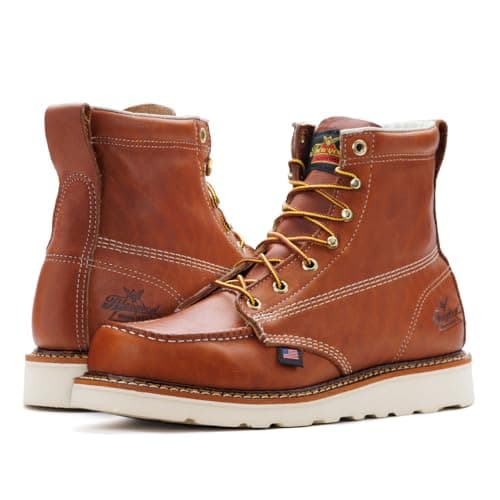
| 1 | Thorogood American Heritage 6" Moc Toe Safety Toe MAXWear Wedge (804-4200) A Goodyear-welted, USA-built wedge with a steel toe and an EH rating — the default answer for anyone who stands on a flat hard floor and wants a boot that can be resoled. | Goodyear storm welt, USA-built | Steel safety toe, moc toe shapeASTM F2413-18, EH | |
| 2 | 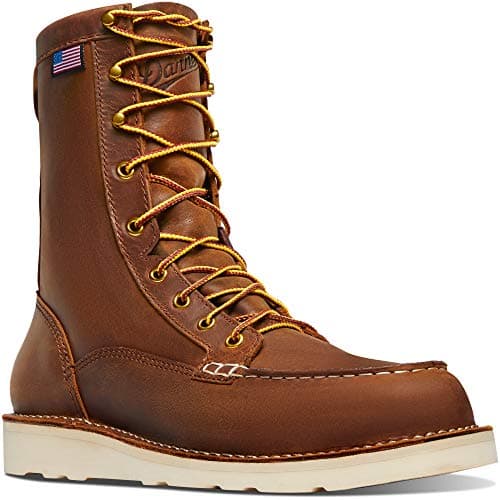 Danner Bull Run Moc Toe 8" Steel Toe Stitchdown construction gives the Bull Run a wider platform than a welted boot of the same size — more stable underfoot, and handcrafted in the USA. | Stitchdown, wider platform | Steel safety toe, moc toe shapeSteel safety toe meets ASTM F2413 for impact and compression | |
| 3 |  White's Boots The Original Smokejumper Handsewn stitchdown, leather midsole, NFPA-certified and built to be rebuilt — the reference point for what a resoleable boot actually costs. | Handsewn stitchdown, the rebuild reference | Soft toe on the Original Smokejumper; White's lists safety-toe models separatelyNFPA certified for wildland fire; no ASTM F2413 protective toe on the soft-toe Original | |
| 4 | 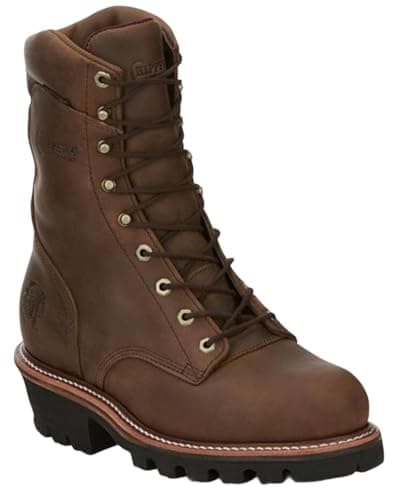 Chippewa Super DNA 9" Waterproof Steel Toe Logger (59407) A Goodyear leather-welted logger on Vibram's Tacoma TC4 Plus — a self-cleaning compound Chippewa specifies for high heat, which is the reason to choose it over a generic lug. | Goodyear leather welt, Vibram | Steel safety toeSteel toe with EH; Chippewa states it meets ASTM F2413 safety footwear standards |
Tap a row to jump to that boot's full write-up. The price column goes straight to Amazon.
How each one is actually assembled
Goodyear welt. The upper and a lining are turned inward over an insole rib, and a strip of leather — the welt — is stitched through both. The outsole is then stitched to that welt. The seam holding the boot together and the seam holding the sole on are separate, so a cobbler can cut the outsole stitching, pull the sole, and stitch a new one to the same welt. Thorogood's American Heritage uses a storm welt, which adds a raised lip that sheds water at the seam.
Stitchdown. The upper is turned outward at the bottom and stitched flat to the midsole — sometimes two or three rows of stitching. There is no welt strip; the upper itself forms the flange. The visible result is the platform edge you can see standing proud of the boot, and the practical result is a wider footprint at the ground than the same last would give in a welt.
Both are genuinely rebuildable, and both are rare. Most of the boots in this registry are cemented or direct-attach, which means a worn outsole ends the boot — resoling work boots covers how to tell which you own.
The comparison
| Goodyear welt | Stitchdown | |
|---|---|---|
| How the upper attaches | Turned inward onto a leather welt strip | Turned outward and stitched flat to the midsole |
| Platform width | Follows the last | Wider at the ground — Danner states it gives a wider platform than a welted boot of the same size |
| Resoleable | Yes, repeatedly | Yes, repeatedly |
| Who can do the work | Any competent cobbler — it is the standard repair | Fewer shops; often sent back to the maker |
| Break-in | Real, but shorter | Longer — Danner advises buying three weeks ahead |
| Water at the seam | A storm welt sheds water at the join | The outward flange is a ledge that collects debris |
| Registry examples | Thorogood 804-4200 and 804-3555; Chippewa Super DNA; Carolina Spruce | Danner Bull Run and Quarry USA; White's Smokejumper; Nicks Lineman |
The platform difference is the real one
Everything else about these two constructions is close enough that most wearers would not notice. The platform width is not. Danner says plainly that stitchdown gives the Bull Run a wider platform than a welted boot of the same size, and the consequence is more lateral stability underfoot — useful on broken ground, on rubble, anywhere the surface is not flat.
The caveat Danner also states is the one people get wrong at purchase: stitchdown adds a visible platform edge but not interior room. The extra width you can see is outside the upper, not inside it, so size to your measured length rather than assuming the boot runs roomy. The work boot sizing guide has the measuring method.
Who will actually do the repair
This is the practical argument for a welt and it gets underweighted. A Goodyear welt is the standard resole every shoe-repair shop in the country is set up for. Stitchdown is less common, needs the upper restitched to a new midsole, and in practice is often sent back to the maker — which means shipping, a queue, and weeks without your boots.
The makers who build stitchdown generally run that service themselves, and some publish what it costs. Nicks lists a resole at $150 and a full rebuild at $250, which is unusually transparent and a useful anchor for what rebuildable footwear actually costs to maintain. Red Wing runs its own factory repair service for its welted models. How long work boots last puts those numbers against replacement cost.
The economics, honestly
A rebuildable boot only pays for itself if you actually rebuild it. White's Original Smokejumper lists at $774.95 at an authorized retailer — handsewn stitchdown, leather midsole and shank, built to be rebuilt — and that is the reference point for what the construction costs at the top end. Against a $110 cemented boot you replace yearly, the handmade boot wins only across many years and several resoles.
The mid-market is where this decision is genuinely live. Thorogood's welted American Heritage sits well below the handmade makers while still being resoleable, which is why it is this site's default recommendation for flat-floor trades. Why work boots are so expensive breaks down where the money goes.
Two things neither construction guarantees
Watch for welt-styled constructions
Some makers use a construction that looks welted and is not. Georgia Boot calls its version a bond welt, and does not publish it as resoleable — treat that as a replace-it boot. The test is not whether you can see stitching around the sole edge; decorative stitching is common on cemented boots. The test is whether the maker names a Goodyear welt or a stitchdown construction, and whether anybody offers a resole service for it.
If the product page says nothing about construction, assume cemented. Makers who build a rebuildable boot say so, because it is the expensive part. Best USA-made work boot brands is largely a list of the makers who do.
Choose a Goodyear welt if…
You want a resole you can get done locally and quickly, you work on flat floors where the wider stitchdown platform buys you nothing, you want a storm welt's water shedding at the seam, or you want rebuildability without the handmade price. Georgia Boot vs Thorogood is the comparison if you are weighing a welt against a modern feature set.
Choose stitchdown if…
Your ground is uneven and the wider platform earns its keep, you want the maker's own rebuild program rather than a local cobbler, or you are buying one pair for a career and accept a long break-in. How to break in work boots fast is worth reading first, and Thorogood vs Danner puts the two constructions against each other brand to brand.
The shortlists for each construction
If the welt is what you want, best Goodyear welt work boots ranks every welted boot in the registry on welt type, upper and widths. Because US bootmaking survived almost entirely in these two constructions, the overlap with best American-made work boots is close to total. And if the reason you want a rebuildable boot is that the job is destroying soles, best heavy-duty work boots covers the builds that publish protection beyond the toe cap.
The picks in full
#1 — Goodyear storm welt, USA-built
Thorogood American Heritage 6" Moc Toe Safety Toe MAXWear Wedge (804-4200)
A Goodyear-welted, USA-built wedge with a steel toe and an EH rating — the default answer for anyone who stands on a flat hard floor and wants a boot that can be resoled.
Published specifications
- Toe
- Steel safety toe, moc toe shape
- Safety rating
- ASTM F2413-18, EH
- Upper
- Tobacco full-grain American leather, unlined
- Outsole
- MAXWear Wedge slip-resistant outsole
- Midsole / shank
- Rubber midsole with composite shank
- Construction
- Goodyear storm welt
- Waterproof
- Not waterproof
- Insulation
- Not insulated
- Widths
- D and EE, sizes 7-14 in both widths
- Weight
- Not published on the manufacturer page
- Made in
- Made in USA with USA and globally sourced components
Specifications read from Thorogood product page (804-4200) on 2026-09-27. We have not worn this boot.
What works
- Goodyear storm welt is a resoleable construction, not a disposable one
- Flat wedge spreads load evenly on concrete instead of concentrating it under a heel
- Unlined upper breaks in to the foot rather than around a liner
- EE width is stocked across the whole size run, not just the middle
What doesn't
- Not waterproof and not insulated — the unlined upper soaks
- A flat wedge gives up bite on mud, gravel and ladder rungs
- Manufacturer publishes no weight figure, so weight comparisons are guesswork
Who this is wrong for
Anyone working outdoors on soft or uneven ground, or in standing water. The wedge has no lugs to bite and the unlined upper is not waterproof.
Sizing
Thorogood's moc-toe last is widely reported to run large; owner reviews consistently suggest going a half size down from a measured Brannock length. D and EE are both stocked, so take the width rather than sizing up for room.
#2 — Stitchdown, wider platform
Danner Bull Run Moc Toe 8" Steel Toe
Stitchdown construction gives the Bull Run a wider platform than a welted boot of the same size — more stable underfoot, and handcrafted in the USA.
Published specifications
- Toe
- Steel safety toe, moc toe shape
- Safety rating
- Steel safety toe meets ASTM F2413 for impact and compression
- Upper
- Tobacco leather upper
- Outsole
- Danner Wedge outsole — non-marking, oil- and slip-resistant, won't track debris
- Midsole / shank
- Not published on the manufacturer page
- Construction
- Handcrafted stitchdown construction
- Waterproof
- Not waterproof in this version; a GTX version is listed separately
- Insulation
- Not insulated
- Made in
- Built in the USA
Specifications read from Danner product page (Bull Run Moc Toe 8" steel toe) on 2026-09-27. We have not worn this boot.
What works
- Stitchdown is the most stable of the resoleable constructions
- Non-marking wedge works indoors and out
- A US-built moc toe with a safety cap, which is a short list
What doesn't
- Not waterproof — the GTX version costs more
- Stitchdown boots take longer to break in than cemented ones
- No published weight
Who this is wrong for
Anyone who needs the boot comfortable on day one. Stitchdown leather needs real break-in; buy it three weeks before you need it.
Sizing
Stitchdown adds a visible platform edge but not interior room. Size to your measured length; the extra width you see is outside the upper, not inside it.
Illustrative category photo — not this model#3 — Handsewn stitchdown, the rebuild reference
White's Boots The Original Smokejumper
Handsewn stitchdown, leather midsole, NFPA-certified and built to be rebuilt — the reference point for what a resoleable boot actually costs.
Published specifications
- Toe
- Soft toe on the Original Smokejumper; White's lists safety-toe models separately
- Safety rating
- NFPA certified for wildland fire; no ASTM F2413 protective toe on the soft-toe Original
- Upper
- 10" full-grain water-resistant leather
- Outsole
- Vibram fire and ice white dot sole
- Midsole / shank
- Leather midsole and shank
- Construction
- Handsewn stitchdown — rebuildable and resoleable
- Waterproof
- Water-resistant leather, not a waterproof membrane
- Insulation
- Not insulated
- Made in
- Handcrafted in the USA
Specifications read from White's Boots product page (The Original Smokejumper) on 2026-09-27. We have not worn this boot.
What works
- Genuinely rebuildable — White's runs a factory rebuild program
- A leather midsole molds to the foot in a way rubber never does
- NFPA certification is a real third-party standard
What doesn't
- The soft-toe Original has no ASTM F2413 protective toe
- Break-in on a stitchdown leather-midsole boot is genuinely weeks
- List price is several times a cemented boot
Who this is wrong for
Anyone who needs a safety toe, or who cannot commit to a long break-in. The Original Smokejumper is a soft toe.
Sizing
Handmade boots are fitted, not guessed. White's publishes a measuring process; use it. A stitchdown leather-midsole boot cannot be returned into shape after it has molded to the wrong foot.
#4 — Goodyear leather welt, Vibram
Chippewa Super DNA 9" Waterproof Steel Toe Logger (59407)
A Goodyear leather-welted logger on Vibram's Tacoma TC4 Plus — a self-cleaning compound Chippewa specifies for high heat, which is the reason to choose it over a generic lug.
Published specifications
- Toe
- Steel safety toe
- Safety rating
- Steel toe with EH; Chippewa states it meets ASTM F2413 safety footwear standards
- Upper
- Premium waterproof full-grain leather
- Outsole
- Vibram Tacoma TC4 Plus — a technical, self-cleaning sole Chippewa specifies for outdoor terrain and high-heat environments; oil- and slip-resisting
- Midsole / shank
- Steel shank with an orthotic insole
- Construction
- Goodyear leather welt
- Waterproof
- Breathable waterproof membrane with a Dri-Lex lining
- Insulation
- Not published on this version; insulated Super DNA models are listed separately
- Widths
- E and EEE
- Weight
- Not published on the manufacturer page
Specifications read from Chippewa product page (Super DNA 9" waterproof steel toe logger, 59407) on 2026-09-29. We have not worn this boot.
What works
- A named Vibram compound with a stated purpose, not just the logo
- Self-cleaning tread genuinely sheds mud instead of packing it
- A leather welt is the most repairable construction here short of handmade
What doesn't
- No D width — a narrow foot has nothing to buy
- No published weight, and 9-inch loggers are never light
- Heat resistance is irrelevant to most trades and you pay for it anyway
Who this is wrong for
Narrow feet and flat floors. The narrowest width offered is an E, and a logger heel belongs on broken ground, not a slab.
Sizing
Chippewa's logger sizing runs wide by design — an E here is closer to another brand's EE. If you normally wear a D, try a half size down before assuming the width is wrong.
Frequently asked questions
Is stitchdown better than a Goodyear welt?
Neither is better overall. Stitchdown gives a wider platform at the ground and more lateral stability, which helps on uneven terrain. A Goodyear welt is the repair every cobbler is set up for, so resoles are faster and easier to arrange locally. Both can be resoled repeatedly.
Can stitchdown boots be resoled?
Yes, repeatedly — that is the point of the construction. The practical difference is that fewer shops do stitchdown work, so it is often sent back to the maker. Nicks publishes a $150 resole and a $250 full rebuild, which gives a sense of the cost and the fact that it is a maker service rather than a corner-shop one.
How do I tell if my boots are Goodyear welted?
Look for the maker naming the construction, not for stitching around the sole edge — decorative stitching is common on cemented boots that cannot be resoled. A welt has a visible leather strip between upper and outsole with the outsole stitched to it. If the product page says nothing about construction, assume cemented.
Does a stitchdown boot run wider?
At the ground, yes, but not inside. Danner states stitchdown gives a wider platform than a welted boot of the same size while adding no interior room — the extra width you can see sits outside the upper. Size to your measured length rather than expecting more space for your foot.
Is a welted boot waterproof?
Not inherently. A storm welt sheds water at the seam, which helps, but the upper decides the rest: Thorogood's 804-4200 is unlined and not waterproof, while the waterproof 1957 Series uses the same welt with a sealed upper. Construction and waterproofing are separate specs.
Sources
- Nicks Boots — resoling vs rebuilding — A maker explaining the difference, with its own published service prices
- Red Wing Shoes — repairs and resoling — Red Wing's own factory repair service
- ASTM F2413 protective footwear standard — technical summary — Label format, the mandatory I and C designations, and each optional code