Soles
Best Lug Sole Work Boots
For ground that moves under you — mud, gravel, rungs and wet steel.
Disclosure: product links on this page go to Amazon. As an Amazon Associate we earn from qualifying purchases, at no extra cost to you. It does not change which boots we recommend or the order they appear in — here is the full disclosure.
Quick picks
| # | Product | Best for | Toe & rating | Price |
|---|---|---|---|---|
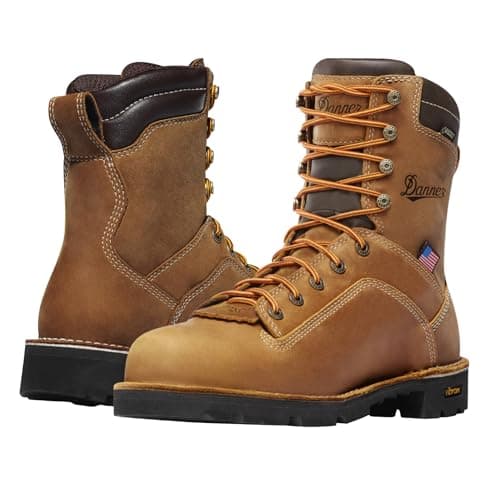
| 1 | Danner Quarry USA 8" Alloy Toe Work Boot A USA-built 8-inch boot with an alloy toe, a 90-degree heel and a non-linear lug pattern designed to shed debris rather than pack it. | Top-end traction on broken ground | Alloy safety toe — a lighter alternative to steelAlloy safety toe meets or exceeds ASTM F2413-11 I/75 C/75 EH for impact, compression and electrical hazard resistance | |
| 2 | 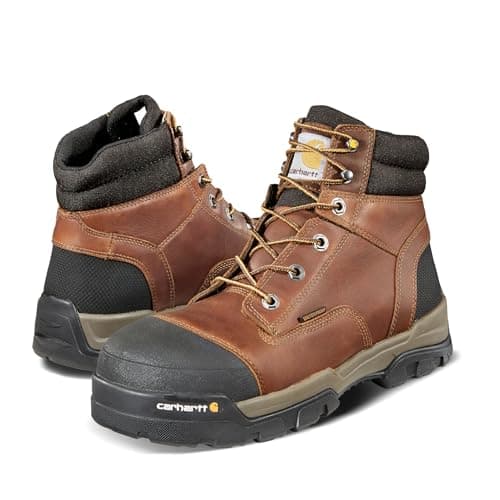 Carhartt Ground Force Waterproof 6" Composite Toe Work Boot A waterproof composite toe with a heat-rated outsole and an APMA-accepted footbed — the pick when arch support is the deciding factor. | Lugs plus ladder-lock grooves | Composite safety toe — lightweight, non-metallic, non-conductiveComposite safety toe meeting ASTM F2413-24 EH; outsole meets ASTM F3445-24 SR | |
| 3 | 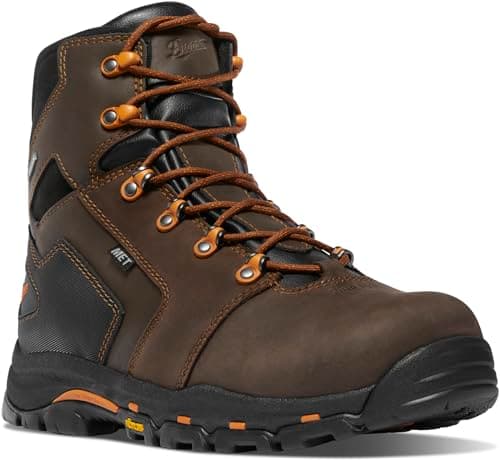 Danner Vicious 6" Composite Toe Work Boot (13879) A GORE-TEX composite-toe boot on a Vibram Vicious outsole with a 90-degree heel — the Vibram pick for anyone who needs a rung-catching heel without a logger's bulk. | Vibram grip, low profile | Composite toe (NMT) — non-metallicASTM F2413-24 I/C EH | |
| 4 | 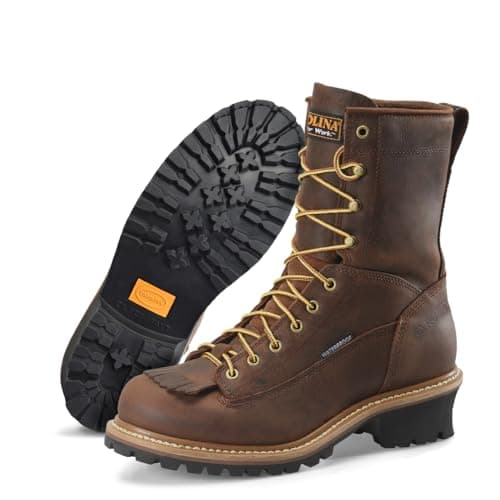 Carolina Spruce 8" Steel Toe Waterproof Logger A waterproof 8-inch logger with a triple-bar steel shank — the stiff underfoot platform that ladder rungs and pole work actually need. | A rigid lug platform for climbing | Steel safety toe capMeets or exceeds ASTM F2413-18 for compression and impact; electrical hazard protection tested to withstand 18,000 volts at 60Hz for one minute without leakage | |
| 5 | 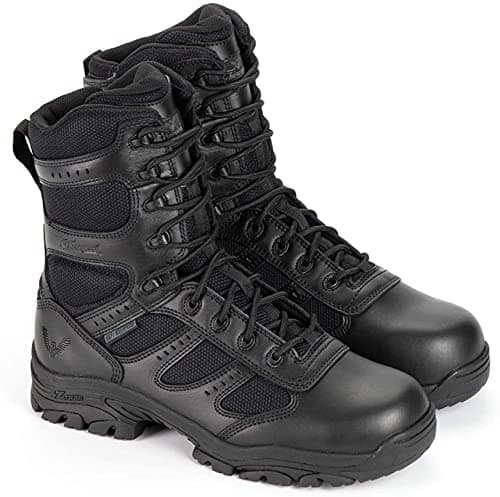 Thorogood The Deuce 8" Waterproof Side-Zip Composite Safety Toe (804-6191) An 8-inch composite-toe boot with a side zip, a waterproof membrane and bloodborne-pathogen resistance — lace it once, then use the zip for the rest of its life. | Budget pick — cheapest published lug pattern here | Composite safety toe with a polishable toeASTM F2413-18 safety toe with EH; slip- and oil-resistant outsole; BBP bloodborne-pathogen resistance to ASTM F1671-13; non-metallic throughout |
Tap a row to jump to that boot's full write-up. The price column goes straight to Amazon.
What a lug sole is, and what it is for
A lug sole is an outsole with deep, separated blocks of rubber and open channels between them. The blocks give you edges that can dig into soft or broken ground; the channels give the mud, gravel and snow somewhere to go so the blocks stay exposed. That second half is the part people forget. A sole with deep lugs and no clearance between them turns into a flat plate the moment it packs, and a packed lug sole is more slippery than a wedge because the surface is now mud on mud.
The opposite choice is a flat wedge, which spreads your weight across the whole footprint and is the right answer on a slab. Wedge sole vs lug sole is the full argument; if you are reading this page because you already know the answer is lugs, carry on.
How these five were chosen
1. The maker publishes something about the tread. A lug pattern, a named compound, or both. "Rugged outsole" with no detail is not a specification, and a boot whose maker will not describe its own sole is not on this page.
2. Heel geometry is stated. A defined 90-degree heel breast is what catches a ladder rung. A rounded or wedge heel does not, no matter how deep the lugs are.
3. Debris release counted as much as lug depth. Danner and Chippewa both publish language about shedding or self-cleaning; most makers do not.
4. Construction stated, because lugs wear out. A lug sole on abrasive ground is the fastest-wearing part of a work boot. If the boot cannot be resoled, lug depth is a consumable you are buying once.
5. A live price, with a budget option named. Nothing on this page is a theoretical boot.
The five, on what each maker publishes
| Outsole | Heel | Construction | Waterproof | |
|---|---|---|---|---|
| Danner Quarry USA 8" | Vibram Quarry rubber, non-linear lug pattern for debris release | 90-degree heel | Recraftable stitchdown | GORE-TEX lining |
| Carhartt Ground Force 6" | Rubber lug outsole, heat-resistant to 300°C / 572°F, oil- and slip-resistant | Defined heel with ladder-lock grooves | Not published as a welt | Storm Defender membrane |
| Danner Vicious 6" | Vibram Vicious, low-profile, oil- and slip-resistant | 90-degree heel | Speed-lace build; Danner states not recraftable | GORE-TEX liner |
| Carolina Spruce 8" Logger | Oil- and slip-resisting rubber logger outsole | Logger heel | Welt construction | SCUBALINER lining |
| Thorogood Deuce 8" | Z-trac dual-density ASR outsole with a rugged lug pattern | Not published as a defined heel | Cement construction | BBP X-Stream membrane |
Danner Quarry USA — the one to beat
Danner publishes more about this outsole than anyone else here publishes about theirs. It is a Vibram Quarry rubber unit with a non-linear lug pattern, which is Danner's own description of a layout designed so the channels do not line up and therefore do not form a mud track across the sole. It sits under a 90-degree heel, a triple-stitched full-grain upper, a breathable GORE-TEX lining and an alloy safety toe rated to ASTM F2413-11 I/75 C/75 EH. It is built in Portland, Oregon, in recraftable stitchdown construction.
That last point is the real argument. Lugs are the part of a work boot that disappears. On a boot you can have rebuilt, buying the deepest, best-documented sole available is a sensible purchase; on a cemented boot it is a one-time consumable.
The honest cons. It is the most expensive boot on this page by a wide margin, it is an 8-inch boot with a membrane — which is the hottest combination in work footwear — and an alloy cap is metal, so it conducts cold and sets off a detector. Danner does not publish a weight for it.
Wrong for: flat indoor floors, and anyone who will track grit onto finished surfaces.
Carhartt Ground Force — lugs with a ladder in mind
The Ground Force is the pick if you climb as well as walk. Carhartt publishes a deep rubber lug outsole with a defined heel and ladder-lock grooves cut into the heel breast, rates the compound heat-resistant to 300°C / 572°F, and carries a composite cap to ASTM F2413-24 EH with an outsole meeting ASTM F3445-24 SR. Underneath there is an APMA-accepted footbed, which is why this boot also turns up in the site's arch-support pages.
The honest cons. It is not published as a welted boot, so treat it as a replace-rather-than-rebuild purchase, and a deep lug outsole on a composite-toe boot at this price point is a compromise between two jobs rather than the best possible version of either.
Wrong for: finished-floor work. The thing that makes it grip outdoors is the thing that carries grit indoors.
Danner Vicious — Vibram without the logger bulk
A six-inch GORE-TEX composite-toe boot on the Vibram Vicious outsole: a low-profile lug with a 90-degree heel, rated ASTM F2413-24 I/C EH, at a published 55 oz per pair. If you want a rung-catching heel and a Vibram compound in something you can actually walk a site in, this is the shape of it.
The honest cons. Danner states plainly that this model is not recraftable, so you are buying the Vibram sole once. It is made in Vietnam, unlike the Quarry. Best Vibram sole work boots separates the Vibram boots you can resole from the ones you cannot.
Wrong for: anyone buying Vibram specifically because they intend to have the boot rebuilt.
Carolina Spruce — the rigid platform
A waterproof 8-inch logger on a welt, with a triple-bar steel shank and a logger heel, EH-tested to withstand 18,000 volts at 60 Hz for one minute without leakage, in D, 2E and 4E. The lug pattern here is a conventional logger unit rather than a published technical compound — what you are buying is the rigidity. A triple-bar shank stops the boot folding over a rung, which is the actual failure mode on a pole or a ladder.
The honest cons. That stiffness is miserable on level ground, the raised heel concentrates load under the heel breast on a slab, and it is not insulated.
Wrong for: warehouse floors and anyone covering distance.
The budget pick
Thorogood's Deuce is the cheapest boot here whose maker actually publishes a lug pattern: a Z-trac dual-density ASR outsole described as a rugged lug, under an 8-inch composite-toe upper with a waterproof membrane, bloodborne-pathogen resistance to ASTM F1671-13, and a side zip so you lace it once. Widths run M, W and XW. It is cemented, so the sole is not replaceable, and Thorogood does not publish a defined heel breast for it — if ladder work is the point, the Carhartt or either Danner is the better answer.
Across the registry the cheaper boots are mostly flat or shallow-tread soles, which is why the budget slot here costs more than the budget slot on most pages. A deep, well-documented lug outsole is a real material cost.
Traction is a tested number, not a tread photo
If what you actually need is grip on a smooth wet floor rather than bite in soft ground, lugs are the wrong spec to shop. Slip resistance is tested under ASTM F3445, which requires a minimum coefficient of friction of 0.40 wet and dry and 0.33 oily-wet, and the boots that pass it well tend to have shallow, siped, close-packed tread — the exact opposite of a lug. Best slip-resistant work boots is that page.
The two requirements genuinely conflict. A lug block has fewer square inches touching a polished floor than a flat siped sole does, so the boot that saves you in a gravel pit is the boot that drops you in a kitchen. Pick for the surface you are actually on most of the day.
How fast lugs wear, and what to watch
On abrasive ground — roofing grit, concrete rubble, scrap — lugs round off at the leading edges first, usually at the outside heel and the ball of the foot. Once the edges are rounded the sole still looks deep and has already lost most of its bite, which is why people are surprised by a slip on a boot that "has plenty of tread left." Check the edges, not the depth.
EH protection degrades on the same schedule, because the insulating outsole is the thing wearing away. EH-rated work boots covers that; the short version is that EH is secondary protection and a worn sole is a worn barrier. Resoling work boots covers what a rebuild costs on the two boots here that allow one.
The picks in full
#1 — Top-end traction on broken ground
Danner Quarry USA 8" Alloy Toe Work Boot
A USA-built 8-inch boot with an alloy toe, a 90-degree heel and a non-linear lug pattern designed to shed debris rather than pack it.
Published specifications
- Toe
- Alloy safety toe — a lighter alternative to steel
- Safety rating
- Alloy safety toe meets or exceeds ASTM F2413-11 I/75 C/75 EH for impact, compression and electrical hazard resistance
- Upper
- Full-grain leather upper, triple-stitched with hyper-strong thread
- Outsole
- Oil- and slip-resistant Vibram Quarry rubber outsole with a 90° heel and a non-linear lug pattern for traction and debris release
- Midsole / shank
- Danner Quarry midsole with a removable OrthoLite triple-density footbed
- Construction
- Recraftable stitchdown construction
- Waterproof
- Waterproof — breathable GORE-TEX lining
- Insulation
- Not insulated
- Made in
- Made in Portland, Oregon
Specifications read from Danner product page (Quarry USA 8" alloy toe) on 2026-09-27. We have not worn this boot.
What works
- The debris-release claim is a real design choice, and you feel it in mud
- 90° heel breast is what you want on a rung or a roof edge
- US-built at a price below the handmade makers
What doesn't
- Alloy is metal: it conducts cold and trips detectors
- A GORE-TEX membrane keeps water out but also slows the boot drying through
- 8-inch shaft is slow to get on and off
Who this is wrong for
Flat-floor indoor trades. Lugs on a polished concrete floor are wasted, and they carry grit onto finished surfaces.
Sizing
Danner's work lasts are fairly true to size but firm through the midfoot. If you have a high instep, lace the lower eyelets loosely for the first week.
#2 — Lugs plus ladder-lock grooves
Carhartt Ground Force Waterproof 6" Composite Toe Work Boot
A waterproof composite toe with a heat-rated outsole and an APMA-accepted footbed — the pick when arch support is the deciding factor.
Published specifications
- Toe
- Composite safety toe — lightweight, non-metallic, non-conductive
- Safety rating
- Composite safety toe meeting ASTM F2413-24 EH; outsole meets ASTM F3445-24 SR
- Upper
- Leather upper with Storm Defender waterproof breathable protection and FastDry lining
- Outsole
- Oil- and slip-resistant non-marking rubber lug outsole with a defined heel and ladder-lock grooves; heat-resistant to 300°C / 572°F
- Midsole / shank
- Carhartt LWD midsole with a nylon shank
- Construction
- Not published as a welt construction
- Waterproof
- Waterproof — Storm Defender
- Insulation
- Not insulated in this model
Specifications read from Carhartt product page (Ground Force waterproof 6" composite toe) on 2026-09-27. We have not worn this boot.
What works
- Both an EH and an SR designation, each against a named ASTM standard
- APMA acceptance is third-party, not marketing
- Ladder-lock grooves are a specific feature for a specific job
What doesn't
- Not resoleable
- Lug outsole tracks debris onto finished floors
- No published weight
Who this is wrong for
Finished-floor work. A deep lug outsole carries grit into rooms you are being paid not to damage.
Sizing
Carhartt's Ground Force last is fairly generous. If you plan to use your own orthotic, pull the INSITE footbed out first — the two together will crowd the boot.
#3 — Vibram grip, low profile
Danner Vicious 6" Composite Toe Work Boot (13879)
A GORE-TEX composite-toe boot on a Vibram Vicious outsole with a 90-degree heel — the Vibram pick for anyone who needs a rung-catching heel without a logger's bulk.
Published specifications
- Toe
- Composite toe (NMT) — non-metallic
- Safety rating
- ASTM F2413-24 I/C EH
- Upper
- Full-grain leather
- Outsole
- Vibram Vicious — oil- and slip-resistant, low-profile, with a 90-degree heel
- Midsole / shank
- Dual-density EVA midsole with a Danner Trailguard TPU shank and a PU footbed
- Construction
- Lace-up with a speed-lace system; Danner states it is not recraftable
- Waterproof
- 100% waterproof and breathable GORE-TEX liner
- Insulation
- Not insulated
- Weight
- 55 oz per pair
- Made in
- Vietnam
Specifications read from Danner product page (Vicious 6" composite toe, 13879) on 2026-09-29. We have not worn this boot.
What works
- A 90-degree heel breast in a low-profile boot, which is unusual
- A Vibram compound on a boot at a normal work price, not a handmade one
- GORE-TEX rather than a generic membrane
- Danner publishes the weight, so you can compare it honestly
What doesn't
- Danner states it is not recraftable — the Vibram sole cannot be replaced
- An EVA midsole will pack out faster than polyurethane
- Made in Vietnam, unlike Danner's USA-built Quarry line
Who this is wrong for
Anyone buying Vibram because they intend to resole. This boot cannot be recrafted; the Thorogood logger and the handmade boots can.
Sizing
Danner's DLE-01 last holds the heel firmly with a roomier toe box. Fit the heel first — slack there is what drives toes into a composite cap.
#4 — A rigid lug platform for climbing
Carolina Spruce 8" Steel Toe Waterproof Logger
A waterproof 8-inch logger with a triple-bar steel shank — the stiff underfoot platform that ladder rungs and pole work actually need.
Published specifications
- Toe
- Steel safety toe cap
- Safety rating
- Meets or exceeds ASTM F2413-18 for compression and impact; electrical hazard protection tested to withstand 18,000 volts at 60Hz for one minute without leakage
- Upper
- Leather upper with the SCUBALINER waterproof lining
- Outsole
- Oil- and slip-resisting rubber logger outsole
- Midsole / shank
- Triple-bar steel shank with a Pillow Cushion footbed
- Construction
- Welt construction
- Waterproof
- Waterproof — SCUBALINER
- Insulation
- Not insulated in this model; Carolina lists an insulated version
- Widths
- D, 2E and 4E
Specifications read from Carolina Shoe product page (Spruce 8" steel toe waterproof logger, CA9825) on 2026-10-01. We have not worn this boot.
What works
- States the EH test conditions, which most brands summarize away
- The triple-bar shank is the real reason to buy a logger
- Waterproof at a working price
What doesn't
- A rigid shank is punishing on flat concrete
- Heavy
- Steel shank and steel toe: fully metallic underfoot
Who this is wrong for
Warehouse and flat-floor work. A logger's stiffness is a feature on a rung and a liability on level ground.
Sizing
Loggers fit tighter through the arch because the shank does not flex. Fit it laced fully and stand on a step edge before you commit.
#5 — Budget pick — cheapest published lug pattern here
Thorogood The Deuce 8" Waterproof Side-Zip Composite Safety Toe (804-6191)
An 8-inch composite-toe boot with a side zip, a waterproof membrane and bloodborne-pathogen resistance — lace it once, then use the zip for the rest of its life.
Published specifications
- Toe
- Composite safety toe with a polishable toe
- Safety rating
- ASTM F2413-18 safety toe with EH; slip- and oil-resistant outsole; BBP bloodborne-pathogen resistance to ASTM F1671-13; non-metallic throughout
- Upper
- Full-grain leather with 400g air mesh
- Outsole
- Z-trac dual-density ASR outsole with a rugged lug pattern
- Midsole / shank
- Composite shank with a removable polyurethane SHOCK ZONE insole
- Construction
- Cement construction
- Waterproof
- BBP X-Stream Waterproof membrane lining
- Insulation
- Not insulated
- Widths
- M sizes 4-15, W sizes 4-15, XW sizes 7-13
- Weight
- Not published on the manufacturer page
- Made in
- Imported
Specifications read from Thorogood product page (The Deuce 8" side-zip, 804-6191) on 2026-09-29. We have not worn this boot.
What works
- The only sensible way to wear an 8-inch boot if you take it off during the day
- Non-metallic throughout, so metal detectors and cold conduction are non-issues
- XW width exists, which is rare in a tactical-cut boot
- Removable polyurethane insole, so the cushioning is replaceable
What doesn't
- Cement construction cannot be resoled
- A zipper is a moving part and the most likely thing to fail on the boot
- Air-mesh panels are waterproof only while the membrane behind them is intact
Who this is wrong for
Anyone who wants a boot rebuilt rather than replaced. This is a cemented boot, and a worn sole ends it.
Sizing
Lace the boot to fit with the zip open, then close the zip — if the zip is doing the tightening, the lacing is too loose and the zipper takes the strain.
Frequently asked questions
Are lug soles good for concrete?
Not especially. On a flat slab a lug sole puts fewer square inches of rubber on the floor than a flat wedge does, and the raised heel on most lug boots concentrates load under the heel breast. If your day is spent on concrete, a wedge sole is the better platform and the best wedge sole work boots page covers it.
What is the difference between a lug sole and a logger sole?
A logger sole is a lug outsole with a tall, aggressively defined heel block — usually a two-inch heel — designed for standing on rungs, spurs and uneven timber. A lug sole is the broader category and includes low-profile versions like the Vibram Vicious with a normal heel height.
Do deeper lugs mean better traction?
Only up to the point where the channels between them stop clearing. Depth without clearance packs with mud and turns the sole into a flat plate. Danner's non-linear Quarry pattern and Chippewa's self-cleaning Vibram Tacoma TC4 Plus are both built around clearance rather than depth.
Can a worn lug sole be replaced?
Only on a welted or stitchdown boot. On this page the Danner Quarry (recraftable stitchdown) and the Carolina Spruce (welt) can be resoled. Danner states the Vicious is not recraftable, the Thorogood Deuce is cemented, and the Carhartt publishes no welt — all three are replace-the-boot builds.
Will a lug sole pass a slip-resistance requirement?
Some do — the Carhartt Ground Force outsole is published as meeting ASTM F3445-24 SR. But a lug pattern is not what the test rewards, and a site that specifies slip-resistant footwear for smooth wet floors is asking for a different sole geometry entirely.
Sources
- Reebok Work Sublite Cushion — ASTM F3445 slip-resistance rating — Slip resistance stated against a named ASTM test method
- NIOSH — Does Slip-Resistant Footwear Reduce Slips, Trips, and Falls in Food Service? — ~17,000 food service workers across 226 school districts; a 67% reduction in slip-injury claims after 5-star slip-rated shoes were issued
- ASTM F2413 protective footwear standard — technical summary — Label format, the mandatory I and C designations, and each optional code
Read next
Wedge Sole vs Lug Sole
Settle the sole geometry before you shop either list.
Best Slip-Resistant Work Boots
If the surface is smooth and wet, lugs are the wrong spec.
Best Logger Boots
The tall-heel end of the lug category, for climbing.
Best Heavy-Duty Work Boots
When the hazard underfoot is impact and puncture, not grip.