Soles
Best Composite Toe Wedge Work Boots
The flat sole, without the metal — and the three makers who actually build it.
Disclosure: product links on this page go to Amazon. As an Amazon Associate we earn from qualifying purchases, at no extra cost to you. It does not change which boots we recommend or the order they appear in — here is the full disclosure.
Quick picks
| # | Product | Best for | Toe & rating | Price |
|---|---|---|---|---|
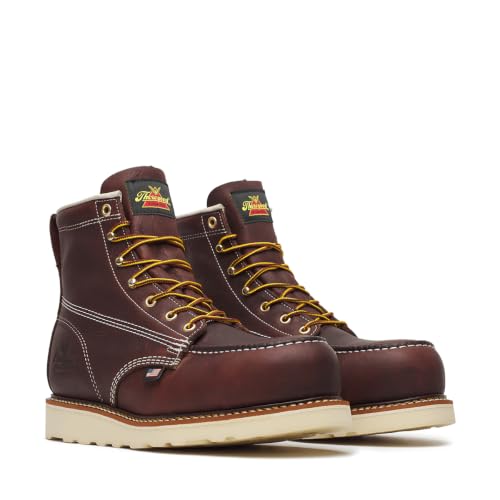
| 1 | Thorogood 6" Nano Composite Safety Toe Moc Toe MAXWear Wedge (804-6120) The same USA-built, Goodyear-welted wedge platform this site recommends more than any other, with a Nano composite cap instead of steel — the only non-metallic wedge here you can have resoled. | Resoleable, and non-metallic throughout | Nano composite safety toe, moc toe shapeSafety toe per ASTM F2413-18; electrical hazard per ASTM F2413-18 or ASTM F2892-18; oil-resistant and slip-resistant | |
| 2 | 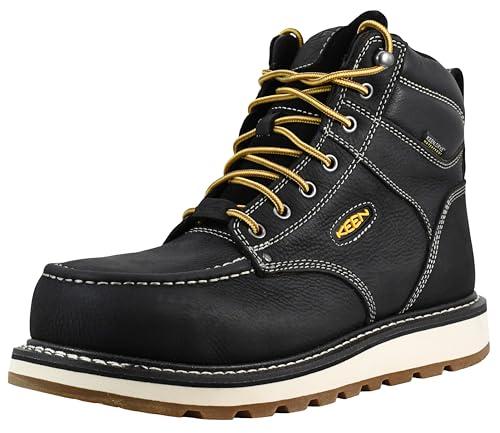 KEEN Utility Cincinnati 6" Composite Toe Waterproof Wedge Work Boot A welted wedge with a waterproof membrane and a non-metallic cap — a combination that barely exists anywhere else, and the pick when the floor is flat and wet. | Waterproof, on a welt | Asymmetrical non-metallic safety toe. KEEN's own page calls it a carbon safety toe and states it weighs 15% less than steel; retailers list the same cap as a composite toeKEEN does not publish a designation string on this model's page. Authorized-retailer listings for the Cincinnati non-metallic toe state it meets or exceeds ASTM F3445-21 and ASTM F2413-18 M I/75 C/75 EH | |
| 3 | 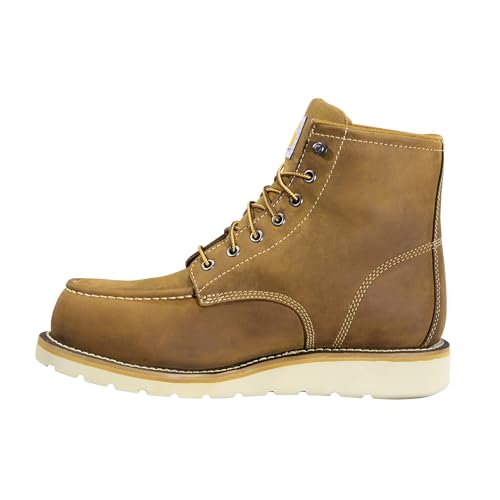 Carhartt 6" Waterproof Moc Nano Toe Wedge Work Boot (FW6425-M) At a published 1 lb 4.8 oz per boot this is the lightest composite wedge here, waterproof, with the newest ASTM revisions printed on the listing — and cemented, so you replace it rather than rebuild it. | Lightest, at 1 lb 4.8 oz | Carhartt Nano composite safety toe, moc toe shapeSafety toe meets or exceeds ASTM F2413-24 EH (electrical hazard); outsole meets or exceeds ASTM F3445-24 SR (slip resistant) | |
| 4 | 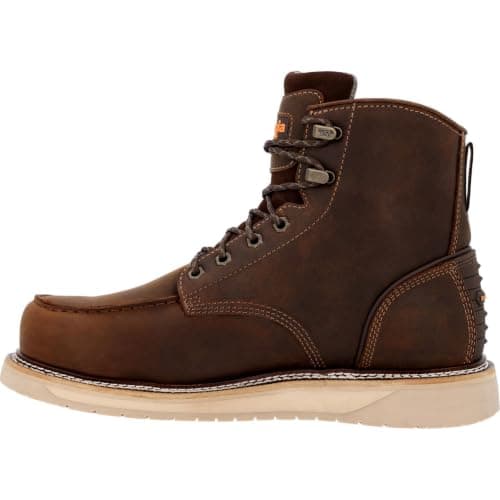 Georgia Boot AMP LT Wedge Composite Toe Waterproof Work Boot (GB00592) A waterproof composite-toe wedge whose SPR leather is specified against named caustics — the pick where the floor is flat and the spills are chemical. | Named chemical resistances | Ergo-Fit composite toeMeets ASTM F2413 Protective Toe Classification and ASTM F2413 Electrical Hazard Classification | |
| 5 | 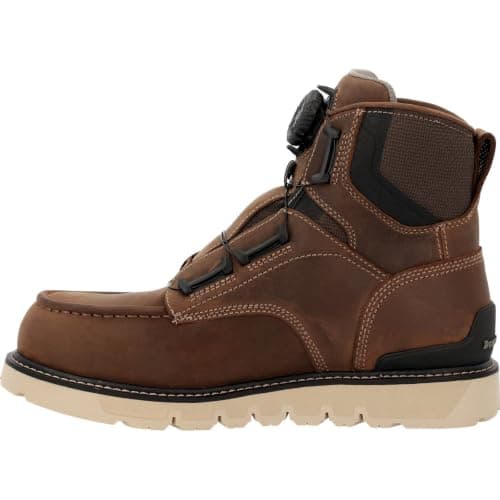 Georgia Boot Carbon Flex 6" BOA Waterproof Carbon Toe Moc-Toe Work Boot (GB00729) A waterproof moc-toe wedge with a carbon cap and a BOA dial instead of laces — retension it with a gloved hand mid-shift, which is the whole argument for a dial. | A dial instead of laces | Ergo-Fit carbon protective toeASTM F2413 protective toe classification; ASTM F2413 electrical hazard classification |
Tap a row to jump to that boot's full write-up. The price column goes straight to Amazon.
Why this list is five boots and not fifteen
A wedge outsole is flat from toe to heel. It spreads your weight across the whole footprint instead of concentrating it under a heel breast, which is why it is the indoor trades' sole — wedge sole vs lug sole is the full argument. A non-metallic safety toe is a separate requirement, usually driven by one of three things: a metal detector at the gate, electrical work where you do not want a conductor wrapped around your toes, or cold, because a steel cap pulls heat out of the front of your foot all day.
Plenty of boots do one or the other. The overlap is small, and it is small for a reason: the wedge is a heritage silhouette, heritage boots are welted, and welted boots have historically shipped with steel caps. The makers who moved to composite went to cemented athletic constructions at the same time. So the honest shape of this category is two welted boots, three cemented ones, and a real price gap between them.
If a metal-free cap is not actually a requirement for you, the wider field is better — the best wedge sole work boots roundup includes steel and aluminum caps and has cheaper options in it.
How these five were chosen
1. A published non-metallic cap. Composite, carbon or Nano — not "alloy," which is metal, and not "safety toe" with no material named. If a maker would not say what the cap is made of, the boot is not here.
2. A genuine wedge outsole. Flat from toe to heel, as the maker describes it. A low-profile lug sole is not a wedge, and a 90-degree heel is explicitly not a wedge — KEEN sells the Cincinnati in both, and only the wedge version is on this page.
3. Construction stated, and treated as the main decision. Welted or cemented changes what the boot costs you over five years far more than the cap material does.
4. What the maker publishes about the shank. A composite cap with a steel shank is still a boot with metal in it. Two of these five publish a non-metallic shank; the rest do not say.
5. Widths, where a maker publishes them. Wedge soles put the whole foot on the floor, so a width that is wrong is wrong for every step.
The five, on what each maker publishes
| Cap | Construction | Waterproof | Widths | Weight | |
|---|---|---|---|---|---|
| Thorogood 804-6120 | Nano composite, ASTM F2413-18 + EH | Goodyear storm welt — resoleable | No, and none claimed | D and EE, 7-15 | Not published |
| KEEN Cincinnati 6" | Non-metallic, published as carbon | Goodyear welt — resoleable | KEEN.DRY membrane | Not published on the maker page | Not published |
| Carhartt FW6425-M | Nano composite, ASTM F2413-24 EH | Cement — not resoleable | Storm Defender membrane | MW only, 8-15 | 1 lb 4.8 oz |
| Georgia AMP LT Wedge | Ergo-Fit composite, ASTM F2413 + EH | Not published as a welt | Georgia Waterproof System | Not published | Not published |
| Georgia Carbon Flex BOA | Ergo-Fit carbon, ASTM F2413 + EH | Bond welt — not resoleable | Georgia Waterproof System | D and EE | 1.95 lbs, size 10M |
Thorogood 804-6120 — the default
This is the 804-4200 with the steel taken out of it. Same Black Walnut full-grain American leather, same MAXWear Wedge, same Goodyear storm welt, same removable Ultimate Shock Absorption footbed over a Poron cushion — and a Nano composite cap with a composite shank instead of steel in both places. That makes it the only boot on this page that is both non-metallic from cap to shank and able to be resoled, which is a genuinely unusual combination and the reason it leads.
Thorogood publishes the safety designation as ASTM F2413-18 for the toe with electrical hazard under ASTM F2413-18 or ASTM F2892-18, plus oil-resistance and slip-resistance, and it publishes the origin wording in full: made in USA with USA and globally sourced components. You also get D and EE in every size from 7 to 15, which is more fit range than anything else here.
The honest cons. No published weight, and a welted boot with a leather midsole is not a light one — if ounces are the priority, the Carhartt below weighs a published 1 lb 4.8 oz and this almost certainly does not. There is no waterproofing of any kind and Thorogood does not claim any. And a welted wedge needs real break-in; how to break in work boots is the method that does not ruin the leather.
Wrong for: wet or uneven outdoor ground. A flat wedge has no lugs to bite and this boot has no membrane.
KEEN Cincinnati 6-inch — waterproof, and still welted
The Cincinnati is the answer to a question most makers duck: what if the flat floor is also wet? It is a Goodyear-welted wedge with the KEEN.DRY waterproof breathable membrane, a barnyard-resistant leather upper and the Luftcell midsole KEEN specifies at nearly 100,000 micro air bubbles per cubic centimeter. The cap is non-metallic — KEEN's own page calls it a carbon safety toe and states it weighs 15% less than steel, while retailers list the same cap as composite. Carbon fiber is a composite, so both labels describe the same thing.
Dairy barns, food plants, wash-down bays and anywhere a hose gets used at the end of the shift are what this boot is for. The welt means you are not throwing it away when the wedge goes — resoling work boots covers what that actually costs.
The honest cons. KEEN does not print an ASTM designation string on this model's page, so the exact classification rests on authorized-retailer listings, which state ASTM F3445-21 and F2413-18 M I/75 C/75 EH. If you need a maker-published string on file for a site induction, the Thorogood and the Carhartt both give you one and this does not. There is no published weight either, and a welted waterproof boot is the heaviest build on this page. Also check which Cincinnati you are buying: KEEN sells a 90-degree-heel version of the same boot, and that one is not a wedge.
Wrong for: hot weather. A membrane in a wedge is a sealed box with no lugs to lift it off the floor — best hot-weather work boots goes the other way deliberately.
Carhartt FW6425-M — the light one
A published 1 lb 4.8 oz per boot, waterproof, with the newest ASTM revisions on the listing: F2413-24 EH for the Nano composite cap and F3445-24 SR for the outsole. Most makers on this page cite a 2018 revision or none at all, so Carhartt is doing something the others are not. The Storm Defender membrane sits behind a FastDry lining, and the wedge is a dual-density rubber unit.
The weight is the argument. On a flat floor, where a wedge belongs, the thing you feel at hour nine is how much boot you have been lifting, and a pound and a quarter per foot is light for a waterproof safety boot.
The honest cons. Cement construction — when the wedge wears through, the boot is finished, and a wedge is the sole geometry that wears fastest on abrasive concrete. One width, MW, so a wide or high-volume foot has nowhere to go; the Thorogood's EE or the Carbon Flex's EE are the alternatives. And a light build means less material underfoot than the welted picks, which some people read as less support.
Wrong for: wide feet, and anyone who intends to resole.
Georgia AMP LT Wedge — if the spills are chemical
Georgia does the thing almost nobody does and names the chemicals its SPR leather is specified to resist: caustic alkali, sulfuric acid, calcium hydroxide, potassium phosphate and caustic potash. "Chemical resistant" is marketing; a list is information. Behind it there is a waterproof system, a Carbo-Tec rubber outsole over dual-density EVA, and a fiberglass shank — so like the Thorogood, this boot has no metal underfoot either.
The honest cons. Memory-foam insoles pack down faster than polyurethane, the EVA midsole compresses over a year of hard use, and it is not resoleable. Georgia does not publish a width run for this model.
Wrong for: cold outdoor work. A dual-density EVA midsole stiffens in the cold and there is no insulation here.
Georgia Carbon Flex BOA — the closure
A carbon cap on a waterproof moc-toe wedge, with a BOA dial instead of laces. The case for a dial is narrow and specific: you can retension it with a gloved hand, mid-shift, without stopping — which matters most to people whose feet swell through the day. Georgia publishes a weight (1.95 lbs at size 10M) and two widths, and adds a stretch gusset that takes some of the instep pressure a dial creates. Best BOA work boots covers dials across the category, including where they are the wrong answer.
The honest cons. The dial is a mechanical part and an impact can break it, and you cannot bodge a broken dial with what is in the truck. A dial also cannot skip an eyelet, so an unusually high instep has no escape route. Bond welt construction is not a resoleable welt despite the name.
Wrong for: anyone who relieves a pressure point by lacing around it. Even tension is exactly what a dial does.
The budget pick, and why it is the odd one
KEEN's Cincinnati was the lowest-priced boot on this page when it was written, which is genuinely unusual for a welted waterproof boot — normally the welt is what you pay extra for. That makes it the value pick as well as the wet-floor pick. The Thorogood sits clearly above the other four, and those four cluster close together, so check the live figure on each card rather than assuming an order; this category moves.
If the budget is the hard constraint and a non-metallic cap is not, the cheapest wedges in the category have steel or aluminum caps and are on the main wedge roundup. Dropping the metal-free requirement saves real money here.
The shank is the spec people forget
If the reason you want a non-metallic cap is a metal detector, the cap is only half the boot. A composite toe over a steel shank still sets off a gate, and most makers do not volunteer what the shank is made of. On this page, Thorogood publishes a composite shank and Georgia publishes a fiberglass shank. KEEN and Carhartt describe midsoles rather than shanks, and Timberland PRO's plated boots — relevant if your real problem is nails rather than detectors — use fiberglass shanks over a puncture-resistant plate, and that plate is usually steel.
If the reason is cold rather than metal detection, the cap material matters more than the shank, because the cap sits directly against your toes. Best composite toe work boots is the wider non-metallic field if a wedge is not a hard requirement.
Fitting a wedge
A wedge has no heel drop, so your weight sits further back than it does in a heeled boot and the heel counter does more of the work. Two things follow. First, heel hold is the fit test that matters — if your heel lifts in a wedge, the whole foot slides forward into a cap that does not move. Second, people coming off a heeled boot often feel calf tightness for the first week, because a flat sole lengthens the Achilles slightly through the stride. That settles; it is not a fit problem.
Otherwise it is the standard method: fit at the end of the day in the sock you actually work in, leave about a thumb's width in front of the longest toe, and never size down to cure heel slip. The work boot sizing guide has the measuring method and the width tables.
The picks in full
#1 — Resoleable, and non-metallic throughout
Thorogood 6" Nano Composite Safety Toe Moc Toe MAXWear Wedge (804-6120)
The same USA-built, Goodyear-welted wedge platform this site recommends more than any other, with a Nano composite cap instead of steel — the only non-metallic wedge here you can have resoled.
Published specifications
- Toe
- Nano composite safety toe, moc toe shape
- Safety rating
- Safety toe per ASTM F2413-18; electrical hazard per ASTM F2413-18 or ASTM F2892-18; oil-resistant and slip-resistant
- Upper
- Black Walnut full-grain American leather
- Outsole
- MAXWear Wedge outsole — flat, no lugs
- Midsole / shank
- Composite shank, with a removable Ultimate Shock Absorption footbed over a Poron comfort cushion insole
- Construction
- Goodyear storm welt
- Waterproof
- Not published on this model's page — treat as not waterproof
- Insulation
- Not published on this model's page — treat as uninsulated
- Widths
- D and EE, whole and half sizes 7-12 plus 13, 14 and 15 in both
- Weight
- Not published on the manufacturer page
- Made in
- Made in USA with USA and globally sourced components
Specifications read from Thorogood product page (6" Black Walnut Nano Moc Toe MAXWear Wedge, 804-6120) on 2026-11-09. We have not worn this boot.
What works
- Resoleable, which almost no composite-toe wedge is
- Non-metallic in both the cap and the shank, so it clears a metal detector
- Two published widths in every size, which is rare at this price
- Made in the USA, with the origin wording stated plainly
What doesn't
- Thorogood does not publish a weight, and a welted boot is not a light one
- No waterproofing at all, and none is claimed
- A welted wedge needs real break-in before a full shift
Who this is wrong for
Wet or uneven outdoor ground. A flat wedge has no lugs to bite and there is no membrane in this boot.
Sizing
Thorogood's American last runs roughly a half size large and the moc toe box is generous. Order your measured Brannock length rather than your sneaker size, and take the EE if you normally need a wide.
#2 — Waterproof, on a welt
KEEN Utility Cincinnati 6" Composite Toe Waterproof Wedge Work Boot
A welted wedge with a waterproof membrane and a non-metallic cap — a combination that barely exists anywhere else, and the pick when the floor is flat and wet.
Published specifications
- Toe
- Asymmetrical non-metallic safety toe. KEEN's own page calls it a carbon safety toe and states it weighs 15% less than steel; retailers list the same cap as a composite toe
- Safety rating
- KEEN does not publish a designation string on this model's page. Authorized-retailer listings for the Cincinnati non-metallic toe state it meets or exceeds ASTM F3445-21 and ASTM F2413-18 M I/75 C/75 EH
- Upper
- Barnyard-resistant leather upper
- Outsole
- Oil- and slip-resistant rubber wedge outsole
- Midsole / shank
- KEEN Luftcell air-infused midsole, stated at nearly 100,000 micro air bubbles per cubic centimeter, over a removable dual-density PolyAer insole
- Construction
- Goodyear welt
- Waterproof
- Waterproof — KEEN.DRY breathable membrane
- Insulation
- Not published on this model's page — treat as uninsulated
Specifications read from KEEN product page (Men's Cincinnati 6-inch Waterproof, carbon safety toe), with the Cincinnati collection page for the wedge sole and welt on 2026-11-09. We have not worn this boot.
What works
- Waterproof and resoleable in one wedge, which is close to unique
- KEEN's roomy toe box suits feet that spread by mid-shift
- Barnyard-resistant leather holds up to the chemistry a farm floor throws at it
What doesn't
- KEEN publishes no ASTM designation string on the model page, so the exact classification rests on retailer listings
- No published weight, and a welted waterproof boot is not light
- No insulation, so this is a three-season wedge
Who this is wrong for
Anyone who needs a published, model-specific ASTM string on file for a site induction. The Thorogood and the Carhartt both publish theirs.
Sizing
KEEN lasts run wide through the forefoot and short in the heel. With a narrow heel, lace a heel lock through the top two eyelet pairs rather than sizing down.
#3 — Lightest, at 1 lb 4.8 oz
Carhartt 6" Waterproof Moc Nano Toe Wedge Work Boot (FW6425-M)
At a published 1 lb 4.8 oz per boot this is the lightest composite wedge here, waterproof, with the newest ASTM revisions printed on the listing — and cemented, so you replace it rather than rebuild it.
Published specifications
- Toe
- Carhartt Nano composite safety toe, moc toe shape
- Safety rating
- Safety toe meets or exceeds ASTM F2413-24 EH (electrical hazard); outsole meets or exceeds ASTM F3445-24 SR (slip resistant)
- Upper
- Premium rugged leather with the Storm Defender waterproof breathable membrane and a FastDry lining
- Outsole
- Dual-density rubber wedge outsole, stated to give full ground-contact traction
- Midsole / shank
- Cushion Comfort polyurethane insole over a PU Strobel pad
- Construction
- Cement construction
- Waterproof
- Waterproof — Storm Defender breathable membrane
- Insulation
- Not listed on the product page
- Widths
- Listed in MW (medium) only, US 8-15
- Weight
- 1 lb 4.8 oz
- Made in
- Imported
Specifications read from Zappos product page (Carhartt 6" Waterproof Moc Nano Toe Wedge, FW6425-M) on 2026-11-09. We have not worn this boot.
What works
- Genuinely light for a waterproof safety boot, and you feel it by hour nine
- Cites the 2024 ASTM revisions rather than a decade-old one
- Carhartt publishes a real weight, which most makers here do not
What doesn't
- Cement construction — a worn wedge ends the boot
- One width only, so a wide foot has nowhere to go
- A light build means a thinner platform underfoot than the welted picks
Who this is wrong for
Anyone with a wide or high-volume foot, and anyone who expects to resole. One width and no welt.
Sizing
Carhartt's moc-toe last is close to true to length but shallow over the instep. If the lace pressure bites across the top of your foot, skip an eyelet pair rather than loosening the whole boot.
#4 — Named chemical resistances
Georgia Boot AMP LT Wedge Composite Toe Waterproof Work Boot (GB00592)
A waterproof composite-toe wedge whose SPR leather is specified against named caustics — the pick where the floor is flat and the spills are chemical.
Published specifications
- Toe
- Ergo-Fit composite toe
- Safety rating
- Meets ASTM F2413 Protective Toe Classification and ASTM F2413 Electrical Hazard Classification
- Upper
- Abrasion-resistant SPR leather, stated to resist caustic alkali, sulfuric acid, calcium hydroxide, potassium phosphate and caustic potash
- Outsole
- Carbo-Tec rubber outsole over dual-density EVA — heat, chemical, abrasion and slip resistant
- Midsole / shank
- Cushioning EVA midsole with a fiberglass shank
- Construction
- Not published as a welt construction
- Waterproof
- Waterproof — Georgia Waterproof System
- Insulation
- Not insulated
Specifications read from Georgia Boot product page (AMP LT Wedge composite toe, GB00592) on 2026-09-27. We have not worn this boot.
What works
- Names the specific chemicals the upper resists instead of saying chemical-resistant
- Fiberglass shank keeps the whole boot non-metallic underfoot
- Wedge sole plus waterproofing is a rare combination
What doesn't
- Memory-foam insoles pack down faster than PU
- EVA midsole compresses over a year of hard use
- Not resoleable
Who this is wrong for
Cold-weather outdoor work. A dual-density EVA midsole stiffens in the cold and this boot has no insulation.
Sizing
Georgia's AMP LT last is medium-volume. If you swap the memory-foam insole for a firmer orthotic you will gain a little room, which can make a snug pair workable.
#5 — A dial instead of laces
Georgia Boot Carbon Flex 6" BOA Waterproof Carbon Toe Moc-Toe Work Boot (GB00729)
A waterproof moc-toe wedge with a carbon cap and a BOA dial instead of laces — retension it with a gloved hand mid-shift, which is the whole argument for a dial.
Published specifications
- Toe
- Ergo-Fit carbon protective toe
- Safety rating
- ASTM F2413 protective toe classification; ASTM F2413 electrical hazard classification
- Upper
- Full-grain leather with a stretch gusset
- Outsole
- Co-molded TPU/PU outsole — heat-, abrasion- and slip-resistant, with flex grooves
- Midsole / shank
- Fiberglass shank with a Counter Lock heel stabilizer and a removable AMP memory-polyurethane insole
- Construction
- Bond welt construction
- Waterproof
- Georgia Waterproof System with a high-performance mesh lining
- Insulation
- Not published
- Widths
- D and EE
- Weight
- 1.95 lbs, size 10M
Specifications read from Georgia Boot product page (Carbon Flex BOA, GB00729) on 2026-09-29. We have not worn this boot.
What works
- A dial you can work with gloves on, and it holds tension evenly
- Carbon cap keeps the weight down and the cold out
- Stretch gusset takes the pressure off the instep that a dial can create
- Published weight, which is more than most brands give you
What doesn't
- The dial is a mechanical part and an impact can break it
- A dial cannot skip an eyelet, so a high instep has no escape route
- Bond welt is not a resoleable construction
Who this is wrong for
Anyone who relieves a pressure point by lacing around it. Even tension is what a dial does, and that is exactly wrong for an unusually high instep.
Sizing
Dial boots feel looser than laces at the same tightness because the pressure is spread. Judge fit by heel hold, not by how snug the top of the foot feels.
Frequently asked questions
Are composite toe wedge boots as protective as steel toe?
For impact and compression, yes — both have to pass the same ASTM F2413 I/75 C/75 test to carry the classification, and every pick on this page does. The differences are elsewhere: composite caps are usually bulkier in profile, they do not conduct cold or electricity, and they do not trigger metal detectors.
Can you resole a composite toe wedge boot?
Only if it is welted, and most are not. On this page the Thorogood 804-6120 (Goodyear storm welt) and the KEEN Cincinnati (Goodyear welt) can be resoled. The Carhartt is cemented and the two Georgia boots are not resoleable welts, so those three are replace-not-rebuild boots.
Does a composite toe wedge boot pass a metal detector?
Only if the shank is non-metallic too. A composite cap over a steel shank still sets a gate off. Thorogood publishes a composite shank on the 804-6120 and Georgia publishes a fiberglass shank on both its wedges; KEEN and Carhartt do not publish a shank material for these models.
Is a wedge sole good for concrete?
It is the sole most people prefer on flat hard floors, because it spreads load across the whole footprint instead of concentrating it under a heel breast. It is a poor choice outdoors on mud, gravel or ladder rungs, where a flat sole has nothing to bite with.
Which composite toe wedge boot is the lightest?
Of the boots here that publish a weight, the Carhartt FW6425-M at 1 lb 4.8 oz per boot is the lightest, with the Georgia Carbon Flex BOA at 1.95 lbs for a size 10M. Thorogood and KEEN do not publish weights for their models, and both are welted builds, which are not light.
Sources
- ASTM F2413 protective footwear standard — technical summary — Label format, the mandatory I and C designations, and each optional code
- What changed in ASTM F2413-18 — Why the Class 50 tier and the numeric suffix disappeared from the marking
- OSHA 29 CFR 1910.136 — Foot protection — The federal rule itself: when protective footwear is required, and which consensus standards it accepts
Read next
Best Wedge Sole Work Boots
The wider field, including steel and aluminum caps and cheaper picks.
Best Composite Toe Work Boots
Every sole geometry, if the non-metallic cap is the hard requirement.
Wedge Sole vs Lug Sole
Settle the sole question before you shop the list.
Best Puncture-Resistant Work Boots
If your real hazard underfoot is nails rather than metal detectors.