Trades
Best Work Boots for Painters
Half the day on a rung, the other half on somebody's finished floor.
Disclosure: product links on this page go to Amazon. As an Amazon Associate we earn from qualifying purchases, at no extra cost to you. It does not change which boots we recommend or the order they appear in — here is the full disclosure.
Quick picks
| # | Product | Best for | Toe & rating | Price |
|---|---|---|---|---|
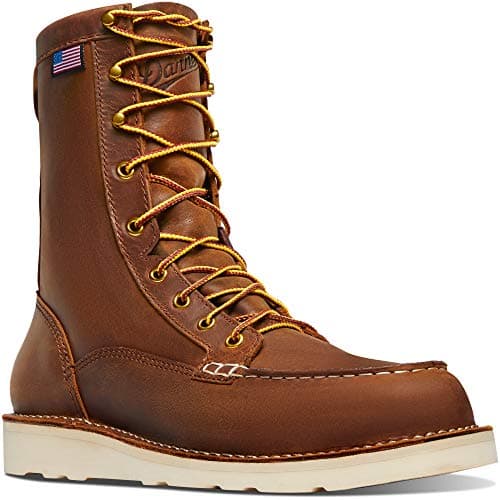
| 1 | Danner Bull Run Moc Toe 8" Steel Toe Stitchdown construction gives the Bull Run a wider platform than a welted boot of the same size — more stable underfoot, and handcrafted in the USA. | Published non-marking, won't track debris | Steel safety toe, moc toe shapeSteel safety toe meets ASTM F2413 for impact and compression | |
| 2 | 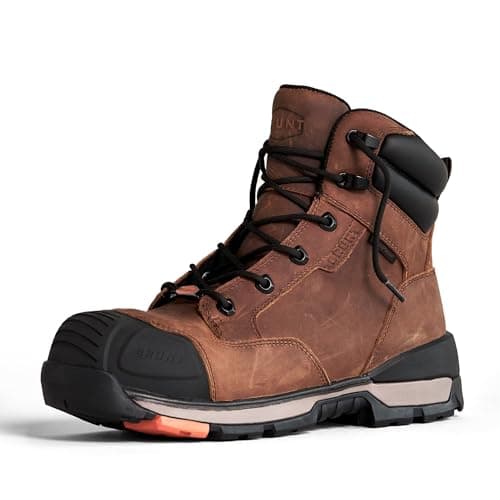 BRUNT The Perkins Waterproof Composite Toe Work Boot The Perkins swaps the Marin's profile for a defined 90-degree heel — the version to buy if you spend the day on ladders, scaffolding or roof edges. | A 90° heel for ladder rungs | Composite safety toe, non-metallicComposite safety toe with electrical hazard (EH) protection; slip- and oil-resistant | |
| 3 | 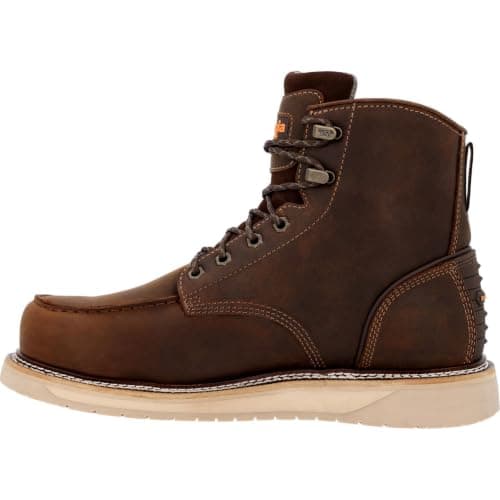 Georgia Boot AMP LT Wedge Composite Toe Waterproof Work Boot (GB00592) A waterproof composite-toe wedge whose SPR leather is specified against named caustics — the pick where the floor is flat and the spills are chemical. | Leather specified against caustics | Ergo-Fit composite toeMeets ASTM F2413 Protective Toe Classification and ASTM F2413 Electrical Hazard Classification | |
| 4 | 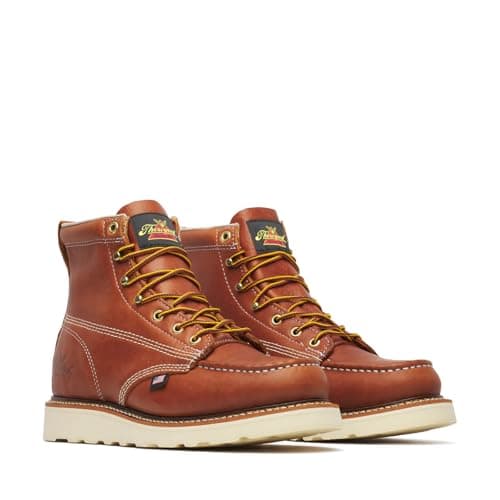 Thorogood American Heritage 6" Moc Toe MAXWear Wedge, soft toe (814-4200) The same USA-built wedge platform as the 804-4200 without the steel toe — lighter on the foot, and the right choice only where no safety toe is required. | The soft-toe option, where it is allowed | Plain (non-safety) moc toeNo safety toe — this model carries no ASTM F2413 toe rating | |
| 5 | 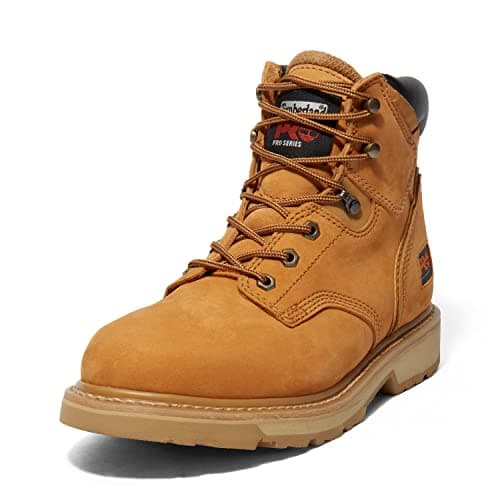 Timberland PRO Pit Boss 6" Steel Toe Work Boot The volume-seller steel toe: asymmetrical cap, EH rating, and a slip- and oil-resistant outsole, in a cement-built boot you replace rather than resole. | Non-marking, lowest-cost compliance | Asymmetrical steel safety toeElectrical hazard protection; all Timberland PRO safety toes meet ASTM F2413 impact (I) and compression (C) when tested to ASTM F2412 | |
| 6 | 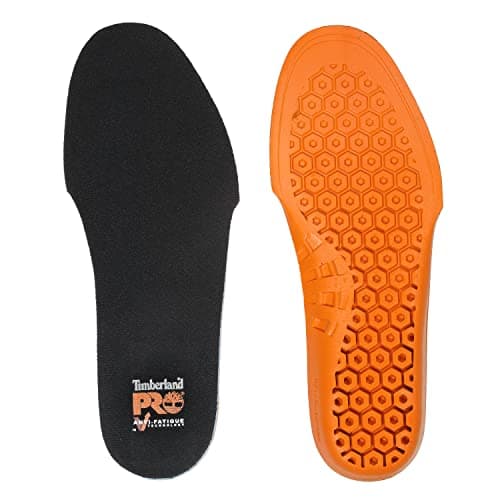 Timberland PRO Anti-Fatigue Technology Replacement Insole (91621) The inverted-cone geometry Timberland puts in its own boots, sold as a drop-in footbed — the cheapest way to get an anti-fatigue platform into a boot that was built without one. | Rescuing a boot you own | Not applicable — insoleThe retailer page claims no ASTM or ESD certification for this insole and states it is not a medical device |
Tap a row to jump to that boot's full write-up. The price column goes straight to Amazon.
What painting actually does to a boot
Painting sits in an odd place among the trades. The impact hazards that drive boot choice on a construction site are mostly absent — nobody is dropping a steel beam on a bedroom floor — and in exchange you get three requirements almost no other trade shares.
You stand on other people's finished surfaces. Hardwood, tile, vinyl, sealed concrete, a client's carpet under a drop cloth. A boot that leaves black scuffs or carries grit indoors creates work you then have to fix for free, and on residential jobs it is the fastest way to lose a referral. The outsole compound is a commercial decision here, not a comfort one.
You are on a ladder for a large share of the day. Stepladders, extension ladders, sometimes a plank. A rung loads a narrow band across the arch, and whether that is tolerable depends almost entirely on the sole profile and the shank underneath it.
Everything you work with attacks leather. Paint, primer, caulk, mineral spirits, lacquer thinner, stripper. Solvents strip the oils out of leather faster than water does, and a boot that gets spattered weekly ages years faster than the same boot on a framing crew.
The five criteria, in the order that matters
1. A published non-marking outsole. Not “light colored” and not an assumption — the maker stating non-marking on the product page. Two picks here publish it outright: Danner says the Bull Run's wedge is non-marking and will not track debris, and Timberland PRO publishes a non-marking rubber outsole on the Pit Boss.
2. A heel profile that suits your ladder time. A defined 90-degree heel breast catches a rung and takes load off the arch; a flat wedge spreads load across the whole footprint and is better when you are standing on a floor. You cannot have both, so pick for where you spend the most hours.
3. Slip resistance on smooth, sheeted surfaces. Plastic sheeting and canvas drop cloths over hard floors are a genuine slip hazard, and a wet-paint floor is worse. ASTM F3445 sets a minimum coefficient of friction of 0.40 wet and dry and 0.33 oily-wet — a boot measured against that is a different claim from one with “superior traction” on a hangtag.
4. Chemical tolerance, where the maker will specify it. Most will not. Georgia Boot is the exception in this registry: it states the AMP LT's SPR leather resists caustic alkali, sulfuric acid, calcium hydroxide, potassium phosphate and caustic potash. Named chemicals beat the phrase “chemical resistant” every time.
5. Weight and breathability, because you are indoors. Painting is climate-controlled work much of the year. Insulation is a liability, a membrane traps heat you do not need to trap, and weight at the end of the leg is paid for on every trip up the ladder.
The picks, on what each maker publishes
| Outsole / marking | Heel profile | Toe | Notes for painters | |
|---|---|---|---|---|
| Danner Bull Run ST | Danner Wedge — published non-marking, won't track debris | Wedge, flat | Steel, ASTM F2413 impact and compression | Stitchdown and USA-built; not waterproof in this version |
| BRUNT The Perkins CT | Rubber, slip- and oil-resistant; heat-resistant to 572°F | Defined 90° heel | Composite with EH | SWITCH-FIT width D or EE; waterproof |
| Georgia AMP LT Wedge CT | Carbo-Tec rubber — heat, chemical, abrasion and slip resistant | Wedge, flat | Ergo-Fit composite with EH | SPR leather specified against five named caustics |
| Thorogood 814-4200 | MAXWear Wedge, slip-resistant | Wedge, flat | None — no ASTM F2413 toe rating | Goodyear welt, USA-built, lightest of the five |
| Timberland PRO Pit Boss ST | Published non-marking rubber; heat, oil, slip, abrasion resistant | Low heel | Asymmetrical steel with EH | Cheapest compliant option; not waterproof |
Danner Bull Run — the default
The Bull Run is the only boot here where the maker addresses the painter's central problem in its own specification. Danner publishes the wedge outsole as non-marking, oil- and slip-resistant, and states it will not track debris. On top of that it is handcrafted stitchdown in the USA, which gives a wider platform than a welted boot of the same size and means the boot can be rebuilt rather than replaced.
The honest cons. It is not waterproof in this version — Danner lists a GTX version separately — so exterior work in wet weather is the wrong application. It is an 8-inch boot, which is more shaft than some painters want for ladder work. And stitchdown leather needs real break-in: Danner says plainly to buy it three weeks before you need it.
Wrong for: anyone who needs the boot comfortable on day one. If you start a job Monday, this is not the boot to order Friday.
BRUNT The Perkins — if you live on a ladder
The Perkins exists for exactly one reason and it is the right reason for a painter: a defined 90-degree heel breast that catches a rung instead of letting your foot slide forward on it. If more than half your day is on a ladder or scaffold, that single feature outweighs most of the rest of the spec sheet.
It is also waterproof, carries a composite toe with EH protection, and uses BRUNT's SWITCH-FIT system, which adjusts the same boot between regular (D) and relaxed (EE) — useful if you are between widths and buying online.
The honest cons. A defined heel is less comfortable than a wedge on flat floors, which is the trade you are accepting. BRUNT does not publish the full ASTM designation line on the product page, only composite-toe and EH compliance. And it is not a welt construction, so treat it as non-resoleable.
Wrong for: flat-floor work. If your days are mostly rolling walls at ground level, the heel breast concentrates load where a wedge would spread it.
Georgia AMP LT Wedge — if solvents are the problem
This is the pick for anyone doing industrial or commercial coating work, stripping, or anything where the floor has chemicals on it rather than just paint. Georgia specifies the SPR leather against five named caustics by name, and the Carbo-Tec outsole as heat, chemical, abrasion and slip resistant. It is also waterproof, and it is a wedge, so it is comfortable standing.
The honest cons. Georgia lists it at $205, which makes it the most expensive boot here, and the dual-density EVA midsole stiffens in cold — it is not an outdoor winter boot. There is no welt, so it cannot be resoled.
Wrong for: cold outdoor work, on the maker's own reasoning.
Thorogood 814-4200 — the soft-toe case
Painters are one of the few trades where a soft toe is often genuinely legal, and it is worth understanding why rather than guessing. OSHA's foot protection rule at 29 CFR 1910.136 requires protective footwear where there is a danger of foot injury from falling or rolling objects, objects piercing the sole, or electrical hazards. Your employer performs that assessment. On a residential repaint with no heavy materials moving, the assessment frequently does not call for a safety toe at all.
Where that is the case, the 814-4200 is the same USA-built, Goodyear-welted MAXWear wedge platform as Thorogood's steel-toe 804-4200 without the cap: lighter on the foot, resoleable, and on an oil-tanned upper that takes conditioner well.
Best soft toe work boots covers the wider soft-toe field and when it is defensible.
Timberland PRO Pit Boss — the budget compliant option
If a site requires a safety toe and you do not want to spend much, the Pit Boss is the answer and it happens to publish non-marking on the outsole, which matters more to a painter than to the trades it was designed for. It carries an asymmetrical steel cap, EH protection, and a 24/7 Comfort Suspension footbed with arch support.
The honest cons. Not waterproof, no published welt construction, so it is a boot you replace rather than rebuild — and Timberland does not publish a weight. The steel cap is also the heaviest and coldest option here, which is a real penalty on ladder work — if weight is what you are trying to cut, the alloy-toe roundup covers the lightest metal caps made.
Wrong for: anyone expecting the boot to last several years and be resoled.
The other half of the job is standing
Painters are on their feet for effectively the whole shift, much of it on hard floors. NIOSH's review of the evidence on prolonged standing at work reports consistent increases in low back pain, physical fatigue, muscle pain, leg swelling and general discomfort, with clear detrimental effects from around three hours of standing onward. That is not something a toe cap addresses.
The cheapest real improvement is the footbed. Most mid-priced boots ship with thin factory foam, and Timberland's Anti-Fatigue replacement insole is the direct upgrade on a hard flat floor — worth noting that Timberland publishes energy return and odor control for it and no ASTM or ESD certification, so it is a comfort part, not a safety one. Best insoles for work boots runs through the options, and best work boots for standing all day is the deeper version of this argument.
Looking after a painter's boots
Two habits, both cheap. Get paint and solvent off the upper the same day rather than at the weekend — solvent sitting on leather pulls the oils out of it, and that is what cracking along the flex crease actually is. Then condition on a shorter cycle than other trades would: every four weeks rather than every six, because you are stripping oils faster than weather alone would.
A liquid conditioner is the right product for most painters because it does not darken the leather, and a wax paste is the one to avoid unless your boots are genuinely wet most days. How to condition leather work boots has the method and the frequency, and work boot care and cleaning covers the rest of the routine.
Buying in order
Confirm first whether your work requires a safety toe — ask your employer or the GC rather than assuming either way, because the answer changes which half of this list applies to you. Then choose on heel profile: 90-degree if your day is ladders, wedge if it is floors. Then on outsole, where non-marking should be published rather than inferred. Then fit, which decides whether you can stand in them for eight hours. ASTM F2413 explained decodes every designation quoted here.
The picks in full
#1 — Published non-marking, won't track debris
Danner Bull Run Moc Toe 8" Steel Toe
Stitchdown construction gives the Bull Run a wider platform than a welted boot of the same size — more stable underfoot, and handcrafted in the USA.
Published specifications
- Toe
- Steel safety toe, moc toe shape
- Safety rating
- Steel safety toe meets ASTM F2413 for impact and compression
- Upper
- Tobacco leather upper
- Outsole
- Danner Wedge outsole — non-marking, oil- and slip-resistant, won't track debris
- Midsole / shank
- Not published on the manufacturer page
- Construction
- Handcrafted stitchdown construction
- Waterproof
- Not waterproof in this version; a GTX version is listed separately
- Insulation
- Not insulated
- Made in
- Built in the USA
Specifications read from Danner product page (Bull Run Moc Toe 8" steel toe) on 2026-09-27. We have not worn this boot.
What works
- Stitchdown is the most stable of the resoleable constructions
- Non-marking wedge works indoors and out
- A US-built moc toe with a safety cap, which is a short list
What doesn't
- Not waterproof — the GTX version costs more
- Stitchdown boots take longer to break in than cemented ones
- No published weight
Who this is wrong for
Anyone who needs the boot comfortable on day one. Stitchdown leather needs real break-in; buy it three weeks before you need it.
Sizing
Stitchdown adds a visible platform edge but not interior room. Size to your measured length; the extra width you see is outside the upper, not inside it.
#2 — A 90° heel for ladder rungs
BRUNT The Perkins Waterproof Composite Toe Work Boot
The Perkins swaps the Marin's profile for a defined 90-degree heel — the version to buy if you spend the day on ladders, scaffolding or roof edges.
Published specifications
- Toe
- Composite safety toe, non-metallic
- Safety rating
- Composite safety toe with electrical hazard (EH) protection; slip- and oil-resistant
- Upper
- Waterproof leather upper
- Outsole
- BRUNT rubber outsole with a 90° heel — high-heat resistant to 572°F / 300°C
- Midsole / shank
- BRUNT polyurethane (PU) midsole
- Construction
- Not published as a welt construction on this model
- Waterproof
- Waterproof
- Insulation
- Not insulated
- Widths
- SWITCH-FIT adjustable between regular (D) and relaxed (EE)
Specifications read from BRUNT Workwear product page (The Perkins waterproof comp toe) on 2026-09-27. We have not worn this boot.
What works
- The 90° heel breast is the single most useful feature for climbing work
- Same width-adjustment system as the Marin
- Non-metallic toe, so no cold conduction
What doesn't
- A defined heel is less comfortable than a wedge on flat concrete
- Full ASTM designation string is not published on the page
- Not resoleable
Who this is wrong for
Flat-floor trades. If your day is spent on level concrete, the heel breast concentrates load where a wedge would spread it.
Sizing
Same last and SWITCH-FIT system as the Marin, so size the same. Check heel hold specifically — a defined heel makes heel lift more noticeable.
#3 — Leather specified against caustics
Georgia Boot AMP LT Wedge Composite Toe Waterproof Work Boot (GB00592)
A waterproof composite-toe wedge whose SPR leather is specified against named caustics — the pick where the floor is flat and the spills are chemical.
Published specifications
- Toe
- Ergo-Fit composite toe
- Safety rating
- Meets ASTM F2413 Protective Toe Classification and ASTM F2413 Electrical Hazard Classification
- Upper
- Abrasion-resistant SPR leather, stated to resist caustic alkali, sulfuric acid, calcium hydroxide, potassium phosphate and caustic potash
- Outsole
- Carbo-Tec rubber outsole over dual-density EVA — heat, chemical, abrasion and slip resistant
- Midsole / shank
- Cushioning EVA midsole with a fiberglass shank
- Construction
- Not published as a welt construction
- Waterproof
- Waterproof — Georgia Waterproof System
- Insulation
- Not insulated
Specifications read from Georgia Boot product page (AMP LT Wedge composite toe, GB00592) on 2026-09-27. We have not worn this boot.
What works
- Names the specific chemicals the upper resists instead of saying chemical-resistant
- Fiberglass shank keeps the whole boot non-metallic underfoot
- Wedge sole plus waterproofing is a rare combination
What doesn't
- Memory-foam insoles pack down faster than PU
- EVA midsole compresses over a year of hard use
- Not resoleable
Who this is wrong for
Cold-weather outdoor work. A dual-density EVA midsole stiffens in the cold and this boot has no insulation.
Sizing
Georgia's AMP LT last is medium-volume. If you swap the memory-foam insole for a firmer orthotic you will gain a little room, which can make a snug pair workable.
#4 — The soft-toe option, where it is allowed
Thorogood American Heritage 6" Moc Toe MAXWear Wedge, soft toe (814-4200)
The same USA-built wedge platform as the 804-4200 without the steel toe — lighter on the foot, and the right choice only where no safety toe is required.
Published specifications
- Toe
- Plain (non-safety) moc toe
- Safety rating
- No safety toe — this model carries no ASTM F2413 toe rating
- Upper
- Tobacco oil-tanned leather
- Outsole
- MAXWear Wedge slip-resistant outsole
- Midsole / shank
- Rubber midsole
- Construction
- Goodyear storm welt
- Waterproof
- Not waterproof
- Insulation
- Not insulated
- Made in
- Made in USA with USA and globally sourced components
Specifications read from Thorogood product page (814-4200) on 2026-09-27. We have not worn this boot.
What works
- Noticeably lighter than the steel-toe 804-4200 on the same platform
- Resoleable Goodyear welt at a soft-toe price
- No steel cap to press on the toes during break-in
What doesn't
- No toe protection at all — fails most site PPE requirements
- Not waterproof
- Same flat-wedge traction limits as the safety-toe version
Who this is wrong for
Any job site that specifies protective footwear. If your employer's hazard assessment calls for a safety toe, this model does not meet it — buy the 804-4200 instead.
Sizing
Same moc-toe last as the 804-4200 and the same reported tendency to run large. A half size down is the common owner recommendation.
#5 — Non-marking, lowest-cost compliance
Timberland PRO Pit Boss 6" Steel Toe Work Boot
The volume-seller steel toe: asymmetrical cap, EH rating, and a slip- and oil-resistant outsole, in a cement-built boot you replace rather than resole.
Published specifications
- Toe
- Asymmetrical steel safety toe
- Safety rating
- Electrical hazard protection; all Timberland PRO safety toes meet ASTM F2413 impact (I) and compression (C) when tested to ASTM F2412
- Upper
- Premium Timberland nubuck leather with a padded top collar
- Outsole
- Heat-, oil-, slip- and abrasion-resistant non-marking rubber outsole
- Midsole / shank
- Timberland PRO 24/7 Comfort Suspension with arch support
- Construction
- Not published as a welt construction — treat as non-resoleable
- Waterproof
- Not waterproof
- Insulation
- Not insulated
- Weight
- Not published on the manufacturer page
Specifications read from Timberland PRO product page (Pit Boss 6" steel toe) on 2026-09-27. We have not worn this boot.
What works
- Cheapest honest path to an ASTM-compliant steel toe on this list
- Asymmetrical cap gives more usable toe room than a symmetrical one
- Non-marking outsole matters on finished floors
What doesn't
- Not a welted boot — when the sole goes, the boot goes
- No waterproofing
- Nubuck scuffs and stains faster than oil-tanned leather
Who this is wrong for
Anyone who wants a boot to last several years and be resoled. This is a replace-it boot, and it is priced like one.
Sizing
Owner reports on the Pit Boss last skew toward roomy; if you are between sizes, the smaller one is usually the safer bet. Try it with the sock you actually wear.
#6 — Rescuing a boot you own
Timberland PRO Anti-Fatigue Technology Replacement Insole (91621)
The inverted-cone geometry Timberland puts in its own boots, sold as a drop-in footbed — the cheapest way to get an anti-fatigue platform into a boot that was built without one.
Published specifications
- Toe
- Not applicable — insole
- Safety rating
- The retailer page claims no ASTM or ESD certification for this insole and states it is not a medical device
- Upper
- Not applicable
- Outsole
- Not applicable
- Midsole / shank
- Geometric anti-fatigue footbed that the page states “returns energy and absorbs shock at the heel and forefoot”, under an anti-microbial top cover
- Construction
- Drop-in replacement footbed, size-banded so it needs little or no trimming
- Waterproof
- Not applicable
- Insulation
- Not applicable
- Widths
- Six size bands: XS (5-6), S (6-7), M (8-9), L (10-11), XL (12-13), 2XL (14-15)
- Weight
- Not published
Specifications read from Authorized safety retailer spec page (WC Safety) — Timberland PRO Anti-Fatigue replacement insoles on 2026-10-04. We have not worn this boot.
What works
- Brings Timberland's own anti-fatigue geometry to any boot with a removable footbed
- Sized in bands rather than one-size-trim-to-fit, so the arch lands in the right place
- Cushioning without the rigid shell of a support insole, which suits people who do not want arch correction
What doesn't
- A cushioning footbed, not a support device — it does not control a collapsing arch
- No published ASTM or ESD rating, so it cannot replace a rated footbed in an ESD boot
- Foam footbeds pack down; expect to replace it once or twice a year in daily use
Who this is wrong for
Anyone who needs arch control rather than cushioning, and anyone whose boot has an ESD or puncture-resistant footbed that this would replace.
Sizing
Pick the band your shoe size falls in and pull the factory footbed out before fitting — stacking an insole on top of the original is the single most common way people make a boot too tight.
Frequently asked questions
Do painters need steel toe boots?
It depends on the hazard assessment. OSHA 29 CFR 1910.136 requires protective footwear where there is a danger of injury from falling or rolling objects, objects piercing the sole, or electrical hazards, and the employer performs that assessment. Residential repaint work frequently does not call for a safety toe; commercial and new-construction sites usually specify one regardless, so confirm before you buy.
What kind of boot sole is best for painters?
A published non-marking outsole, because you work on finished floors and a scuff becomes free work. Beyond that, pick the heel profile for where you spend your hours: a defined 90-degree heel catches ladder rungs and takes load off the arch, while a flat wedge spreads load better when you are standing on a floor.
Are wedge sole boots good for ladder work?
Less good than a defined heel. A wedge has no heel breast to catch the rung, so your foot can slide forward and the rung loads a narrow band across the arch. If more than half your day is on a ladder, a 90-degree heel is the better buy even though it is less comfortable on flat floors.
How do I get paint off my work boots?
Deal with it the same day rather than at the weekend, and keep solvent contact as brief as you can — mineral spirits and lacquer thinner strip the oils out of leather faster than water does, which is what causes cracking along the flex crease. Clean, dry at room temperature, then condition.
Do I need waterproof boots as a painter?
Usually not, if your work is interior. A membrane traps heat you do not need to trap indoors and adds cost. Exterior painting in wet weather is the case for a sealed boot — the Perkins and the Georgia AMP LT are the waterproof picks here.
Sources
- OSHA 29 CFR 1910.136 — Foot protection — The federal rule itself: when protective footwear is required, and which consensus standards it accepts
- ASTM F2413 protective footwear standard — technical summary — Label format, the mandatory I and C designations, and each optional code
- NIOSH Science Blog — Prolonged Standing at Work — NIOSH's own summary of the evidence on prolonged standing
- Reebok Work Sublite Cushion — ASTM F3445 slip-resistance rating — Slip resistance stated against a named ASTM test method
- Timberland PRO Anti-Fatigue replacement insole — retailer spec page — What the insole claims and what it does not: energy return and odor control, no ASTM or ESD certification
Read next
Best Soft Toe Work Boots
When a non-rated boot is genuinely allowed, and when it is not.
Best Work Boots for Standing All Day
The other half of a painter's day.
Wedge Sole vs Lug Sole
The heel-profile decision, in full.
ASTM F2413 Explained
The rating your trade actually needs, and what each code on the label certifies.
Work Boot Sizing Guide
Get the fit right before you spend money — most boot complaints are fit.
How to Break In Work Boots
What to do in the two weeks before your first full shift in a new pair.