Safety Toes
Best Carbon Fiber Toe Work Boots
The same 75 foot-pounds, with less metal and less weight.
Disclosure: product links on this page go to Amazon. As an Amazon Associate we earn from qualifying purchases, at no extra cost to you. It does not change which boots we recommend or the order they appear in — here is the full disclosure.
Quick picks
| # | Product | Best for | Toe & rating | Price |
|---|---|---|---|---|
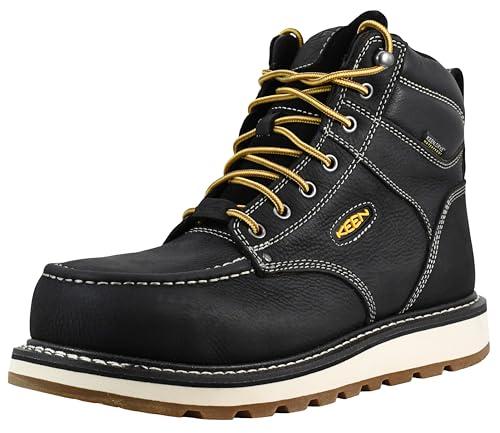
| 1 | KEEN Utility Cincinnati 6" Composite Toe Waterproof Wedge Work Boot A welted wedge with a waterproof membrane and a non-metallic cap — a combination that barely exists anywhere else, and the pick when the floor is flat and wet. | A carbon cap on a welt you can resole | Asymmetrical non-metallic safety toe. KEEN's own page calls it a carbon safety toe and states it weighs 15% less than steel; retailers list the same cap as a composite toeKEEN does not publish a designation string on this model's page. Authorized-retailer listings for the Cincinnati non-metallic toe state it meets or exceeds ASTM F3445-21 and ASTM F2413-18 M I/75 C/75 EH | |
| 2 | 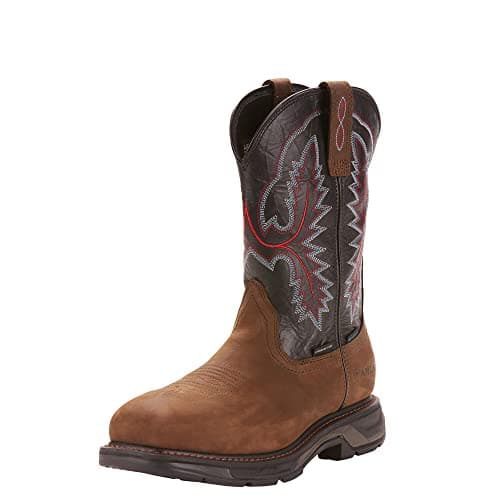 Ariat WorkHog XT Waterproof Carbon Toe Work Boot Ariat builds the WorkHog XT around lateral stability and a wide midfoot platform — the pull-on answer for outdoor work on ground that never sits level. | Lateral stability on ground that is never level | Carbon safety toe, non-metallicASTM F2413 I/C EH SRO on the WorkHog XT Incognito carbon toe, per Ariat's published specification | |
| 3 | 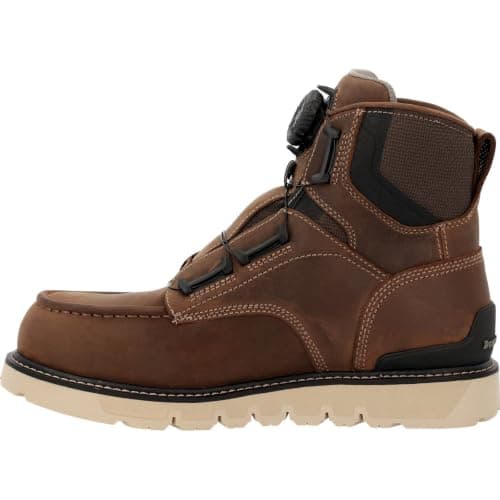 Georgia Boot Carbon Flex 6" BOA Waterproof Carbon Toe Moc-Toe Work Boot (GB00729) A waterproof moc-toe wedge with a carbon cap and a BOA dial instead of laces — retension it with a gloved hand mid-shift, which is the whole argument for a dial. | A dial instead of laces | Ergo-Fit carbon protective toeASTM F2413 protective toe classification; ASTM F2413 electrical hazard classification | |
| 4 | 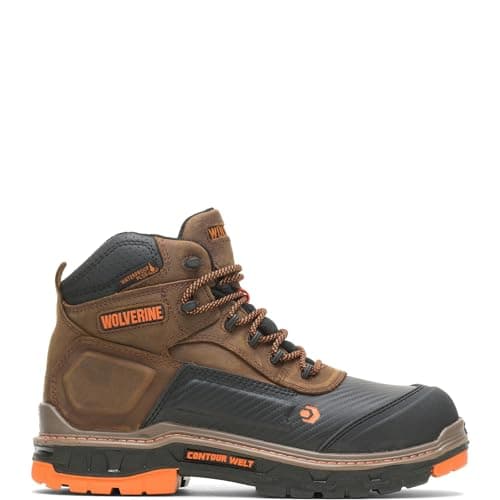 Wolverine Overpass CarbonMAX 6" Composite Toe Waterproof Boot A waterproof CarbonMAX composite toe on a flexible dual-compound outsole — the Overpass is built to move with the foot rather than brace it. | CarbonMAX in a boot built to flex | CarbonMAX composite safety toe, non-metallicASTM F2413 M/I/C EH rated composite toe | |
| 5 | 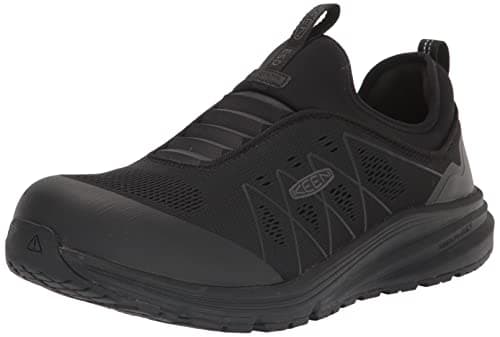 KEEN Utility Vista Energy Shift Carbon-Fiber Toe Work Sneaker A safety-toe work sneaker with a midsole KEEN rates at up to 50% energy return — for warehouse and plant floors where you cover distance rather than terrain. | Budget pick — carbon cap in a work sneaker | Carbon-fiber safety toe, non-metallicKEEN Utility safety toe tested to ASTM F2413-18 M/I/75/C/75; the ESD version adds an electrostatic dissipative outsole |
Tap a row to jump to that boot's full write-up. The price column goes straight to Amazon.
What a carbon fiber toe actually is
A carbon fiber safety toe is a non-metallic cap made from carbon fiber in a resin matrix. Carbon fiber is a composite, so the labels overlap: KEEN calls the cap on the Cincinnati a carbon safety toe while authorized retailers list the same cap as composite, and Wolverine's CarbonMAX is a carbon-reinforced composite. They are describing the same family of material, and carbon fiber toe vs composite toe separates the marketing from the engineering properly.
What matters for compliance is the classification, not the material name. Under ASTM F2413 a protective toe has to survive 75 foot-pounds of impact and 2,500 pounds of compression regardless of what it is made of. Steel, alloy, composite and carbon caps all pass the same test. No cap type is "safer" under the standard.
Why you would choose carbon over steel
Three reasons, in order of how often they actually apply:
Weight. KEEN publishes carbon caps as saving about 15% over steel and aluminium caps as saving about 35%. On a boot you lift twenty thousand times a shift, that is measurable.
Cold. A metal cap conducts heat out of the front of your foot all day. Non-metallic caps do not, which is why cold-weather boots skew composite.
Metal detectors. Airports, foundries, secure sites. The catch is the shank: a carbon cap over a steel shank still sets off a gate, and most makers do not publish shank material.
The trade-off runs the other way on repeated impact. A metal cap deforms and keeps working; a non-metallic cap is engineered around one serious hit and should be retired after it takes one.
The five, on what each maker publishes
| Cap | Published rating | Construction | Waterproof | |
|---|---|---|---|---|
| KEEN Cincinnati 6" | Non-metallic; KEEN calls it carbon, 15% lighter than steel | Retailer listings: ASTM F3445-21 and F2413-18 M I/75 C/75 EH | Goodyear welt — resoleable | KEEN.DRY membrane |
| Ariat WorkHog XT Carbon | Carbon, non-metallic | ASTM F2413 I/C EH SRO on the Incognito carbon toe | Not published as a welt | DRYShield |
| Georgia Carbon Flex BOA | Ergo-Fit carbon | ASTM F2413 protective toe and electrical hazard classifications | Bond welt — not resoleable | Georgia Waterproof System |
| Wolverine Overpass | CarbonMAX composite | ASTM F2413 M/I/C EH | Not published as a welt | Waterproof leather upper |
| KEEN Vista Energy Shift | Carbon fiber, non-metallic | ASTM F2413-18 M/I/75/C/75; ESD version adds a dissipative outsole | Cemented athletic | No |
KEEN Cincinnati — the one you can rebuild
A Goodyear-welted wedge with the KEEN.DRY waterproof breathable membrane, a barnyard-resistant leather upper, a Luftcell air-infused midsole KEEN specifies at nearly 100,000 micro air bubbles per cubic centimeter, and an asymmetrical non-metallic cap the brand describes as carbon and states weighs 15% less than steel.
A welted, waterproof, non-metallic boot barely exists elsewhere in the category, and the welt is what makes it the lead pick: a carbon cap lasts as long as the boot, and on this boot the boot lasts as long as you keep paying for soles.
The honest cons. KEEN does not print a model-specific ASTM designation string on this page — the classification rests on authorized-retailer listings — so if you need a maker-published string for a site induction, this is not it. No published weight, no published width run, and a membrane in a flat wedge is hot in summer. Check which Cincinnati you are buying: there is a 90-degree-heel version that is not a wedge.
Wrong for: hot-weather outdoor work.
Ariat WorkHog XT Carbon — the rough-ground pick
Ariat publishes ASTM F2413 I/C EH SRO for the Incognito carbon toe and builds the boot on the ATS Max platform with an extra-wide midfoot and a dual-density EVA midsole, under DRYShield waterproofing. The design brief is lateral stability: a wide platform resists rolling on ground that never sits level.
The honest cons. That wide platform is a liability in a crawl space or any confined work, and it is one of the more expensive boots here. Not published as welted.
Wrong for: tight indoor work.
Georgia Carbon Flex BOA — the closure
An Ergo-Fit carbon cap on a waterproof moc-toe wedge, with a BOA dial in place of laces, a fiberglass shank — so no metal underfoot either — a Counter Lock heel stabilizer, a published 1.95 lbs at size 10M and both D and EE widths. The case for a dial is narrow and real: you can retension it with a gloved hand mid-shift without stopping, which matters most if your feet swell through the day.
The honest cons. A dial is a mechanical part and an impact can break it, and you cannot bodge a broken dial with what is in the truck. A dial cannot skip an eyelet, so a high instep has no escape route. Bond welt is not a resoleable welt despite the name. Best BOA work boots covers dials across the category.
Wrong for: anyone who relieves a pressure point by lacing around it.
Wolverine Overpass — CarbonMAX, built to flex
A waterproof CarbonMAX composite toe rated ASTM F2413 M/I/C EH, on a dual-compound rubber and PU outsole with a nylon shank and an abrasion-resistant toe overlay. Wolverine builds this boot to move with the foot, which is right for trades that squat, kneel and climb in and out of vehicles.
The honest cons. A flexible boot with a nylon shank is the wrong platform for standing on a rung all day. Not published as welted.
Wrong for: pole and ladder work.
The budget pick
KEEN's Vista Energy Shift is a carbon-fiber-toe work sneaker on the KEEN.ReGEN midsole, which KEEN rates at up to 50% energy return per step, tested to ASTM F2413-18 M/I/75/C/75, with an ESD version listed separately. It was the cheapest carbon-toe product in this registry at the last price refresh, and for warehouse and plant floors where you cover distance on smooth ground it is genuinely the right tool rather than a compromise.
What you give up: it is not waterproof, it is cemented, and the textile upper has no business near welding, scrap or anything that drags. Work boots that feel like sneakers covers the rest of that category.
The shank decides whether you clear a detector
If a metal gate is the reason you want a non-metallic cap, the cap is half the boot. On this page Georgia publishes a fiberglass shank and KEEN publishes midsoles rather than shanks; Wolverine publishes a nylon shank, which is non-metallic. Ariat publishes an EVA midsole on the ATS Max platform without naming a shank.
Ask before you buy, and if nobody will answer, assume there is steel in it. Best composite toe work boots has the wider non-metallic field.
The picks in full
#1 — A carbon cap on a welt you can resole
KEEN Utility Cincinnati 6" Composite Toe Waterproof Wedge Work Boot
A welted wedge with a waterproof membrane and a non-metallic cap — a combination that barely exists anywhere else, and the pick when the floor is flat and wet.
Published specifications
- Toe
- Asymmetrical non-metallic safety toe. KEEN's own page calls it a carbon safety toe and states it weighs 15% less than steel; retailers list the same cap as a composite toe
- Safety rating
- KEEN does not publish a designation string on this model's page. Authorized-retailer listings for the Cincinnati non-metallic toe state it meets or exceeds ASTM F3445-21 and ASTM F2413-18 M I/75 C/75 EH
- Upper
- Barnyard-resistant leather upper
- Outsole
- Oil- and slip-resistant rubber wedge outsole
- Midsole / shank
- KEEN Luftcell air-infused midsole, stated at nearly 100,000 micro air bubbles per cubic centimeter, over a removable dual-density PolyAer insole
- Construction
- Goodyear welt
- Waterproof
- Waterproof — KEEN.DRY breathable membrane
- Insulation
- Not published on this model's page — treat as uninsulated
Specifications read from KEEN product page (Men's Cincinnati 6-inch Waterproof, carbon safety toe), with the Cincinnati collection page for the wedge sole and welt on 2026-11-09. We have not worn this boot.
What works
- Waterproof and resoleable in one wedge, which is close to unique
- KEEN's roomy toe box suits feet that spread by mid-shift
- Barnyard-resistant leather holds up to the chemistry a farm floor throws at it
What doesn't
- KEEN publishes no ASTM designation string on the model page, so the exact classification rests on retailer listings
- No published weight, and a welted waterproof boot is not light
- No insulation, so this is a three-season wedge
Who this is wrong for
Anyone who needs a published, model-specific ASTM string on file for a site induction. The Thorogood and the Carhartt both publish theirs.
Sizing
KEEN lasts run wide through the forefoot and short in the heel. With a narrow heel, lace a heel lock through the top two eyelet pairs rather than sizing down.
#2 — Lateral stability on ground that is never level
Ariat WorkHog XT Waterproof Carbon Toe Work Boot
Ariat builds the WorkHog XT around lateral stability and a wide midfoot platform — the pull-on answer for outdoor work on ground that never sits level.
Published specifications
- Toe
- Carbon safety toe, non-metallic
- Safety rating
- ASTM F2413 I/C EH SRO on the WorkHog XT Incognito carbon toe, per Ariat's published specification
- Upper
- Leather upper with DRYShield waterproof breathable construction
- Outsole
- Ariat work outsole, slip-resistant (SRO on the rated models)
- Midsole / shank
- ATS Max platform with an extra-wide midfoot and a dual-density EVA midsole
- Construction
- Not published as a welt construction
- Waterproof
- Waterproof — DRYShield
- Insulation
- Not insulated
Specifications read from Ariat product page (WorkHog XT waterproof carbon toe) on 2026-09-27. We have not worn this boot.
What works
- Lateral stability is the design brief, and it shows on uneven ground
- Carries an SRO slip designation as well as EH on the rated models
- Pull-on entry with a lacing-free instep
What doesn't
- Ariat publishes the full designation on some WorkHog XT models and not others — check the exact variant
- Wide midfoot platform feels clumsy indoors
- Not resoleable
Who this is wrong for
Tight indoor work in confined spaces. The wide platform that helps on rubble is a hindrance in a crawl space.
Sizing
Ariat runs a touch long for many owners; a half size down is a common report. Because it is a pull-on, size for the instep first.
#3 — A dial instead of laces
Georgia Boot Carbon Flex 6" BOA Waterproof Carbon Toe Moc-Toe Work Boot (GB00729)
A waterproof moc-toe wedge with a carbon cap and a BOA dial instead of laces — retension it with a gloved hand mid-shift, which is the whole argument for a dial.
Published specifications
- Toe
- Ergo-Fit carbon protective toe
- Safety rating
- ASTM F2413 protective toe classification; ASTM F2413 electrical hazard classification
- Upper
- Full-grain leather with a stretch gusset
- Outsole
- Co-molded TPU/PU outsole — heat-, abrasion- and slip-resistant, with flex grooves
- Midsole / shank
- Fiberglass shank with a Counter Lock heel stabilizer and a removable AMP memory-polyurethane insole
- Construction
- Bond welt construction
- Waterproof
- Georgia Waterproof System with a high-performance mesh lining
- Insulation
- Not published
- Widths
- D and EE
- Weight
- 1.95 lbs, size 10M
Specifications read from Georgia Boot product page (Carbon Flex BOA, GB00729) on 2026-09-29. We have not worn this boot.
What works
- A dial you can work with gloves on, and it holds tension evenly
- Carbon cap keeps the weight down and the cold out
- Stretch gusset takes the pressure off the instep that a dial can create
- Published weight, which is more than most brands give you
What doesn't
- The dial is a mechanical part and an impact can break it
- A dial cannot skip an eyelet, so a high instep has no escape route
- Bond welt is not a resoleable construction
Who this is wrong for
Anyone who relieves a pressure point by lacing around it. Even tension is what a dial does, and that is exactly wrong for an unusually high instep.
Sizing
Dial boots feel looser than laces at the same tightness because the pressure is spread. Judge fit by heel hold, not by how snug the top of the foot feels.
#4 — CarbonMAX in a boot built to flex
Wolverine Overpass CarbonMAX 6" Composite Toe Waterproof Boot
A waterproof CarbonMAX composite toe on a flexible dual-compound outsole — the Overpass is built to move with the foot rather than brace it.
Published specifications
- Toe
- CarbonMAX composite safety toe, non-metallic
- Safety rating
- ASTM F2413 M/I/C EH rated composite toe
- Upper
- Premium waterproof leather with an abrasion-resistant toe
- Outsole
- Dual-compound rubber and PU outsole
- Midsole / shank
- Advanced comfort PU midsole with a nylon shank
- Construction
- Not published as a welt construction
- Waterproof
- Waterproof leather upper
- Insulation
- Not insulated
Specifications read from Wolverine product page (Overpass CarbonMAX 6") on 2026-09-27. We have not worn this boot.
What works
- Genuinely flexible for a safety-toe boot
- Waterproof leather rather than a membrane-only claim
- Removable footbed, so an orthotic actually fits
What doesn't
- A nylon shank is not a climbing shank
- PU midsoles eventually crumble with age and disuse
- Not resoleable
Who this is wrong for
Pole and ladder work. A flexible boot with a nylon shank is the wrong platform for standing on a rung all day.
Sizing
The Overpass runs close to true. Because the footbed is removable, fit it with your orthotic in place if you use one — swapping later changes the fit by a half size in feel.
#5 — Budget pick — carbon cap in a work sneaker
KEEN Utility Vista Energy Shift Carbon-Fiber Toe Work Sneaker
A safety-toe work sneaker with a midsole KEEN rates at up to 50% energy return — for warehouse and plant floors where you cover distance rather than terrain.
Published specifications
- Toe
- Carbon-fiber safety toe, non-metallic
- Safety rating
- KEEN Utility safety toe tested to ASTM F2413-18 M/I/75/C/75; the ESD version adds an electrostatic dissipative outsole
- Upper
- Textile and synthetic upper
- Outsole
- Oil- and slip-resistant outsole; ESD outsole on the ESD version
- Midsole / shank
- KEEN.ReGEN midsole, returning up to 50% energy per step, per KEEN
- Construction
- Cemented athletic construction
- Waterproof
- Not waterproof
- Insulation
- Not insulated
Specifications read from KEEN Utility product page (Vista Energy Shift ESD) on 2026-09-27. We have not worn this boot.
What works
- By far the lightest safety-toe option on this list
- ESD version solves a real problem for electronics and plant work
- Athletic flex suits smooth floors and long walking distances
What doesn't
- No ankle support at all
- Textile upper is not a match for abrasion, sparks or sharp debris
- Not waterproof, not resoleable
Who this is wrong for
Anyone on uneven ground, around welding, or handling anything that drags across the upper. This is an indoor smooth-floor shoe.
Sizing
Sneaker sizing, so it feels shorter than a boot in the same number. Leave a thumbnail of room ahead of the longest toe.
Frequently asked questions
Is a carbon fiber toe as strong as steel?
For the ASTM F2413 test, yes — both must survive 75 foot-pounds of impact and 2,500 pounds of compression to carry the classification. The difference is in repeated impact: a metal cap deforms and keeps protecting, while a non-metallic cap is designed around a single serious hit and should be retired after one.
Is carbon fiber lighter than a composite toe?
Usually slightly, because carbon fiber is stiffer per gram, so a thinner cap passes the same test. KEEN publishes about a 15% saving over steel for its carbon caps and about 35% for aluminium. Most makers publish the comparison against steel rather than against other composites.
Will a carbon fiber toe set off a metal detector?
The cap will not, because there is no metal in it. The shank, eyelets, hardware or a puncture plate still can. Check for a published non-metallic shank — Georgia's fiberglass shank and Wolverine's nylon shank qualify — before relying on it at a gate.
Are carbon fiber toe boots good in the cold?
Better than steel, yes. A metal cap conducts heat out of the front of your foot continuously; a carbon or composite cap does not. If you work outdoors in winter, a non-metallic cap is the single cheapest improvement to toe temperature.
Which carbon fiber toe boot can be resoled?
Of the five here, only the KEEN Cincinnati, which is built on a Goodyear welt. Georgia's Carbon Flex uses a bond welt, which despite the name is a cemented construction, and the Ariat, Wolverine and KEEN Vista are not published as welted.
Sources
- ASTM F2413 protective footwear standard — technical summary — Label format, the mandatory I and C designations, and each optional code
- KEEN Utility — aluminum toe collection and ASTM compliance — KEEN's published ASTM F2413-18 M/I/75/C/75 EH designation and the 35%-lighter aluminum claim
- What changed in ASTM F2413-18 — Why the Class 50 tier and the numeric suffix disappeared from the marking
Read next
Carbon Fiber Toe vs Composite Toe
The material question, before you shop the list.
Best Composite Toe Work Boots
The wider non-metallic field, including cheaper picks.
Best Composite Toe Work Boots Under $200
The same field with a hard price ceiling.
Best Alloy Toe Work Boots
The lightest metal cap, if a detector is not your problem.