Soles
Work Boots vs Work Shoes
Same ratings, different failure modes — and the floor decides.
Disclosure: product links on this page go to Amazon. As an Amazon Associate we earn from qualifying purchases, at no extra cost to you. It does not change which boots we recommend or the order they appear in — here is the full disclosure.
Quick picks
| # | Product | Best for | Toe & rating | Price |
|---|---|---|---|---|
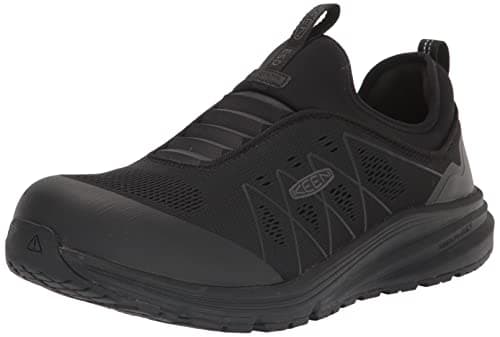
| 1 | KEEN Utility Vista Energy Shift Carbon-Fiber Toe Work Sneaker A safety-toe work sneaker with a midsole KEEN rates at up to 50% energy return — for warehouse and plant floors where you cover distance rather than terrain. | Shoe: distance on smooth floors | Carbon-fiber safety toe, non-metallicKEEN Utility safety toe tested to ASTM F2413-18 M/I/75/C/75; the ESD version adds an electrostatic dissipative outsole | |
| 2 | 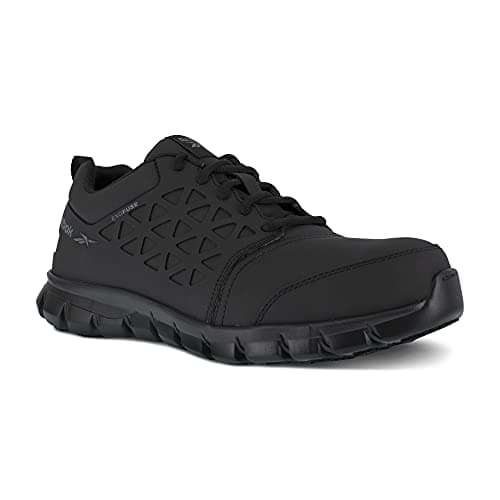 Reebok Work Sublite Cushion Composite Toe Athletic Work Shoe An ASTM F3445 slip-rated composite-toe work shoe with no exposed metal on the upper — built for wet smooth floors, not for terrain. | Shoe: a published slip rating | Composite safety toe, non-metallicASTM F3445 slip-resistant rated; composite toe; static dissipative and puncture-resistant versions listed separately | |
| 3 | 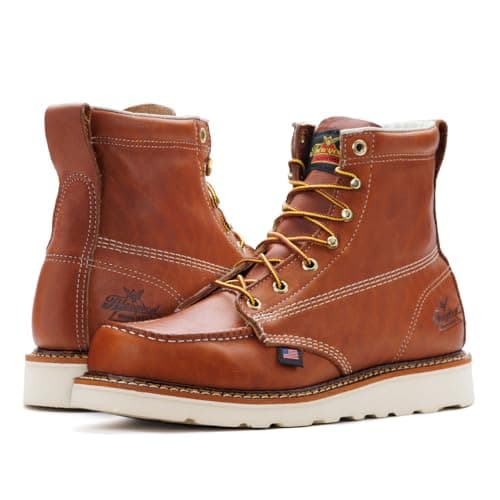 Thorogood American Heritage 6" Moc Toe Safety Toe MAXWear Wedge (804-4200) A Goodyear-welted, USA-built wedge with a steel toe and an EH rating — the default answer for anyone who stands on a flat hard floor and wants a boot that can be resoled. | Boot: standing on flat concrete | Steel safety toe, moc toe shapeASTM F2413-18, EH | |
| 4 | 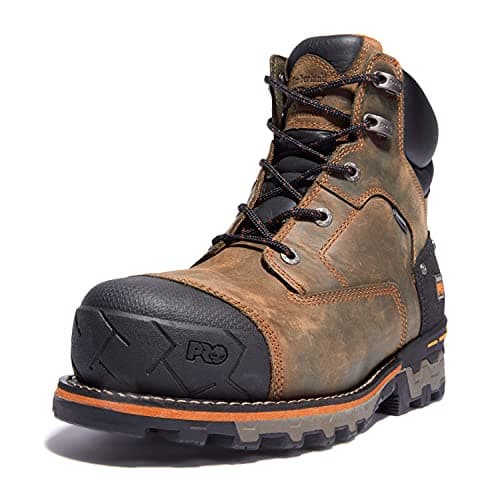 Timberland PRO Boondock 6" Composite Toe Waterproof Work Boot A waterproof composite-toe boot whose all-weather TPU outsole is specifically formulated to stay flexible when it gets cold — which is when most rubber compounds stop gripping. | Boot: wet, cold, uneven ground | Asymmetrical composite safety toe, non-metallicMeets ASTM F2412-18a and ASTM F2413-18 for impact (I) and compression (C); EH protection meets ASTM F2413-18 and ASTM F2892-18; waterproof membrane meets ASTM F1671-07 |
Tap a row to jump to that boot's full write-up. The price column goes straight to Amazon.
The ratings are identical, so ignore them here
ASTM F2413 certifies a protective toe to 75 foot-pounds of impact and 2,500 pounds of compression, and it says nothing about shaft height. A low-cut composite-toe work shoe and an 8-inch steel-toe boot can carry the same I/75 C/75 line, the same EH designation and the same ASTM F3445 slip rating. The Reebok Sublite on this list publishes an ASTM F3445 slip-resistance rating — a named test — in a shoe.
So the compliance question is usually settled before the boot-or-shoe question. Check your site PPE matrix: some employers specify a height (“6-inch minimum”) separately from the cap, and where they do, that is the end of the discussion. ASTM F2413 explained decodes the designation line.
What actually differs
| Work shoe | Work boot | |
|---|---|---|
| ASTM toe rating available | Yes, identical | Yes, identical |
| Ankle support | None | Meaningful from 6 inches up |
| Debris, water and sparks over the top | Enters freely | Excluded to the shaft height |
| Weight | Lightest option in the category | Heavier, and it is at the end of the lever |
| Heat | Coolest option | Warmer, worse with a membrane |
| Sole construction | Almost always cemented | Cemented, direct attach, or welted |
| Resoleable | No | Only if welted or stitchdown |
| Ladder rungs | Flat sole, no heel shelf | Defined heel on most work soles |
Where the shoe genuinely wins
Warehouse and distribution, plant and production floors, food service, retail stockrooms, electronics assembly, light maintenance — anywhere the surface is smooth, level and indoors, and the day is measured in miles walked rather than terrain crossed. A work shoe is lighter at the end of the leg you swing thousands of times a shift, it flexes with the foot, and it runs cooler.
Two specific cases make it more than a comfort preference. Static- sensitive work needs an ESD or static-dissipative outsole, and the athletic work-shoe category is where those live — KEEN lists an ESD version of the Vista Energy Shift. And food service wants the best available slip rating on a wet greasy floor, where lug depth is useless and the compound is everything; NIOSH studied roughly 17,000 food service workers across 226 school districts and recorded a 67% reduction in slip-injury claims after high-rated slip-resistant shoes were issued. Best non-slip work boots for restaurants has that study in full.
Where the boot wins, and it is not close
Three things a low-cut shoe cannot do.
Keep things out. Concrete dust, gravel, hot slag, sawdust, mud and water all come in over the collar of a shoe. Welding is the clearest case — spatter inside a low shoe is a burn you cannot shake out — but anyone who has emptied gravel out of a shoe at lunch knows the problem.
Support the ankle on bad ground. Rubble, trench edges, formwork, roof slopes and loose soil all generate the lateral loads a shoe has nothing to resist. 6-inch vs 8-inch work boots covers how much more you get from each additional inch, which is less than people assume but not zero.
Be resoleable. Work shoes are cemented, universally. A Goodyear-welted or stitchdown boot can be resoled indefinitely, which changes the cost per year rather than the cost per pair — resoling work boots does that arithmetic.
The answer most trades land on
Two pairs, chosen for two different days, which is cheaper than it sounds because each one lasts longer when it is not doing the other one's job. A maintenance tech who spends three days a week on a plant floor and two outside has an obvious split. So does anyone whose summer and winter work look nothing alike.
If you only buy one, buy for your worst day rather than your average one. The boot that is slightly heavy on a warehouse floor is an inconvenience; the shoe that lets slag or gravel in on a bad day is an injury. And if the single pair has to be a boot, a flat wedge sole gets you most of the way to work-shoe comfort on hard floors — wedge sole vs lug sole is that decision.
The other boots people compare against
Three more of these comparisons come up constantly, and each has a different answer. Work boots vs hiking boots is the one most people get wrong, because a hiking boot has no protective toe. Work boots vs cowboy boots covers the western shapes that do carry safety ratings, and work boots vs combat boots explains why military footwear is built for a different job entirely.
The picks in full
#1 — Shoe: distance on smooth floors
KEEN Utility Vista Energy Shift Carbon-Fiber Toe Work Sneaker
A safety-toe work sneaker with a midsole KEEN rates at up to 50% energy return — for warehouse and plant floors where you cover distance rather than terrain.
Published specifications
- Toe
- Carbon-fiber safety toe, non-metallic
- Safety rating
- KEEN Utility safety toe tested to ASTM F2413-18 M/I/75/C/75; the ESD version adds an electrostatic dissipative outsole
- Upper
- Textile and synthetic upper
- Outsole
- Oil- and slip-resistant outsole; ESD outsole on the ESD version
- Midsole / shank
- KEEN.ReGEN midsole, returning up to 50% energy per step, per KEEN
- Construction
- Cemented athletic construction
- Waterproof
- Not waterproof
- Insulation
- Not insulated
Specifications read from KEEN Utility product page (Vista Energy Shift ESD) on 2026-09-27. We have not worn this boot.
What works
- By far the lightest safety-toe option on this list
- ESD version solves a real problem for electronics and plant work
- Athletic flex suits smooth floors and long walking distances
What doesn't
- No ankle support at all
- Textile upper is not a match for abrasion, sparks or sharp debris
- Not waterproof, not resoleable
Who this is wrong for
Anyone on uneven ground, around welding, or handling anything that drags across the upper. This is an indoor smooth-floor shoe.
Sizing
Sneaker sizing, so it feels shorter than a boot in the same number. Leave a thumbnail of room ahead of the longest toe.
#2 — Shoe: a published slip rating
Reebok Work Sublite Cushion Composite Toe Athletic Work Shoe
An ASTM F3445 slip-rated composite-toe work shoe with no exposed metal on the upper — built for wet smooth floors, not for terrain.
Published specifications
- Toe
- Composite safety toe, non-metallic
- Safety rating
- ASTM F3445 slip-resistant rated; composite toe; static dissipative and puncture-resistant versions listed separately
- Upper
- Exofuse water-resistant breathable microfiber with a nylon mesh lining
- Outsole
- Oil-, abrasion-, chemical- and slip-resistant outsole with full-foot flex grooves
- Midsole / shank
- Sublite EVA cushion midsole with rubber heel and forefoot pads
- Construction
- Cemented athletic construction
- Waterproof
- Water-resistant, not waterproof
- Insulation
- Not insulated
Specifications read from Authorized retailer spec page (Steel-Toe-Shoes.com) — Reebok Sublite Cushion RB4039 on 2026-09-27. We have not worn this boot.
What works
- Slip resistance stated against a named ASTM test rather than as a claim
- No exposed metal, which matters in food service and electronics
- Very light
What doesn't
- Water-resistant only
- No ankle support
- Microfiber upper is not built for abrasion
Who this is wrong for
Outdoor construction. This is a smooth-floor shoe; the outsole and upper are both wrong for rubble and grit.
Sizing
Athletic sizing with a wide toe box. Most owners take their normal running-shoe size; if you are between, the extra width usually removes the need to go up.
#3 — Boot: standing on flat concrete
Thorogood American Heritage 6" Moc Toe Safety Toe MAXWear Wedge (804-4200)
A Goodyear-welted, USA-built wedge with a steel toe and an EH rating — the default answer for anyone who stands on a flat hard floor and wants a boot that can be resoled.
Published specifications
- Toe
- Steel safety toe, moc toe shape
- Safety rating
- ASTM F2413-18, EH
- Upper
- Tobacco full-grain American leather, unlined
- Outsole
- MAXWear Wedge slip-resistant outsole
- Midsole / shank
- Rubber midsole with composite shank
- Construction
- Goodyear storm welt
- Waterproof
- Not waterproof
- Insulation
- Not insulated
- Widths
- D and EE, sizes 7-14 in both widths
- Weight
- Not published on the manufacturer page
- Made in
- Made in USA with USA and globally sourced components
Specifications read from Thorogood product page (804-4200) on 2026-09-27. We have not worn this boot.
What works
- Goodyear storm welt is a resoleable construction, not a disposable one
- Flat wedge spreads load evenly on concrete instead of concentrating it under a heel
- Unlined upper breaks in to the foot rather than around a liner
- EE width is stocked across the whole size run, not just the middle
What doesn't
- Not waterproof and not insulated — the unlined upper soaks
- A flat wedge gives up bite on mud, gravel and ladder rungs
- Manufacturer publishes no weight figure, so weight comparisons are guesswork
Who this is wrong for
Anyone working outdoors on soft or uneven ground, or in standing water. The wedge has no lugs to bite and the unlined upper is not waterproof.
Sizing
Thorogood's moc-toe last is widely reported to run large; owner reviews consistently suggest going a half size down from a measured Brannock length. D and EE are both stocked, so take the width rather than sizing up for room.
#4 — Boot: wet, cold, uneven ground
Timberland PRO Boondock 6" Composite Toe Waterproof Work Boot
A waterproof composite-toe boot whose all-weather TPU outsole is specifically formulated to stay flexible when it gets cold — which is when most rubber compounds stop gripping.
Published specifications
- Toe
- Asymmetrical composite safety toe, non-metallic
- Safety rating
- Meets ASTM F2412-18a and ASTM F2413-18 for impact (I) and compression (C); EH protection meets ASTM F2413-18 and ASTM F2892-18; waterproof membrane meets ASTM F1671-07
- Upper
- Leather upper with a waterproof membrane
- Outsole
- All-weather TPU outsole, formulated to stay flexible in variable weather; slip-, oil- and abrasion-resistant
- Midsole / shank
- Not published as a shank specification
- Construction
- Not published as a welt construction
- Waterproof
- Waterproof, membrane meets ASTM F1671-07
- Insulation
- Not insulated in this version; Timberland PRO also lists a 600g insulated Boondock
- Weight
- Not published on the manufacturer page
Specifications read from Timberland PRO Boondock composite toe specifications (Timberland PRO product listing) on 2026-09-27. We have not worn this boot.
What works
- The cold-weather outsole claim is specific and testable, not marketing mush
- Composite toe does not conduct cold into the toes
- Waterproofing is stated against a named ASTM test method
What doesn't
- Well known among owners as a heavy boot for its class
- A membrane plus a thick outsole is a warm combination in summer
- Not a resoleable construction
Who this is wrong for
Anyone counting grams. If weight is your first criterion, a composite-toe work hiker will be noticeably lighter.
Sizing
The Boondock's toe box is generous but the instep is snug; owners with a high instep frequently report needing a wide. Fit it with the insole you intend to use.
Frequently asked questions
Are work shoes as safe as work boots?
For toe protection, yes — ASTM F2413 says nothing about shaft height, so a low-cut safety shoe and an 8-inch boot can carry identical I/75 C/75 and EH designations. What a shoe cannot do is support the ankle on uneven ground or keep debris, water and hot spatter from coming in over the collar.
Can I wear work shoes instead of work boots on a construction site?
Only if your site PPE matrix allows it. Some employers specify a minimum shaft height separately from the cap, and where they do, a shoe is non-compliant regardless of its ratings. Even where it is allowed, rubble, trench edges and dropped debris are the conditions a low-cut shoe handles worst.
Are work shoes better for standing all day?
On a smooth flat indoor floor, often yes: they are lighter, flex with the foot and run cooler. The things that actually decide all-day comfort are the footbed, the midsole and whether the sole spreads load evenly, and a flat wedge-soled boot competes directly with a work shoe on all three.
What is the difference between a safety shoe and a safety boot?
Shaft height, and everything that follows from it: ankle support, debris exclusion, weight, heat, and sole construction. Safety shoes are almost universally cemented and therefore not resoleable, while boots are available welted. The toe cap and its rating can be identical in both.
Sources
- ASTM F2413 protective footwear standard — technical summary — Label format, the mandatory I and C designations, and each optional code
- Reebok Work Sublite Cushion — ASTM F3445 slip-resistance rating — Slip resistance stated against a named ASTM test method
- NIOSH — Does Slip-Resistant Footwear Reduce Slips, Trips, and Falls in Food Service? — ~17,000 food service workers across 226 school districts; a 67% reduction in slip-injury claims after 5-star slip-rated shoes were issued
- OSHA 29 CFR 1910.136 — Foot protection — The federal rule itself: when protective footwear is required, and which consensus standards it accepts
Read next
6-Inch vs 8-Inch Work Boots
Once you have chosen a boot, how tall it should be.
Work Boots That Feel Like Sneakers
If you want the shoe's comfort without giving up the shaft.
Best Lightweight Work Boots
The boots that close most of the weight gap.
Wedge Sole vs Lug Sole
The sole decision that matters more than height on a flat floor.