Trades
Best Work Boots for Factory Workers
A flat floor with hazards on it — which is a different problem from a warehouse.
Disclosure: product links on this page go to Amazon. As an Amazon Associate we earn from qualifying purchases, at no extra cost to you. It does not change which boots we recommend or the order they appear in — here is the full disclosure.
Quick picks
| # | Product | Best for | Toe & rating | Price |
|---|---|---|---|---|
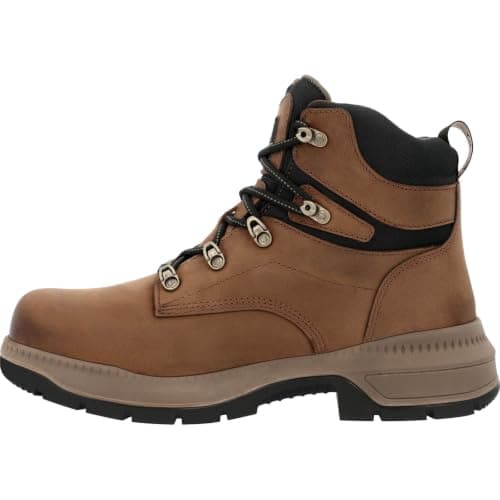
| 1 | Rocky Worksmart Composite Toe Internal MET Guard Waterproof Work Boot An internal metatarsal guard inside a waterproof composite-toe boot — Mt-class protection without the external bulge that catches on everything. | Met protection you can still kneel in | Composite safety toe with an internal metatarsal guardComposite safety toe with internal metatarsal protection; Rocky lists ASTM F2413 compliance on the Worksmart line | |
| 2 | 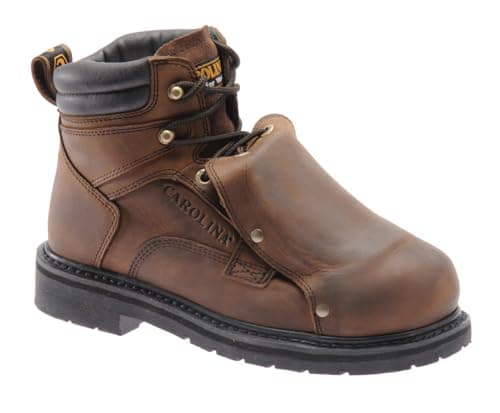 Carolina Metpro 6" Wide Steel Toe External Met Guard (599) A welted steel toe with a leather-wrapped external met guard on a heat-resisting Vibram outsole — the heaviest-duty combination here, and one of the few met-guard boots that publishes the Mt class, the EH test and the outsole's heat rating together. | Heavy repeated impact, 500°F outsole | Steel safety toe cap behind a heavy plastic, dense-foam-lined external metatarsal guardASTM F2413-18 safety toe; ASTM F2413-18 Class Mt75 metatarsal impact resistance; electrical-hazard rated, tested to withstand 18,000 volts at 60Hz for one minute | |
| 3 | 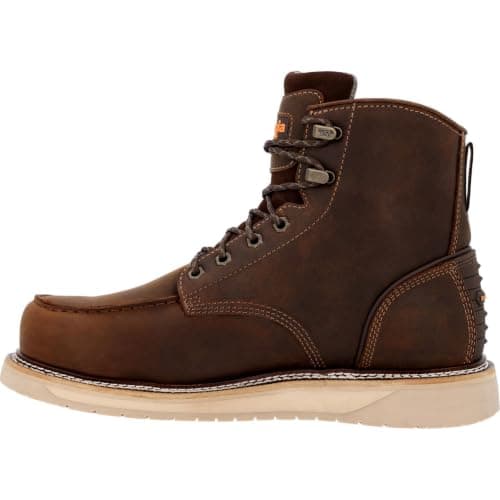 Georgia Boot AMP LT Wedge Composite Toe Waterproof Work Boot (GB00592) A waterproof composite-toe wedge whose SPR leather is specified against named caustics — the pick where the floor is flat and the spills are chemical. | Chemical splash on a flat floor | Ergo-Fit composite toeMeets ASTM F2413 Protective Toe Classification and ASTM F2413 Electrical Hazard Classification | |
| 4 | 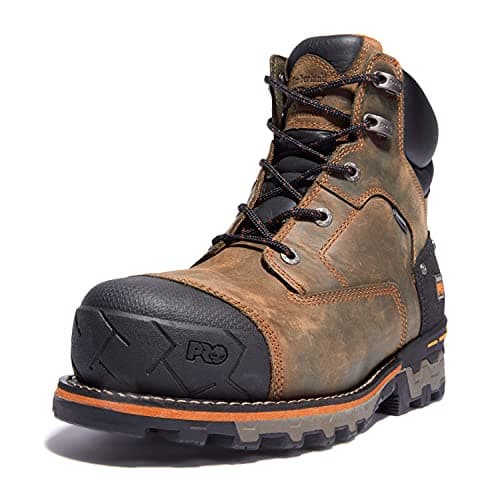 Timberland PRO Boondock 6" Composite Toe Waterproof Work Boot A waterproof composite-toe boot whose all-weather TPU outsole is specifically formulated to stay flexible when it gets cold — which is when most rubber compounds stop gripping. | The fullest published spec sheet | Asymmetrical composite safety toe, non-metallicMeets ASTM F2412-18a and ASTM F2413-18 for impact (I) and compression (C); EH protection meets ASTM F2413-18 and ASTM F2892-18; waterproof membrane meets ASTM F1671-07 | |
| 5 | 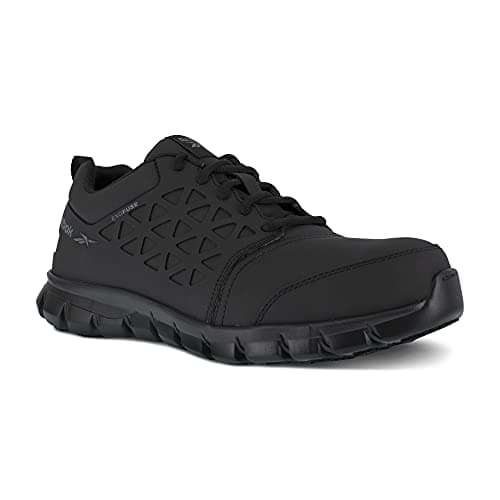 Reebok Work Sublite Cushion Composite Toe Athletic Work Shoe An ASTM F3445 slip-rated composite-toe work shoe with no exposed metal on the upper — built for wet smooth floors, not for terrain. | Light assembly work, slip-rated | Composite safety toe, non-metallicASTM F3445 slip-resistant rated; composite toe; static dissipative and puncture-resistant versions listed separately |
Tap a row to jump to that boot's full write-up. The price column goes straight to Amazon.
Why this is not the warehouse answer
Warehouse and factory get recommended the same boots and they should not be. A warehouse is a distance problem: a flat floor, no hazards to speak of, and ten miles a shift. The right answer there is the lightest compliant boot you can find.
A production floor is a standing problem with hazards layered on top. You cover less ground, but there is material moving, machinery with pinch points, metal swarf underfoot, oils and coolants on the floor, and in many plants a static-control requirement. The boot has to answer those and then be comfortable for eight hours in one place. The warehouse page is the right one if your job is genuinely just distance.
Start from the hazard assessment, not the boot
OSHA's foot protection rule at 29 CFR 1910.136 requires protective footwear where there is a danger of foot injury from falling or rolling objects, objects piercing the sole, or exposure to electrical hazards. The employer does the assessment; what you can do is make sure the boot you buy actually carries the designation that assessment implies.
| Hazard on your floor | What to specify | Pick here |
|---|---|---|
| Something can land on the instep | Mt designation — metatarsal protection under ASTM F2413 | Rocky Worksmart internal MET; Carolina Metpro external |
| Repeated heavy impact or hot material | Steel cap plus a heat-rated outsole | Carolina Metpro — Vibram rated to a minimum 500°F |
| Oils, coolants, caustics on the floor | Named chemical and slip resistance | Georgia AMP LT — SPR leather specified against named caustics |
| Wet or smooth floor | ASTM F3445 slip rating, not a marketing phrase | Reebok Sublite Cushion — F3445 rated |
| Live or energised equipment | EH designation | Timberland PRO Boondock — EH to F2413-18 and F2892-18 |
| Static-sensitive assembly | SD (static dissipative) — a different property entirely | KEEN's ESD version of the Vista Energy Shift |
Met guards: internal or external
A metatarsal guard covers the instep, which the toe cap does not. Under ASTM F2413 it is an optional Mt designation with its own impact test, and it is the single most under-specified feature in manufacturing, because the injuries it prevents — something landing between the toes and the ankle — are exactly the ones a toe cap misses.
The choice between internal and external is practical. An external guard is visible, which some employers require precisely so it can be checked from across the floor; Timberland PRO and Carolina both build them. Rocky's internal version flexes better for kneeling and climbing, and does not catch on things. Carolina is one of the few makers to publish the Mt class explicitly — Mt75 on the Metpro — alongside the EH test condition and the outsole heat rating. Metatarsal guard boots covers the designation in detail.
SD is not EH, and plants confuse them constantly
These two designations are opposites and buying the wrong one is a real problem. EH resists current passing through the sole; it is protection for the wearer near energised equipment. SD, static dissipative, deliberately drains static charge from the wearer to ground at a controlled rate — it is protection for the product, in electronics assembly, and for the environment in some chemical plants.
If your plant specifies ESD footwear, an EH-rated boot does not satisfy it and may actively fail the floor test. KEEN lists an ESD version of the Vista Energy Shift with a dissipative outsole, which is the kind of explicit variant to look for. What EH rated means sets out the difference properly.
Then solve the standing
NIOSH's review of prolonged standing at work reports consistent increases in low back pain, physical fatigue, muscle pain and leg swelling, with clear detrimental effects from around three hours of standing onward and an association with roughly double the risk of sick leave. Concrete makes it worse because it returns the full impact of every step.
Two things help on a fixed station. A flat wedge outsole spreads load across the whole footprint rather than concentrating it at a heel breast — Georgia's AMP LT is the wedge here, and it happens to be the one with the chemical-resistance specification. And a real insole instead of the thin factory foam most mid-priced boots ship with. Best work boots for standing all day and best insoles for work boots both go deeper than there is room for here.
The swarf problem
Machine shops and fabrication floors put metal chips and offcuts on the ground, and they embed in outsoles. Two consequences follow. A chip working through the sole is a puncture injury, which is what the PR designation and puncture-resistant insoles address — Superfeet's Work PR insole is tested to ASTM F2413 and EN ISO 22568-4:2021 Type PS, which is an unusually specific claim for an aftermarket insole. And embedded metal compromises an EH rating, because it is a conductive path the maker never certified.
Practical habit: check your outsoles weekly and pick out anything metallic. It takes two minutes and it is the difference between a rating that still means something and one that does not.
What to buy, in order
Get the mandatory designations from your employer first — Mt, EH, SD, PR are all optional codes and only your plant knows which apply. Then choose on floor surface: wedge for flat and dry, slip-rated outsole for wet or oily, lugged only if you are in and out of a yard. Then fit, which decides whether you can stand in them. Then weight, last — it matters less here than it does for a warehouse picker. ASTM F2413 explained decodes every code on the label.
The picks in full
#1 — Met protection you can still kneel in
Rocky Worksmart Composite Toe Internal MET Guard Waterproof Work Boot
An internal metatarsal guard inside a waterproof composite-toe boot — Mt-class protection without the external bulge that catches on everything.
Published specifications
- Toe
- Composite safety toe with an internal metatarsal guard
- Safety rating
- Composite safety toe with internal metatarsal protection; Rocky lists ASTM F2413 compliance on the Worksmart line
- Upper
- Leather upper with a waterproof membrane
- Outsole
- Rocky work outsole
- Midsole / shank
- Not published on the manufacturer page
- Construction
- Not published as a welt construction
- Waterproof
- Waterproof
- Insulation
- Not insulated
Specifications read from Rocky Boots product page (Worksmart comp toe internal MET guard waterproof) on 2026-09-27. We have not worn this boot.
What works
- Internal guard flexes with the foot — you can kneel and climb in it
- Nothing external to catch on a rung
- Non-metallic cap
What doesn't
- Harder for a supervisor to verify at a glance than an external guard
- The guard takes up instep volume
- Limited published spec detail
Who this is wrong for
Sites that require visible met protection. Some employers specify an external guard precisely because it can be seen.
Sizing
An internal met guard fills the instep. If you have a high-volume foot, expect to need a wide — and lace the instep loosely for the first week.
#2 — Heavy repeated impact, 500°F outsole
Carolina Metpro 6" Wide Steel Toe External Met Guard (599)
A welted steel toe with a leather-wrapped external met guard on a heat-resisting Vibram outsole — the heaviest-duty combination here, and one of the few met-guard boots that publishes the Mt class, the EH test and the outsole's heat rating together.
Published specifications
- Toe
- Steel safety toe cap behind a heavy plastic, dense-foam-lined external metatarsal guard
- Safety rating
- ASTM F2413-18 safety toe; ASTM F2413-18 Class Mt75 metatarsal impact resistance; electrical-hazard rated, tested to withstand 18,000 volts at 60Hz for one minute
- Upper
- Dark brown Crazy Horse leather upper, Taibrelle lined
- Outsole
- Vibram heat-resisting rubber outsole, rated heat-resistant to a minimum of 500°F
- Midsole / shank
- Steel shank; removable AG7 polyurethane footbed
- Construction
- Welt construction
- Waterproof
- Not published on the product page — treat this model as not waterproof
- Insulation
- Not published on the product page — treat as uninsulated
- Widths
- D and 2E, sizes 7-14
Specifications read from Carolina Shoe product page (Metpro 6" wide steel toe external met guard, 599) on 2026-10-16. We have not worn this boot.
What works
- Steel handles repeated heavy impact better than any composite
- Publishes the Mt class, the EH test condition and the outsole heat rating — most met-guard listings publish none of the three
- Welt construction, so the heaviest-duty boot here is also the one you can have resoled
What doesn't
- Heavy, and it feels it by hour ten
- An external guard catches on ladder rungs and is awkward to kneel in
- No waterproof membrane published, so this is a dry-site boot
Who this is wrong for
Anyone who walks long distances or works in standing water. This is a boot for standing in one hazardous dry place, not covering ground.
Sizing
Between the steel cap and the guard, the front half of this boot has the least spare volume of anything here, and the guard changes how the instep laces: loose over the guard, tight at the ankle. Take the 2E before you take a longer size. Fit it in the afternoon, when your feet are at their largest.
#3 — Chemical splash on a flat floor
Georgia Boot AMP LT Wedge Composite Toe Waterproof Work Boot (GB00592)
A waterproof composite-toe wedge whose SPR leather is specified against named caustics — the pick where the floor is flat and the spills are chemical.
Published specifications
- Toe
- Ergo-Fit composite toe
- Safety rating
- Meets ASTM F2413 Protective Toe Classification and ASTM F2413 Electrical Hazard Classification
- Upper
- Abrasion-resistant SPR leather, stated to resist caustic alkali, sulfuric acid, calcium hydroxide, potassium phosphate and caustic potash
- Outsole
- Carbo-Tec rubber outsole over dual-density EVA — heat, chemical, abrasion and slip resistant
- Midsole / shank
- Cushioning EVA midsole with a fiberglass shank
- Construction
- Not published as a welt construction
- Waterproof
- Waterproof — Georgia Waterproof System
- Insulation
- Not insulated
Specifications read from Georgia Boot product page (AMP LT Wedge composite toe, GB00592) on 2026-09-27. We have not worn this boot.
What works
- Names the specific chemicals the upper resists instead of saying chemical-resistant
- Fiberglass shank keeps the whole boot non-metallic underfoot
- Wedge sole plus waterproofing is a rare combination
What doesn't
- Memory-foam insoles pack down faster than PU
- EVA midsole compresses over a year of hard use
- Not resoleable
Who this is wrong for
Cold-weather outdoor work. A dual-density EVA midsole stiffens in the cold and this boot has no insulation.
Sizing
Georgia's AMP LT last is medium-volume. If you swap the memory-foam insole for a firmer orthotic you will gain a little room, which can make a snug pair workable.
#4 — The fullest published spec sheet
Timberland PRO Boondock 6" Composite Toe Waterproof Work Boot
A waterproof composite-toe boot whose all-weather TPU outsole is specifically formulated to stay flexible when it gets cold — which is when most rubber compounds stop gripping.
Published specifications
- Toe
- Asymmetrical composite safety toe, non-metallic
- Safety rating
- Meets ASTM F2412-18a and ASTM F2413-18 for impact (I) and compression (C); EH protection meets ASTM F2413-18 and ASTM F2892-18; waterproof membrane meets ASTM F1671-07
- Upper
- Leather upper with a waterproof membrane
- Outsole
- All-weather TPU outsole, formulated to stay flexible in variable weather; slip-, oil- and abrasion-resistant
- Midsole / shank
- Not published as a shank specification
- Construction
- Not published as a welt construction
- Waterproof
- Waterproof, membrane meets ASTM F1671-07
- Insulation
- Not insulated in this version; Timberland PRO also lists a 600g insulated Boondock
- Weight
- Not published on the manufacturer page
Specifications read from Timberland PRO Boondock composite toe specifications (Timberland PRO product listing) on 2026-09-27. We have not worn this boot.
What works
- The cold-weather outsole claim is specific and testable, not marketing mush
- Composite toe does not conduct cold into the toes
- Waterproofing is stated against a named ASTM test method
What doesn't
- Well known among owners as a heavy boot for its class
- A membrane plus a thick outsole is a warm combination in summer
- Not a resoleable construction
Who this is wrong for
Anyone counting grams. If weight is your first criterion, a composite-toe work hiker will be noticeably lighter.
Sizing
The Boondock's toe box is generous but the instep is snug; owners with a high instep frequently report needing a wide. Fit it with the insole you intend to use.
#5 — Light assembly work, slip-rated
Reebok Work Sublite Cushion Composite Toe Athletic Work Shoe
An ASTM F3445 slip-rated composite-toe work shoe with no exposed metal on the upper — built for wet smooth floors, not for terrain.
Published specifications
- Toe
- Composite safety toe, non-metallic
- Safety rating
- ASTM F3445 slip-resistant rated; composite toe; static dissipative and puncture-resistant versions listed separately
- Upper
- Exofuse water-resistant breathable microfiber with a nylon mesh lining
- Outsole
- Oil-, abrasion-, chemical- and slip-resistant outsole with full-foot flex grooves
- Midsole / shank
- Sublite EVA cushion midsole with rubber heel and forefoot pads
- Construction
- Cemented athletic construction
- Waterproof
- Water-resistant, not waterproof
- Insulation
- Not insulated
Specifications read from Authorized retailer spec page (Steel-Toe-Shoes.com) — Reebok Sublite Cushion RB4039 on 2026-09-27. We have not worn this boot.
What works
- Slip resistance stated against a named ASTM test rather than as a claim
- No exposed metal, which matters in food service and electronics
- Very light
What doesn't
- Water-resistant only
- No ankle support
- Microfiber upper is not built for abrasion
Who this is wrong for
Outdoor construction. This is a smooth-floor shoe; the outsole and upper are both wrong for rubble and grit.
Sizing
Athletic sizing with a wide toe box. Most owners take their normal running-shoe size; if you are between, the extra width usually removes the need to go up.
Frequently asked questions
What boots do factory workers need?
It depends on the plant's hazard assessment, but the common set is an ASTM F2413 safety toe, an EH rating near energised equipment, a metatarsal guard where objects can land on the instep, and a slip-rated outsole for oily or wet floors. Static-sensitive assembly needs SD footwear instead of EH, which is a different designation entirely.
Are steel toe boots required in a factory?
Not automatically. OSHA 29 CFR 1910.136 requires protective footwear where there is a danger of injury from falling or rolling objects, objects piercing the sole, or electrical hazards — the employer performs that assessment. Many plants require safety toes across the floor as a blanket policy regardless.
What is the difference between EH and SD boots?
They are opposite properties. EH resists current passing through the sole, protecting the wearer near live equipment. SD, static dissipative, drains static from the wearer to ground at a controlled rate, protecting sensitive products and environments. An EH boot does not satisfy an ESD floor requirement.
Do I need a metatarsal guard in a factory?
If anything on your floor can land on the top of your foot — stock, dies, castings, tooling — then yes, because the toe cap covers only the toes. Ask whether your employer specifies an internal or external guard: external ones are visible for inspection, internal ones flex better if you kneel or climb.
Are wedge soles good for factory floors?
On a flat, dry production floor, yes. A wedge spreads load across the whole footprint instead of concentrating it under a heel breast, which is what you want when you stand in one place. On an oily or wet floor, prioritise a published ASTM F3445 slip rating over the sole profile.
Sources
- OSHA 29 CFR 1910.136 — Foot protection — The federal rule itself: when protective footwear is required, and which consensus standards it accepts
- ASTM F2413 protective footwear standard — technical summary — Label format, the mandatory I and C designations, and each optional code
- NIOSH Science Blog — Prolonged Standing at Work — NIOSH's own summary of the evidence on prolonged standing
- Reebok Work Sublite Cushion — ASTM F3445 slip-resistance rating — Slip resistance stated against a named ASTM test method
Read next
Metatarsal Guard Boots
The Mt designation, and internal versus external guards.
What EH Rated Means on Work Boots
The rating most plants require, and the SD confusion.
Best Work Boots for Standing All Day
The other half of the factory problem.
ASTM F2413 Explained
The rating your trade actually needs, and what each code on the label certifies.
Work Boot Sizing Guide
Get the fit right before you spend money — most boot complaints are fit.
How to Break In Work Boots
What to do in the two weeks before your first full shift in a new pair.