Trades
Best Work Boots for Roofing
Everything about this boot is the outsole. The rest is secondary.
Disclosure: product links on this page go to Amazon. As an Amazon Associate we earn from qualifying purchases, at no extra cost to you. It does not change which boots we recommend or the order they appear in — here is the full disclosure.
Quick picks
| # | Product | Best for | Toe & rating | Price |
|---|---|---|---|---|
| 1 |  Carhartt Ground Force Waterproof 6" Composite Toe Work Boot A waterproof composite toe with a heat-rated outsole and an APMA-accepted footbed — the pick when arch support is the deciding factor. | ASTM F3445 slip rating | Composite safety toe — lightweight, non-metallic, non-conductiveComposite safety toe meeting ASTM F2413-24 EH; outsole meets ASTM F3445-24 SR | |
| 2 |  BRUNT The Perkins Waterproof Composite Toe Work Boot The Perkins swaps the Marin's profile for a defined 90-degree heel — the version to buy if you spend the day on ladders, scaffolding or roof edges. | 90° heel on a pitch | Composite safety toe, non-metallicComposite safety toe with electrical hazard (EH) protection; slip- and oil-resistant | |
| 3 |  Danner Quarry USA 8" Alloy Toe Work Boot A USA-built 8-inch boot with an alloy toe, a 90-degree heel and a non-linear lug pattern designed to shed debris rather than pack it. | Debris-shedding lug pattern | Alloy safety toe — a lighter alternative to steelMeets ASTM F2413 for impact and compression; non-conductive soles meet ASTM F2413 for electrical hazard (EH) resistance in dry conditions | |
| 4 | KEEN Utility Flint II Steel Toe Work Boot KEEN's work-hiker with a steel toe, EH-rated outsole and siping cut specifically for slick surfaces — a light boot for trades that walk all day. | Siped outsole, low weight | Steel safety toeASTM F2413-18 M/I/75/C/75 with EH (KEEN Utility safety-toe standard); EH-rated outsole with siping for traction on slick or wet surfaces | |
| 5 | Timberland PRO Boondock 6" Composite Toe Waterproof Work Boot A waterproof composite-toe boot whose all-weather TPU outsole is specifically formulated to stay flexible when it gets cold — which is when most rubber compounds stop gripping. | Cold and frosted mornings | Asymmetrical composite safety toe, non-metallicMeets ASTM F2412-18a and ASTM F2413-18 for impact (I) and compression (C); EH protection meets ASTM F2413-18 and ASTM F2892-18; waterproof membrane meets ASTM F1671-07 |
Tap a row to jump to that boot's full write-up. The price column goes straight to Amazon.
What a pitched roof demands
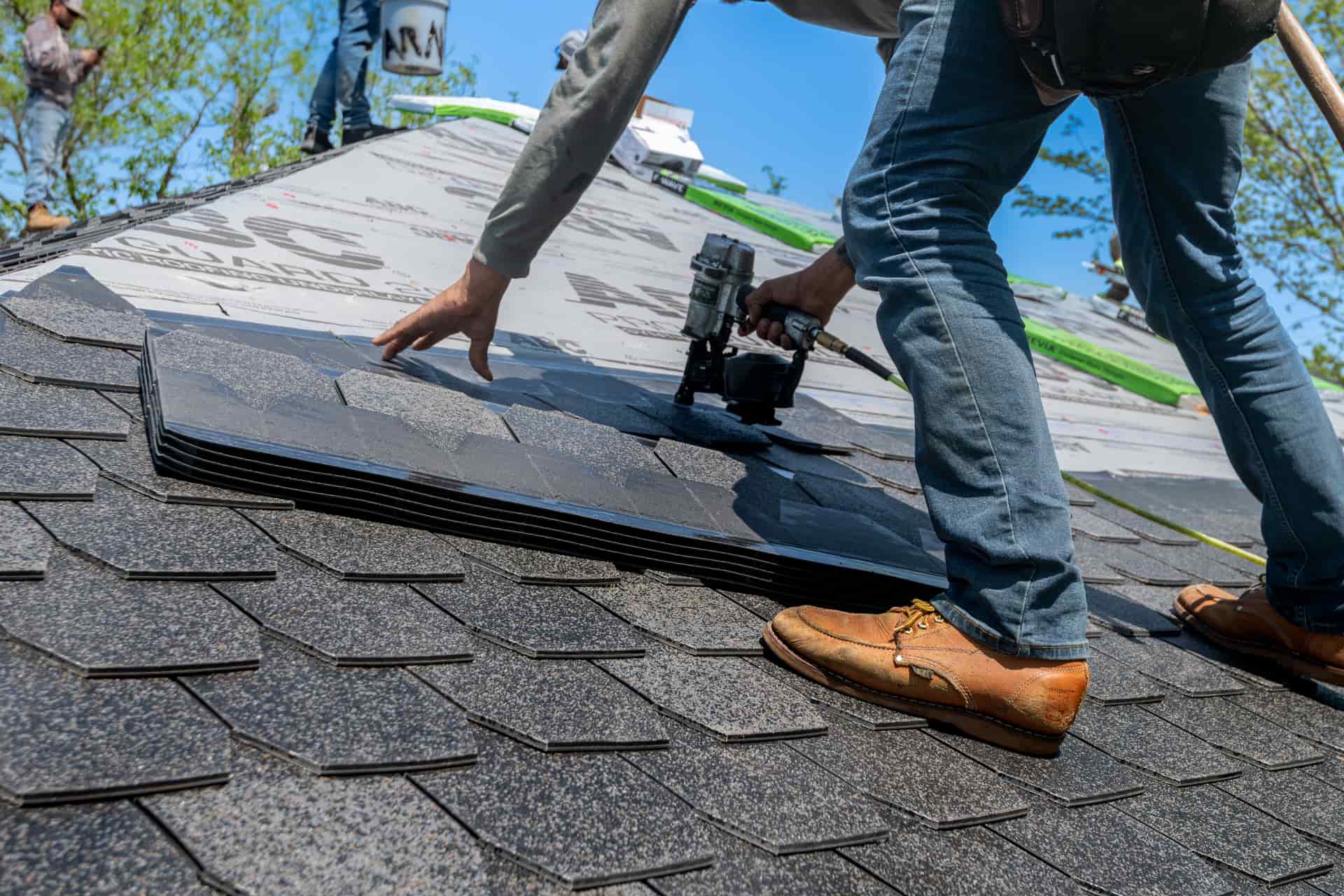
Contact area under load. On a slope, your sole meets the deck at an angle, and a stiff sole contacts only at its edge. A boot that flexes keeps more rubber down. That is why the boots that work best on roofs are often the flexible ones, which is the opposite of what most “heavy duty” marketing suggests.
A named slip designation. ASTM F3445 sets a minimum coefficient of friction of 0.40 in wet and dry conditions and 0.33 in oily-wet conditions. A boot that publishes an SR or SRO designation has been tested; a boot that says “superior traction” has not.
A heel you can hook. Roof jacks, battens and ridge boards all give you something to catch, and a defined 90-degree heel breast catches it where a wedge simply slides over. This is the one place a wedge sole — excellent on concrete — is genuinely the wrong tool.
The granule problem
Loose asphalt granules on a finished surface are the single most common cause of a slip on a roof, and no outsole eliminates them. What an outsole can do is shed them rather than pack them into the tread, which is why Danner specifies a non-linear lug pattern for debris release on the Quarry USA. A tread packed solid with granules is a smooth sole.
Practically: clear your soles before you step onto a pitch, and again whenever you have been walking in tear-off debris. It is a two-second habit that does more than any boot choice.
Hot roofs
A black roof in July is a heat problem as much as a traction one. Two things follow. An outsole compound soft enough to grip will also wear faster on hot abrasive shingle, so expect shorter outsole life than the same boot on a job site. And an uninsulated, non-membrane boot is markedly more comfortable up there than a waterproof one — see hot-weather boots.
What to look for
- An SR or SRO designation against ASTM F3445.
- A defined heel breast, not a wedge.
- A tread that sheds debris rather than one with deep square voids that pack solid.
- A flexible sole so more rubber stays on the deck at an angle.
- Six inches, and light. You climb a ladder dozens of times a day carrying material.
- Breathability over waterproofing unless you work through winter — a roof in summer is brutal in a membrane boot.
The picks in full
Illustrative category photo — not this model#1 — ASTM F3445 slip rating
Carhartt Ground Force Waterproof 6" Composite Toe Work Boot
A waterproof composite toe with a heat-rated outsole and an APMA-accepted footbed — the pick when arch support is the deciding factor.
Published specifications
- Toe
- Composite safety toe — lightweight, non-metallic, non-conductive
- Safety rating
- Composite safety toe meeting ASTM F2413-24 EH; outsole meets ASTM F3445-24 SR
- Upper
- Leather upper with Storm Defender waterproof breathable protection and FastDry lining
- Outsole
- Oil- and slip-resistant non-marking rubber lug outsole with a defined heel and ladder-lock grooves; heat-resistant to 300°C / 572°F
- Midsole / shank
- Carhartt LWD midsole with a nylon shank
- Construction
- Not published as a welt construction
- Waterproof
- Waterproof — Storm Defender
- Insulation
- Not insulated in this model
Specifications read from Carhartt product page (Ground Force waterproof 6" composite toe) on 2026-09-27. We have not worn this boot.
What works
- Both an EH and an SR designation, each against a named ASTM standard
- APMA acceptance is third-party, not marketing
- Ladder-lock grooves are a specific feature for a specific job
What doesn't
- Not resoleable
- Lug outsole tracks debris onto finished floors
- No published weight
Who this is wrong for
Finished-floor work. A deep lug outsole carries grit into rooms you are being paid not to damage.
Sizing
Carhartt's Ground Force last is fairly generous. If you plan to use your own orthotic, pull the INSITE footbed out first — the two together will crowd the boot.
Illustrative category photo — not this model#2 — 90° heel on a pitch
BRUNT The Perkins Waterproof Composite Toe Work Boot
The Perkins swaps the Marin's profile for a defined 90-degree heel — the version to buy if you spend the day on ladders, scaffolding or roof edges.
Published specifications
- Toe
- Composite safety toe, non-metallic
- Safety rating
- Composite safety toe with electrical hazard (EH) protection; slip- and oil-resistant
- Upper
- Waterproof leather upper
- Outsole
- BRUNT rubber outsole with a 90° heel — high-heat resistant to 572°F / 300°C
- Midsole / shank
- BRUNT polyurethane (PU) midsole
- Construction
- Not published as a welt construction on this model
- Waterproof
- Waterproof
- Insulation
- Not insulated
- Widths
- SWITCH-FIT adjustable between regular (D) and relaxed (EE)
Specifications read from BRUNT Workwear product page (The Perkins waterproof comp toe) on 2026-09-27. We have not worn this boot.
What works
- The 90° heel breast is the single most useful feature for climbing work
- Same width-adjustment system as the Marin
- Non-metallic toe, so no cold conduction
What doesn't
- A defined heel is less comfortable than a wedge on flat concrete
- Full ASTM designation string is not published on the page
- Not resoleable
Who this is wrong for
Flat-floor trades. If your day is spent on level concrete, the heel breast concentrates load where a wedge would spread it.
Sizing
Same last and SWITCH-FIT system as the Marin, so size the same. Check heel hold specifically — a defined heel makes heel lift more noticeable.
Illustrative category photo — not this model#3 — Debris-shedding lug pattern
Danner Quarry USA 8" Alloy Toe Work Boot
A USA-built 8-inch boot with an alloy toe, a 90-degree heel and a non-linear lug pattern designed to shed debris rather than pack it.
Published specifications
- Toe
- Alloy safety toe — a lighter alternative to steel
- Safety rating
- Meets ASTM F2413 for impact and compression; non-conductive soles meet ASTM F2413 for electrical hazard (EH) resistance in dry conditions
- Upper
- Leather upper, triple-stitched with hyper-strong thread
- Outsole
- Exclusive Danner outsole with a 90° heel, oil- and slip-resistant rubber compound, and a non-linear lug pattern for traction and debris release
- Midsole / shank
- Not published on the manufacturer page
- Construction
- Not published as a welt construction on this page
- Waterproof
- Not stated on the alloy-toe Quarry USA page
- Insulation
- Not stated on the alloy-toe Quarry USA page
- Made in
- Made in Portland, Oregon
Specifications read from Danner product page (Quarry USA 8" alloy toe) on 2026-09-27. We have not worn this boot.
What works
- The debris-release claim is a real design choice, and you feel it in mud
- 90° heel breast is what you want on a rung or a roof edge
- US-built at a price below the handmade makers
What doesn't
- Alloy is metal: it conducts cold and trips detectors
- Danner does not publish waterproofing on this model — do not assume it
- 8-inch shaft is slow to get on and off
Who this is wrong for
Flat-floor indoor trades. Lugs on a polished concrete floor are wasted, and they carry grit onto finished surfaces.
Sizing
Danner's work lasts are fairly true to size but firm through the midfoot. If you have a high instep, lace the lower eyelets loosely for the first week.
Illustrative category photo — not this model#4 — Siped outsole, low weight
KEEN Utility Flint II Steel Toe Work Boot
KEEN's work-hiker with a steel toe, EH-rated outsole and siping cut specifically for slick surfaces — a light boot for trades that walk all day.
Published specifications
- Toe
- Steel safety toe
- Safety rating
- ASTM F2413-18 M/I/75/C/75 with EH (KEEN Utility safety-toe standard); EH-rated outsole with siping for traction on slick or wet surfaces
- Upper
- Leather and textile upper
- Outsole
- EH-rated outsole with strategically placed siping
- Midsole / shank
- KEEN.ReGEN cushioning with an ergonomic insole
- Construction
- Not published as a welt construction
- Waterproof
- Not waterproof in the base Flint II
- Insulation
- Not insulated
Specifications read from KEEN Utility product page (Flint II steel toe) on 2026-09-27. We have not worn this boot.
What works
- Siping is a specific traction feature, not a generic tread claim
- Light enough to walk a full shift in
- ReGEN cushioning holds up better than plain EVA
What doesn't
- Not waterproof in the base model
- Low-cut versions offer no ankle support
- Not resoleable
Who this is wrong for
Wet trades. If your feet get soaked regularly, start with a membrane boot instead — the Flint II's virtue is low weight, not water resistance.
Sizing
Standard KEEN Original Fit: generous forefoot, normal heel. Take your usual size and use the lacing to lock the heel.
Illustrative category photo — not this model#5 — Cold and frosted mornings
Timberland PRO Boondock 6" Composite Toe Waterproof Work Boot
A waterproof composite-toe boot whose all-weather TPU outsole is specifically formulated to stay flexible when it gets cold — which is when most rubber compounds stop gripping.
Published specifications
- Toe
- Asymmetrical composite safety toe, non-metallic
- Safety rating
- Meets ASTM F2412-18a and ASTM F2413-18 for impact (I) and compression (C); EH protection meets ASTM F2413-18 and ASTM F2892-18; waterproof membrane meets ASTM F1671-07
- Upper
- Leather upper with a waterproof membrane
- Outsole
- All-weather TPU outsole, formulated to stay flexible in variable weather; slip-, oil- and abrasion-resistant
- Midsole / shank
- Not published as a shank specification
- Construction
- Not published as a welt construction
- Waterproof
- Waterproof, membrane meets ASTM F1671-07
- Insulation
- Not insulated in this version; Timberland PRO also lists a 600g insulated Boondock
- Weight
- Not published on the manufacturer page
Specifications read from Timberland PRO Boondock composite toe specifications (Timberland PRO product listing) on 2026-09-27. We have not worn this boot.
What works
- The cold-weather outsole claim is specific and testable, not marketing mush
- Composite toe does not conduct cold into the toes
- Waterproofing is stated against a named ASTM test method
What doesn't
- Well known among owners as a heavy boot for its class
- A membrane plus a thick outsole is a warm combination in summer
- Not a resoleable construction
Who this is wrong for
Anyone counting grams. If weight is your first criterion, a composite-toe work hiker will be noticeably lighter.
Sizing
The Boondock's toe box is generous but the instep is snug; owners with a high instep frequently report needing a wide. Fit it with the insole you intend to use.
Frequently asked questions
Are wedge sole boots good for roofing?
Generally no. A wedge spreads load beautifully on a flat surface and is the right answer on concrete, but it has no heel breast to catch a batten or a jack, and its flat profile gives you nothing to edge with on a pitch. Take a defined heel for roof work.
What makes a boot slip resistant on a roof?
A soft rubber compound that deforms around the surface, a tread pattern that sheds granules rather than packing them, enough sole flex to keep rubber in contact at an angle, and a defined heel. ASTM F3445 is the named test — 0.40 minimum coefficient of friction wet and dry, 0.33 oily-wet.
Should roofing boots be waterproof?
Only if you work through wet or cold weather. A waterproof membrane cuts breathability, and a black roof in summer is already the hottest surface on any job site. If you roof year-round, two pairs is a more comfortable answer than one compromise pair.
How long do roofing boots last?
Less than the same boot elsewhere. The soft compounds that grip on shingle wear fastest on hot abrasive shingle, so outsole life is genuinely shorter. Judge replacement on tread depth rather than on the calendar, and remember a worn outsole also means a degraded EH rating if the boot has one.
Sources
- Reebok Work Sublite Cushion — ASTM F3445 slip-resistance rating — Slip resistance stated against a named ASTM test method
- OSHA 29 CFR 1910.136 — Foot protection — The federal rule itself: when protective footwear is required, and which consensus standards it accepts
- ASTM F2413 protective footwear standard — technical summary — Label format, the mandatory I and C designations, and each optional code
Read next
Best Slip-Resistant Work Boots
The full slip-rated list, with what ASTM F3445 actually measures.
Wedge Sole vs Lug Sole
Why a wedge is right on a slab and wrong on a pitch.
ASTM F2413 Explained
The rating your trade actually needs, and what each code on the label certifies.
Work Boot Sizing Guide
Get the fit right before you spend money — most boot complaints are fit.
How to Break In Work Boots
What to do in the two weeks before your first full shift in a new pair.