Trades
Best Work Boots for Farmers and Ranchers
On and off all day, wet by seven, and nothing like a job site.
Disclosure: product links on this page go to Amazon. As an Amazon Associate we earn from qualifying purchases, at no extra cost to you. It does not change which boots we recommend or the order they appear in — here is the full disclosure.
Quick picks
| # | Product | Best for | Toe & rating | Price |
|---|---|---|---|---|
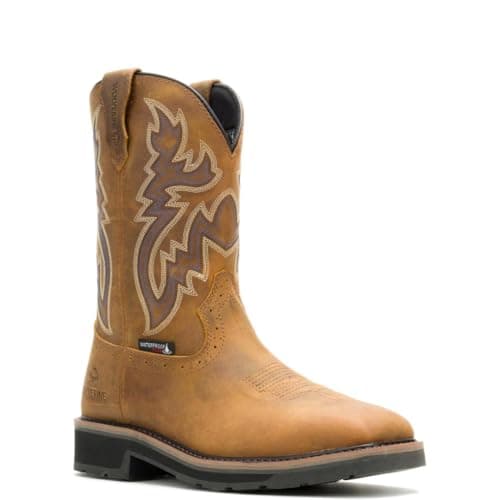
| 1 | Wolverine Rancher Pull-On Steel-Toe Work Wellington A waterproof pull-on with a steel toe, EH and SR rating — no laces to tie, no laces to catch, and the current ASTM F2413-24 designation. | The default: pull-on, waterproof, rated | Steel safety toeASTM F2413-24 I/C EH SR | |
| 2 | 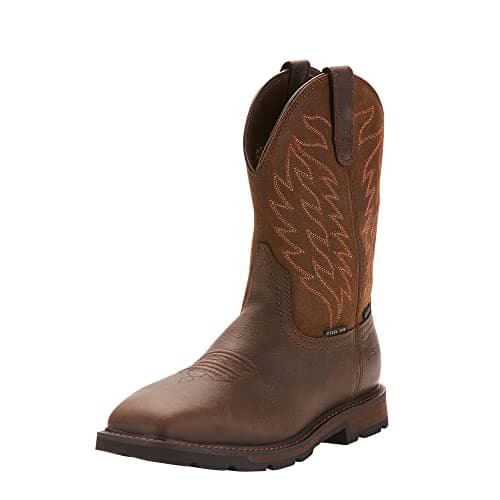 Ariat Groundbreaker H2O EH Steel Toe Wellington Work Boot Waterproof, EH-rated, steel-toe pull-on at the bottom of Ariat's range — the low-cost way into a lace-free waterproof boot. | The same idea at entry price | Steel safety toeEH rated with steel safety toe | |
| 3 | 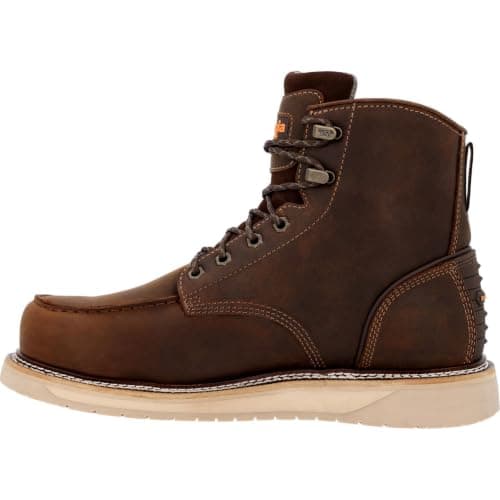 Georgia Boot AMP LT Wedge Composite Toe Waterproof Work Boot (GB00592) A waterproof composite-toe wedge whose SPR leather is specified against named caustics — the pick where the floor is flat and the spills are chemical. | Fertilizer, lime and chemical splash | Ergo-Fit composite toeMeets ASTM F2413 Protective Toe Classification and ASTM F2413 Electrical Hazard Classification | |
| 4 | 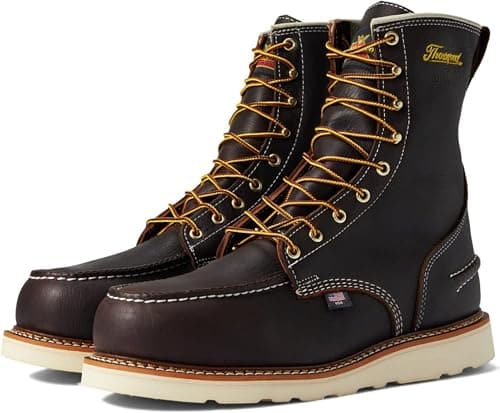 Thorogood 1957 Series Waterproof 8" Safety Toe Moc Toe MAXWear Wedge (804-3800) The 8-inch version of Thorogood's waterproof 1957 wedge — more shaft to keep debris and water out, same resoleable welt. | A lace-up you can resole | Steel safety toe, moc toe shapeSafety toe per ASTM F2413; see the product page for the model's full designation line | |
| 5 | 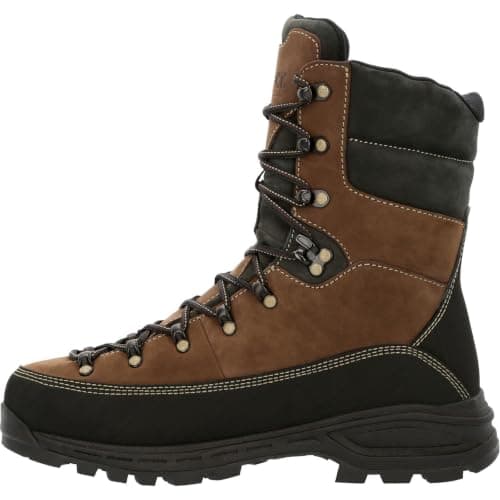 Rocky Mountain Stalker Pro Waterproof 400G Insulated Boot A 10-inch waterproof boot with 400g Thinsulate Ultra — the tier that keeps working when you are active rather than standing still. | Winter chores — no safety toe | Non-safety toe in this model — check the variant before buying for a job siteNo protective toe designation published for this model |
Tap a row to jump to that boot's full write-up. The price column goes straight to Amazon.
Why laces lose on a farm
A lace-up gives you better fit control than any pull-on, and on most job sites that settles the argument. Farm work breaks it for four reasons, none of them about comfort: laces pack with mud and manure and stop cinching; they are a snag hazard around augers, PTO shafts and chain drives; you are in and out of a cab, a shop and a house repeatedly; and the boot gets hosed down rather than brushed off, which destroys a lace and its eyelets faster than it damages leather.
The honest cost of a pull-on is heel lock. Without laces you cannot correct heel slip, and heel slip is what raises blisters. A pull-on has to be sized for the widest part of your foot in order to get past the instep, which often leaves the heel a little loose — fix it with a thicker sock or a heel-grip insole rather than by buying a shorter boot. Pull-on vs lace-up work boots lays out the whole trade.
| What you are doing | The feature that matters | What it costs you |
|---|---|---|
| Feeding and moving stock in mud | A pull-on shaft you can hose off | No heel lock, and debris over the top |
| Spreading fertilizer, lime or spray | An upper specified against named chemicals | Usually a cemented sole you cannot resole |
| Tractor and implement work | No laces to catch, and a defined heel for the step | Less support for walking fence line |
| Walking fence or checking pasture all morning | A lace-up with real ankle support | Laces in mud, and slow on and off |
| Winter chores at first light | 400g insulation and a tall waterproof shaft | Far too warm from April onward |
| In the milking parlour or on a wet slab | A published slip-resistance designation | Softer compounds wear faster on gravel |
Chemical splash is the spec nobody reads
Anhydrous, lime, caustic cleaners in the parlour and concentrated spray all attack leather and sole adhesive, and “chemical resistant” on a hangtag means nothing on its own. Georgia's AMP LT Wedge is the pick here because the maker publishes which chemicals: its SPR leather is stated to resist caustic alkali, sulfuric acid, calcium hydroxide, potassium phosphate and caustic potash. That is a specification. A boot that merely says it is chemical resistant is a claim with no test behind it.
A fiberglass shank, as in that boot, also keeps the whole build non-metallic underfoot — which is relevant if you move between a chemical shed and anything energized.
Do farmers need a safety toe?
Legally, usually not. Family farms with no employees sit outside most of OSHA's enforcement reach, and 29 CFR 1910.136 requires protective footwear where an employer's hazard assessment finds a hazard — a test that assumes an employer. Practically, the hazards do not care: a 1,400-pound cow standing on your foot and an implement coming off a jack are both impact events, and a safety toe is cheap insurance against both.
The real reason to buy a rated boot is that the rating is proof of a build standard rather than just a cap. A boot carrying the ASTM F2413-24 I/C EH SR line, as the Rancher does, has had its impact, compression, electrical and slip properties measured. One that carries nothing has had none of them measured. The exception on this list is the Mountain Stalker, which publishes no protective toe designation at all — it is a chore and winter boot, not PPE, and it is listed as such.
The second pair, and why it is insulated
Almost everyone who works outdoors year-round ends up with two pairs, and on a farm the split is obvious: a hoseable wellington for the eight warm months and a tall insulated boot for chores in the dark. 400 grams is the right tier for that work because you are moving — carrying feed, breaking ice, walking out to a gate — and 600g or more will have you sweating by nine, which makes you colder by three. What 200g insulation means explains why the gram figure is not a temperature, and why over-buying is the usual mistake.
The picks in full
#1 — The default: pull-on, waterproof, rated
Wolverine Rancher Pull-On Steel-Toe Work Wellington
A waterproof pull-on with a steel toe, EH and SR rating — no laces to tie, no laces to catch, and the current ASTM F2413-24 designation.
Published specifications
- Toe
- Steel safety toe
- Safety rating
- ASTM F2413-24 I/C EH SR
- Upper
- Premium waterproof full-grain leather
- Outsole
- Slip-resistant work outsole
- Midsole / shank
- Not published on the manufacturer page
- Construction
- Not published as a welt construction
- Waterproof
- Waterproof full-grain leather upper
- Insulation
- Not insulated
Specifications read from Wolverine product page (Rancher pull-on steel toe wellington) on 2026-09-27. We have not worn this boot.
What works
- Carries the SR slip-resistance designation as well as EH
- On and off in seconds, which matters if you are in and out of a cab
- No laces to catch in machinery or on rungs
What doesn't
- No lacing means no way to fine-tune fit or lock the heel
- Pull-on shafts let debris in at the top
- Harder to get a precise fit than a lace-up
Who this is wrong for
Anyone with a narrow heel or a hard-to-fit foot. Without laces, you cannot correct heel slip, and heel slip is what causes blisters.
Sizing
Pull-ons must be sized for the widest part of your foot to get past the instep, which often means a slightly loose heel. Size for the instep, then fix the heel with a thicker sock or a heel-grip insole.
#2 — The same idea at entry price
Ariat Groundbreaker H2O EH Steel Toe Wellington Work Boot
Waterproof, EH-rated, steel-toe pull-on at the bottom of Ariat's range — the low-cost way into a lace-free waterproof boot.
Published specifications
- Toe
- Steel safety toe
- Safety rating
- EH rated with steel safety toe
- Upper
- Leather upper with waterproof PRO construction
- Outsole
- Ariat work outsole
- Midsole / shank
- 4LR footbed technology for cushioning and support
- Construction
- Not published as a welt construction
- Waterproof
- Waterproof — Ariat PRO construction
- Insulation
- Not insulated
- Widths
- A wide (EE) version is listed
Specifications read from Authorized retailer spec page (Academy) — Ariat Groundbreaker Wide H2O EH steel toe wellington on 2026-09-27. We have not worn this boot.
What works
- Cheapest waterproof EH pull-on here
- Wide version genuinely stocked
- No laces to deal with in mud
What doesn't
- Entry-tier materials — expect a shorter life than the WorkHog XT
- Steel toe conducts cold
- Retailer page publishes less detail than Ariat's own pages
Who this is wrong for
Anyone in real cold. A steel cap with no insulation is the worst toe-temperature combination available.
Sizing
Groundbreaker pull-ons need room at the instep to get on. If your foot is high-volume, take the EE before you take a longer size.
#3 — Fertilizer, lime and chemical splash
Georgia Boot AMP LT Wedge Composite Toe Waterproof Work Boot (GB00592)
A waterproof composite-toe wedge whose SPR leather is specified against named caustics — the pick where the floor is flat and the spills are chemical.
Published specifications
- Toe
- Ergo-Fit composite toe
- Safety rating
- Meets ASTM F2413 Protective Toe Classification and ASTM F2413 Electrical Hazard Classification
- Upper
- Abrasion-resistant SPR leather, stated to resist caustic alkali, sulfuric acid, calcium hydroxide, potassium phosphate and caustic potash
- Outsole
- Carbo-Tec rubber outsole over dual-density EVA — heat, chemical, abrasion and slip resistant
- Midsole / shank
- Cushioning EVA midsole with a fiberglass shank
- Construction
- Not published as a welt construction
- Waterproof
- Waterproof — Georgia Waterproof System
- Insulation
- Not insulated
Specifications read from Georgia Boot product page (AMP LT Wedge composite toe, GB00592) on 2026-09-27. We have not worn this boot.
What works
- Names the specific chemicals the upper resists instead of saying chemical-resistant
- Fiberglass shank keeps the whole boot non-metallic underfoot
- Wedge sole plus waterproofing is a rare combination
What doesn't
- Memory-foam insoles pack down faster than PU
- EVA midsole compresses over a year of hard use
- Not resoleable
Who this is wrong for
Cold-weather outdoor work. A dual-density EVA midsole stiffens in the cold and this boot has no insulation.
Sizing
Georgia's AMP LT last is medium-volume. If you swap the memory-foam insole for a firmer orthotic you will gain a little room, which can make a snug pair workable.
#4 — A lace-up you can resole
Thorogood 1957 Series Waterproof 8" Safety Toe Moc Toe MAXWear Wedge (804-3800)
The 8-inch version of Thorogood's waterproof 1957 wedge — more shaft to keep debris and water out, same resoleable welt.
Published specifications
- Toe
- Steel safety toe, moc toe shape
- Safety rating
- Safety toe per ASTM F2413; see the product page for the model's full designation line
- Upper
- Briar Pitstop leather
- Outsole
- MAXWear Wedge outsole
- Midsole / shank
- Not published on the manufacturer page
- Construction
- Goodyear welt
- Waterproof
- Waterproof
- Insulation
- Not insulated
- Made in
- Not published on this model's page
Specifications read from Thorogood product page (1957 Series, 804-3800) on 2026-09-27. We have not worn this boot.
What works
- Taller shaft keeps concrete dust, mud and water out of the boot
- Waterproof and resoleable in the same boot
- The extra shaft locks the ankle for uneven ground
What doesn't
- Slowest boot here to get on and off
- Hot — a tall waterproof shaft is the worst possible summer combination
- Heaviest of the Thorogood wedges listed here
Who this is wrong for
Anyone in and out of a vehicle repeatedly, or working in heat. An 8-inch waterproof boot is the wrong tool for both.
Sizing
Break in an 8-inch shaft gradually — the flex point at the ankle is where most people get rubbed. Wear it for short spells with your work sock before a full shift.
#5 — Winter chores — no safety toe
Rocky Mountain Stalker Pro Waterproof 400G Insulated Boot
A 10-inch waterproof boot with 400g Thinsulate Ultra — the tier that keeps working when you are active rather than standing still.
Published specifications
- Toe
- Non-safety toe in this model — check the variant before buying for a job site
- Safety rating
- No protective toe designation published for this model
- Upper
- 10" waterproof full-grain leather
- Outsole
- Rocky outdoor outsole
- Midsole / shank
- Not published on the manufacturer page
- Construction
- Not published as a welt construction
- Waterproof
- Waterproof with Rocky Vapor Pass technology
- Insulation
- 400g 3M Thinsulate Ultra Insulation
Specifications read from Authorized retailer spec page (WorkBoots.com) — Rocky Mountain Stalker Pro 400G on 2026-09-27. We have not worn this boot.
What works
- 400g is the right tier if you are moving — 600g overheats an active worker
- Tall waterproof shaft
- Breathability is addressed, not ignored
What doesn't
- No protective toe — this is not a PPE boot
- Too warm for mild weather
- Retailer page, not a manufacturer page
Who this is wrong for
Any site requiring protective footwear. There is no safety toe here.
Sizing
A 10-inch shaft needs lacing discipline: snug at the ankle, looser at the top, or the shaft will bite behind the knee of the calf.
Frequently asked questions
What are the best work boots for farmers?
A waterproof pull-on wellington for most of the year. It hoses off, has no laces to pack with mud or catch in a PTO shaft, and comes off at the door. The Wolverine Rancher is the straightforward version — waterproof full-grain leather carrying ASTM F2413-24 I/C with EH and SR. Add a lace-up if you walk fence line, and an insulated boot for winter chores.
Do farmers need steel toe boots?
Rarely as a legal matter — OSHA's footwear rule assumes an employer and a hazard assessment, and most family operations fall outside it. As a practical matter the hazards are real: livestock standing on a foot and implements coming off a jack are both impact events. The stronger argument for a rated boot is that the rating proves impact, compression, electrical and slip properties were actually measured.
Are rubber boots or leather boots better for farm work?
Rubber wins for standing in slurry or a wash-down parlour and loses everywhere else: no support, no breathability and no rating. A waterproof leather pull-on is the compromise most full-time operators settle on, with rubber kept by the door for the wettest hour of the day.
What insulation do I need for winter farm chores?
400 grams for active chores — feeding, breaking ice, walking out to gates. The gram figure measures insulation per square meter, not a temperature, and the common mistake is buying for the forecast instead of for your own activity level. Heavier tiers are for standing still.
Sources
- OSHA 29 CFR 1910.136 — Foot protection — The federal rule itself: when protective footwear is required, and which consensus standards it accepts
- ASTM F2413 protective footwear standard — technical summary — Label format, the mandatory I and C designations, and each optional code
- 3M Thinsulate insulation — What the gram figure on an insulated boot actually measures
Read next
Pull-On vs Lace-Up Work Boots
The heel-lock trade you accept when you give up laces.
Best Pull-On Work Boots
The wider pull-on shortlist, beyond the farm-specific picks.
ASTM F2413 Explained
The rating your trade actually needs, and what each code on the label certifies.
Work Boot Sizing Guide
Get the fit right before you spend money — most boot complaints are fit.
How to Break In Work Boots
What to do in the two weeks before your first full shift in a new pair.