Brands
Timberland PRO vs Ariat
Two different design lineages, and the ground decides between them.
Disclosure: product links on this page go to Amazon. As an Amazon Associate we earn from qualifying purchases, at no extra cost to you. It does not change which boots we recommend or the order they appear in — here is the full disclosure.
Quick picks
| # | Product | Best for | Toe & rating | Price |
|---|---|---|---|---|
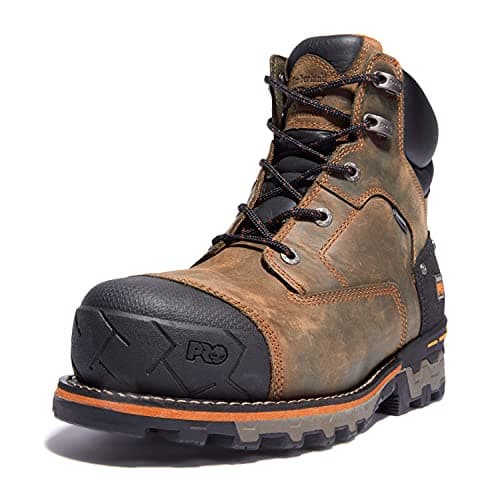
| 1 | Timberland PRO Boondock 6" Composite Toe Waterproof Work Boot A waterproof composite-toe boot whose all-weather TPU outsole is specifically formulated to stay flexible when it gets cold — which is when most rubber compounds stop gripping. | Timberland PRO: fullest spec sheet | Asymmetrical composite safety toe, non-metallicMeets ASTM F2412-18a and ASTM F2413-18 for impact (I) and compression (C); EH protection meets ASTM F2413-18 and ASTM F2892-18; waterproof membrane meets ASTM F1671-07 | |
| 2 | 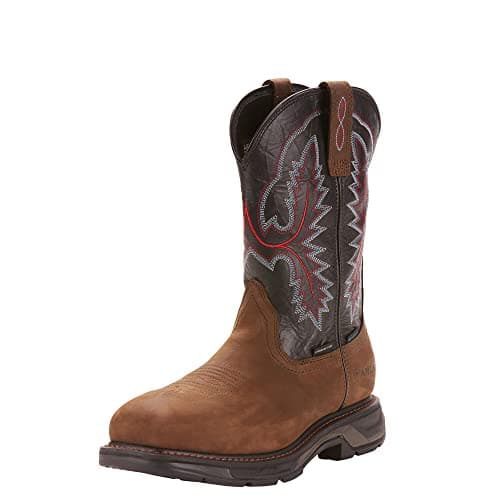 Ariat WorkHog XT Waterproof Carbon Toe Work Boot Ariat builds the WorkHog XT around lateral stability and a wide midfoot platform — the pull-on answer for outdoor work on ground that never sits level. | Ariat: stability on uneven ground | Carbon safety toe, non-metallicASTM F2413 I/C EH SRO on the WorkHog XT Incognito carbon toe, per Ariat's published specification | |
| 3 | 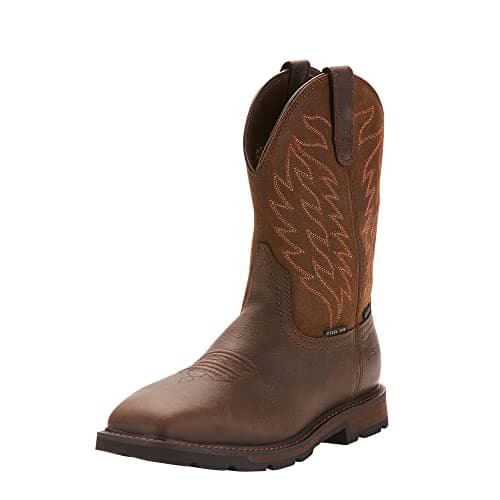 Ariat Groundbreaker H2O EH Steel Toe Wellington Work Boot Waterproof, EH-rated, steel-toe pull-on at the bottom of Ariat's range — the low-cost way into a lace-free waterproof boot. | Ariat: waterproof pull-on, entry price | Steel safety toeEH rated with steel safety toe |
Tap a row to jump to that boot's full write-up. The price column goes straight to Amazon.
The comparison
| Timberland PRO Boondock CT | Ariat WorkHog XT carbon toe | |
|---|---|---|
| Toe | Asymmetrical composite | Carbon, non-metallic |
| Published rating | ASTM F2412-18a and F2413-18 I and C; EH to F2413-18 and F2892-18 | ASTM F2413 I/C EH SRO on the Incognito carbon toe |
| Slip rating | Outsole stated slip-, oil- and abrasion-resistant; no ASTM slip tier named | SRO — the oily-wet tier, named |
| Waterproofing | Membrane stated to meet ASTM F1671-07 | DRYShield waterproof breathable |
| Outsole | All-weather TPU, formulated to stay flexible when cold | Ariat work outsole |
| Platform | Conventional work-boot last | ATS Max with an extra-wide midfoot and dual-density EVA |
| Closure | Lace-up | Pull-on |
| Construction | Not published as a welt | Not published as a welt |
The platform is the real difference
Ariat's ATS Max is a wide midfoot with a dual-density EVA midsole, and it does something specific: it resists rolling sideways. On rubble, rutted ground, stirrup edges and anything that never sits level, that lateral stability is a genuine advantage and it is why the WorkHog XT has the following it does among farm, ranch and oilfield workers.
The same width is a liability in a crawl space or a plant room, and Ariat's own positioning is honest about the trade — tight indoor work in confined spaces is where the wide platform gets in the way. The Boondock is the conventional-last answer: narrower underfoot, easier in tight places, and with the cold-flex outsole that Timberland is almost alone in specifying.
SRO is a named tier, and Ariat names it
Slip resistance is where Ariat out-publishes Timberland here. ASTM F3445 sets a minimum coefficient of friction of 0.40 wet and dry and 0.33 oily-wet, and SRO is the designation for the oily-wet case specifically. Ariat states SRO on the rated WorkHog XT models.
Timberland describes the Boondock outsole as slip-, oil- and abrasion-resistant without naming an ASTM slip tier, which is a weaker claim even though the outsole may well perform. If you work on an oily floor — a shop, a plant, a rig deck — the named designation is the one to buy on. Best slip-resistant work boots explains the difference between a tested rating and a descriptive phrase.
Lace-up versus pull-on is not a style question
Ariat's strength in this registry is pull-ons: the WorkHog XT and the cheaper Groundbreaker H2O wellington, which is waterproof, EH-rated and steel-toed at the bottom of Ariat's range and is also listed in a wide (EE) version. A pull-on goes on and off in seconds, has no laces to catch in machinery, and sheds mud without lace eyelets packing with it.
What a pull-on cannot do is adjust. If your heel slips, there is no closure to fix it, and heel slip is what causes blisters — so a pull-on is a bad buy for a hard-to-fit foot. Pull-on vs lace-up work boots is the full comparison, and best pull-on work boots is the roundup.
One more note on cold
Ariat's Groundbreaker is a steel cap with no insulation, which is the worst toe-temperature combination available — metal conducting heat out with nothing to slow it. If you are buying either brand for winter, the composite and carbon caps are the ones to take, and the Boondock's cold-flexible outsole is a real advantage on top. Steel toe vs composite toe covers the conduction question properly.
Buy Timberland PRO if…
You work on a job site, you need the full designation line for a submission, you work indoors or in tight spaces, or you work outdoors through winter and want an outsole specified to stay flexible in the cold.
Buy Ariat if…
Your ground is uneven — farm, ranch, oilfield, yard — or your floor is oily and you want the named SRO tier. Take the WorkHog XT for the stability platform and the Groundbreaker if you want a waterproof pull-on at the lowest price, with the caveat about the uninsulated steel cap.
Where both lose
Neither publishes a welt, so neither is resoleable, and neither publishes a weight on these models. If you want a boot you can rebuild, the comparison to run is between the welted makers instead — Red Wing vs Thorogood and Thorogood vs Ariat both put a welt on one side of the table.
The picks in full
#1 — Timberland PRO: fullest spec sheet
Timberland PRO Boondock 6" Composite Toe Waterproof Work Boot
A waterproof composite-toe boot whose all-weather TPU outsole is specifically formulated to stay flexible when it gets cold — which is when most rubber compounds stop gripping.
Published specifications
- Toe
- Asymmetrical composite safety toe, non-metallic
- Safety rating
- Meets ASTM F2412-18a and ASTM F2413-18 for impact (I) and compression (C); EH protection meets ASTM F2413-18 and ASTM F2892-18; waterproof membrane meets ASTM F1671-07
- Upper
- Leather upper with a waterproof membrane
- Outsole
- All-weather TPU outsole, formulated to stay flexible in variable weather; slip-, oil- and abrasion-resistant
- Midsole / shank
- Not published as a shank specification
- Construction
- Not published as a welt construction
- Waterproof
- Waterproof, membrane meets ASTM F1671-07
- Insulation
- Not insulated in this version; Timberland PRO also lists a 600g insulated Boondock
- Weight
- Not published on the manufacturer page
Specifications read from Timberland PRO Boondock composite toe specifications (Timberland PRO product listing) on 2026-09-27. We have not worn this boot.
What works
- The cold-weather outsole claim is specific and testable, not marketing mush
- Composite toe does not conduct cold into the toes
- Waterproofing is stated against a named ASTM test method
What doesn't
- Well known among owners as a heavy boot for its class
- A membrane plus a thick outsole is a warm combination in summer
- Not a resoleable construction
Who this is wrong for
Anyone counting grams. If weight is your first criterion, a composite-toe work hiker will be noticeably lighter.
Sizing
The Boondock's toe box is generous but the instep is snug; owners with a high instep frequently report needing a wide. Fit it with the insole you intend to use.
#2 — Ariat: stability on uneven ground
Ariat WorkHog XT Waterproof Carbon Toe Work Boot
Ariat builds the WorkHog XT around lateral stability and a wide midfoot platform — the pull-on answer for outdoor work on ground that never sits level.
Published specifications
- Toe
- Carbon safety toe, non-metallic
- Safety rating
- ASTM F2413 I/C EH SRO on the WorkHog XT Incognito carbon toe, per Ariat's published specification
- Upper
- Leather upper with DRYShield waterproof breathable construction
- Outsole
- Ariat work outsole, slip-resistant (SRO on the rated models)
- Midsole / shank
- ATS Max platform with an extra-wide midfoot and a dual-density EVA midsole
- Construction
- Not published as a welt construction
- Waterproof
- Waterproof — DRYShield
- Insulation
- Not insulated
Specifications read from Ariat product page (WorkHog XT waterproof carbon toe) on 2026-09-27. We have not worn this boot.
What works
- Lateral stability is the design brief, and it shows on uneven ground
- Carries an SRO slip designation as well as EH on the rated models
- Pull-on entry with a lacing-free instep
What doesn't
- Ariat publishes the full designation on some WorkHog XT models and not others — check the exact variant
- Wide midfoot platform feels clumsy indoors
- Not resoleable
Who this is wrong for
Tight indoor work in confined spaces. The wide platform that helps on rubble is a hindrance in a crawl space.
Sizing
Ariat runs a touch long for many owners; a half size down is a common report. Because it is a pull-on, size for the instep first.
#3 — Ariat: waterproof pull-on, entry price
Ariat Groundbreaker H2O EH Steel Toe Wellington Work Boot
Waterproof, EH-rated, steel-toe pull-on at the bottom of Ariat's range — the low-cost way into a lace-free waterproof boot.
Published specifications
- Toe
- Steel safety toe
- Safety rating
- EH rated with steel safety toe
- Upper
- Leather upper with waterproof PRO construction
- Outsole
- Ariat work outsole
- Midsole / shank
- 4LR footbed technology for cushioning and support
- Construction
- Not published as a welt construction
- Waterproof
- Waterproof — Ariat PRO construction
- Insulation
- Not insulated
- Widths
- A wide (EE) version is listed
Specifications read from Authorized retailer spec page (Academy) — Ariat Groundbreaker Wide H2O EH steel toe wellington on 2026-09-27. We have not worn this boot.
What works
- Cheapest waterproof EH pull-on here
- Wide version genuinely stocked
- No laces to deal with in mud
What doesn't
- Entry-tier materials — expect a shorter life than the WorkHog XT
- Steel toe conducts cold
- Retailer page publishes less detail than Ariat's own pages
Who this is wrong for
Anyone in real cold. A steel cap with no insulation is the worst toe-temperature combination available.
Sizing
Groundbreaker pull-ons need room at the instep to get on. If your foot is high-volume, take the EE before you take a longer size.
Frequently asked questions
Is Timberland PRO better than Ariat?
For job-site work, indoor trades and cold-weather outdoor work, yes — Timberland PRO publishes the fullest ASTM line here and specifies an outsole formulated to stay flexible when cold. Ariat is the better choice on uneven ground thanks to its wide ATS Max platform, and it publishes a named SRO oily-wet slip rating that Timberland does not.
Are Ariat work boots good for construction?
They can be, but the design lineage is western rather than construction. The WorkHog XT's extra-wide midfoot resists rolling on rubble and rutted ground, which suits outdoor site work, while the same width is awkward in crawl spaces and confined plant rooms.
What does SRO mean on Ariat boots?
SRO is the oily-wet slip-resistance designation. ASTM F3445 requires a minimum coefficient of friction of 0.40 in wet and dry conditions and 0.33 in oily-wet, and SRO covers that harder oily case specifically. It is a measured threshold rather than a descriptive phrase like 'oil resistant'.
Which brand is better for wet work?
Both publish waterproofing, but they publish it differently. Timberland states the Boondock membrane meets ASTM F1671-07, which is a named standard. Ariat states DRYShield waterproof breathable construction without naming a test. For an oily wet floor rather than standing water, Ariat's SRO rating is the more relevant number.
Sources
- Timberland PRO technology glossary — Anti-Fatigue Technology and the inverted-cone footbed geometry, in Timberland's words
- Reebok Work Sublite Cushion — ASTM F3445 slip-resistance rating — Slip resistance stated against a named ASTM test method
- ASTM F2413 protective footwear standard — technical summary — Label format, the mandatory I and C designations, and each optional code