Comfort & Fit
Do Work Boots Run Big?
Usually yes. Sizing down is usually the wrong answer anyway.
Disclosure: product links on this page go to Amazon. As an Amazon Associate we earn from qualifying purchases, at no extra cost to you. It does not change which boots we recommend or the order they appear in — here is the full disclosure.
Quick picks
| # | Product | Best for | Toe & rating | Price |
|---|---|---|---|---|
| 1 |  Red Wing King Toe 6-inch Waterproof Safety Toe Boot (#2240) Red Wing publishes 44% more toe room than a standard work boot and stocks four widths — the clearest answer on this list for a foot that fights every other last. | Four stocked widths: B, D, EE and H | Non-metallic safety toeASTM F2413-24, I/C, EH | |
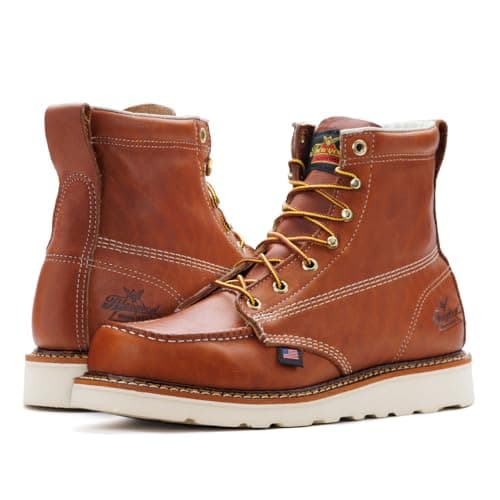
| 2 | Thorogood American Heritage 6" Moc Toe Safety Toe MAXWear Wedge (804-4200) A Goodyear-welted, USA-built wedge with a steel toe and an EH rating — the default answer for anyone who stands on a flat hard floor and wants a boot that can be resoled. | A last that genuinely runs large | Steel safety toe, moc toe shapeASTM F2413-18, EH | |
| 3 | 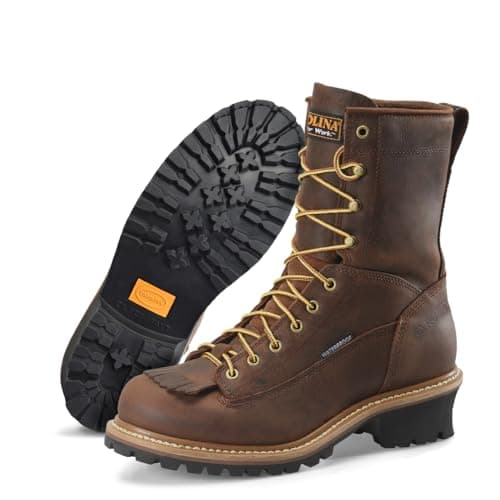 Carolina Spruce 8" Steel Toe Waterproof Logger A waterproof 8-inch logger with a triple-bar steel shank — the stiff underfoot platform that ladder rungs and pole work actually need. | D, 2E and 4E in a logger | Steel safety toe capMeets or exceeds ASTM F2413-18 for compression and impact; electrical hazard protection tested to withstand 18,000 volts at 60Hz for one minute without leakage | |
| 4 | 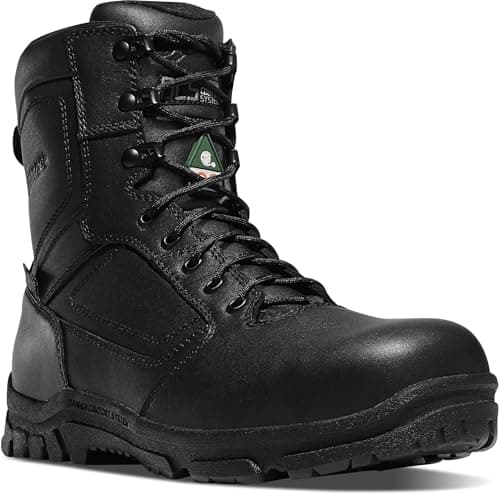 Danner 8" Composite Toe EMS/CSA Side-Zip Work Boot (23826) A waterproof 8-inch composite-toe boot with a semi-locking side zip and a B-through-EE width run — the fit-first side zip, and the only one here in a narrow width. | A narrow B width, which is rare | Composite toe capANSI/ASTM I75 and C75 approved; electrical hazard rated; NFPA EMS certified; body-fluid-borne pathogen resistant |
Tap a row to jump to that boot's full write-up. The price column goes straight to Amazon.
Why they feel big
Three things are happening at once, and they are easy to mistake for one another.
A safety cap needs volume. A steel, composite or carbon toe box is a rigid shell that cannot flex around your foot, so makers build in clearance ahead of and above the toes. In a soft-toe shoe your foot pushes the upper out of the way; in a safety boot it hits a wall. So the wall gets moved further out, and the boot feels roomy at the front even when the length is right.
Work lasts are built for a work sock. The reference fit is a midweight sock, not a thin dress sock. Try the boot in a thin sock and you will find half a size of slop that is not really there.
Some lasts are simply long. This is the part that is real and brand-specific. Thorogood's moc-toe last is the best-documented example: owner reviews consistently report it running large, and the common recommendation is a half size down from a measured Brannock length. That is a property of the last, not of work boots in general.
What to change, by symptom
| What you feel | What it means | The fix |
|---|---|---|
| Heel lifts when you walk | The boot is too wide or too long at the back | Narrower width, or heel-lock lacing — not a shorter boot |
| Foot slides forward into the toe cap | Heel is not locked | Lace the top two eyelets tight; add a heel-grip insole |
| Toes touch the end of the cap | The boot is too short, full stop | Size up, and take a narrower width if it then feels loose |
| Loose across the ball of the foot | The width is wrong, not the length | Take a D instead of an EE, or a B if the maker stocks one |
| Tight over the instep but roomy at the toes | High-volume foot in a shallow boot | Skip the eyelet over the instep; try a wider width in the same length |
| Fits in the morning, tight by 3pm | Normal. Feet swell across a shift | Fit boots in the afternoon, never first thing |
Measure first, then read the brand
Start from a measured length. A Brannock device at a work boot retailer gives you heel-to-toe length, heel-to-ball length and width, and the heel-to-ball figure is the one most people have never seen — it is where the boot needs to flex, and a boot that flexes behind the ball of your foot will crease into your instep for its whole life.
Then treat each last separately. “Work boots run big” is a useful prior and a bad rule. Red Wing's King Toe publishes 44% more toe room than a standard work boot and stocks four widths from B to H — that boot does not run long, it runs wide, and sizing down to fix it throws away the only reason to buy it. Carolina stocks D, 2E and 4E on the Spruce logger. Danner lists B, D and EE on the 23826. The work boot sizing guide has the width letters and the conversion tables.
Steel toe boots specifically
Safety-toe boots attract this question more than any other category, because the cap is where you feel a short boot first and most painfully. The rule that matters: you should never be able to touch the inside of the cap with your toes, even when walking downhill, because the cap does not give and your toenail does. How steel toe boots should fit goes through the test properly, including why the cap also sets a hard limit on how much insole you can add.
One more thing people mistake for sizing: break-in. A new welted boot with a rubber midsole feels stiff and roomy at the same time for the first week, and then packs down into your foot. How to break in work boots is the sequence; the point here is not to return a boot for size in the first three days, because the boot you are judging is not the boot you will be wearing.
The picks in full
Illustrative category photo — not this model#1 — Four stocked widths: B, D, EE and H
Red Wing King Toe 6-inch Waterproof Safety Toe Boot (#2240)
Red Wing publishes 44% more toe room than a standard work boot and stocks four widths — the clearest answer on this list for a foot that fights every other last.
Published specifications
- Toe
- Non-metallic safety toe
- Safety rating
- ASTM F2413-24, I/C, EH
- Upper
- Waterproof waxed nubuck leather
- Outsole
- TPU-PU Galaxy outsole
- Midsole / shank
- Non-metallic shank
- Construction
- Direct attach — Red Wing states this model is not resoleable
- Waterproof
- Yes — Red Wing waterproofing system
- Insulation
- Not stated on the product page
- Widths
- Narrow (B), Regular (D), Wide (EE), Wide (H)
- Weight
- 3 lb 7 oz
- Made in
- Globally sourced
Specifications read from Red Wing Shoes product page (#2240) on 2026-09-27. We have not worn this boot.
What works
- Genuinely the widest toe box on this list, and Red Wing publishes the figure
- Four widths including an H, which almost nobody stocks
- Fully non-metallic underfoot — relevant for metal detectors
- Red Wing publishes an actual weight, which most brands do not
What doesn't
- Direct-attach construction: Red Wing states it is not resoleable
- Expensive for a boot you cannot rebuild
- The square King Toe silhouette is divisive
Who this is wrong for
Anyone buying for longevity through resoling. Red Wing's own page says no on this model — look at their welted Heritage lines instead.
Sizing
The King Toe last adds room at the toes, not at the heel. If you have a narrow heel, take the B width before you size down; sizing down to fix heel slip will crowd the toes the boot was built to free.
#2 — A last that genuinely runs large
Thorogood American Heritage 6" Moc Toe Safety Toe MAXWear Wedge (804-4200)
A Goodyear-welted, USA-built wedge with a steel toe and an EH rating — the default answer for anyone who stands on a flat hard floor and wants a boot that can be resoled.
Published specifications
- Toe
- Steel safety toe, moc toe shape
- Safety rating
- ASTM F2413-18, EH
- Upper
- Tobacco full-grain American leather, unlined
- Outsole
- MAXWear Wedge slip-resistant outsole
- Midsole / shank
- Rubber midsole with composite shank
- Construction
- Goodyear storm welt
- Waterproof
- Not waterproof
- Insulation
- Not insulated
- Widths
- D and EE, sizes 7-14 in both widths
- Weight
- Not published on the manufacturer page
- Made in
- Made in USA with USA and globally sourced components
Specifications read from Thorogood product page (804-4200) on 2026-09-27. We have not worn this boot.
What works
- Goodyear storm welt is a resoleable construction, not a disposable one
- Flat wedge spreads load evenly on concrete instead of concentrating it under a heel
- Unlined upper breaks in to the foot rather than around a liner
- EE width is stocked across the whole size run, not just the middle
What doesn't
- Not waterproof and not insulated — the unlined upper soaks
- A flat wedge gives up bite on mud, gravel and ladder rungs
- Manufacturer publishes no weight figure, so weight comparisons are guesswork
Who this is wrong for
Anyone working outdoors on soft or uneven ground, or in standing water. The wedge has no lugs to bite and the unlined upper is not waterproof.
Sizing
Thorogood's moc-toe last is widely reported to run large; owner reviews consistently suggest going a half size down from a measured Brannock length. D and EE are both stocked, so take the width rather than sizing up for room.
#3 — D, 2E and 4E in a logger
Carolina Spruce 8" Steel Toe Waterproof Logger
A waterproof 8-inch logger with a triple-bar steel shank — the stiff underfoot platform that ladder rungs and pole work actually need.
Published specifications
- Toe
- Steel safety toe cap
- Safety rating
- Meets or exceeds ASTM F2413-18 for compression and impact; electrical hazard protection tested to withstand 18,000 volts at 60Hz for one minute without leakage
- Upper
- Leather upper with the SCUBALINER waterproof lining
- Outsole
- Oil- and slip-resisting rubber logger outsole
- Midsole / shank
- Triple-bar steel shank with a Pillow Cushion footbed
- Construction
- Welt construction
- Waterproof
- Waterproof — SCUBALINER
- Insulation
- Not insulated in this model; Carolina lists an insulated version
- Widths
- D, 2E and 4E
Specifications read from Carolina Shoe product page (Spruce 8" steel toe waterproof logger, CA9825) on 2026-10-01. We have not worn this boot.
What works
- States the EH test conditions, which most brands summarize away
- The triple-bar shank is the real reason to buy a logger
- Waterproof at a working price
What doesn't
- A rigid shank is punishing on flat concrete
- Heavy
- Steel shank and steel toe: fully metallic underfoot
Who this is wrong for
Warehouse and flat-floor work. A logger's stiffness is a feature on a rung and a liability on level ground.
Sizing
Loggers fit tighter through the arch because the shank does not flex. Fit it laced fully and stand on a step edge before you commit.
#4 — A narrow B width, which is rare
Danner 8" Composite Toe EMS/CSA Side-Zip Work Boot (23826)
A waterproof 8-inch composite-toe boot with a semi-locking side zip and a B-through-EE width run — the fit-first side zip, and the only one here in a narrow width.
Published specifications
- Toe
- Composite toe cap
- Safety rating
- ANSI/ASTM I75 and C75 approved; electrical hazard rated; NFPA EMS certified; body-fluid-borne pathogen resistant
- Upper
- Waterproof, polishable full-grain leather with ripstop ballistic nylon
- Outsole
- Danner Lockout slip-resistant outsole with a dynamic lug pattern
- Midsole / shank
- Nylon shank with a dual-density footbed
- Construction
- Not published on the retailer spec page
- Waterproof
- Waterproof Danner Dry liner
- Insulation
- Not published
- Widths
- B, D and EE, sizes 6-16
- Weight
- Not published
Specifications read from Authorized retailer spec page (Steel-Toe-Shoes.com) — Danner 23826 on 2026-09-29. We have not worn this boot.
What works
- A narrow B width, which almost nothing else in this category offers
- Composite cap — no cold conduction and no metal-detector problem
- Polishable leather, for anywhere a boot has to look inspected
What doesn't
- Most expensive side zip here
- Neither Danner nor the retailer publishes the construction method
- Lug tread tracks grit indoors
Who this is wrong for
Flat-floor indoor trades on a budget. You are paying for EMS certification and a width run you may not need.
Sizing
Take the width before the length here — the B, D and EE run is the reason to buy this boot, and sizing up to buy room is what it is meant to prevent.
Frequently asked questions
Do work boots run big or small?
Most run big relative to a dress shoe or sneaker in the same number, but the cause is usually extra width and volume to accommodate a safety cap and a work sock — not extra length. A few lasts genuinely run long; Thorogood's moc toe is the most widely reported, where owners commonly take a half size down from a measured Brannock length.
Should I size down in work boots?
Only if the length is genuinely long on that specific last. If the boot is loose across the ball or the heel lifts, take a narrower width in the same length instead. Sizing down to remove sideways slop drives your toes into the safety cap, which does not flex and will bruise a toenail.
Do steel toe boots run bigger than regular boots?
They feel bigger, because the rigid cap has clearance built in ahead of and above the toes that a soft-toe shoe does not need. The length is usually correct. The test is whether your toes can touch the inside of the cap when you walk downhill — if they can, the boot is too short regardless of the number on it.
What time of day should I try on work boots?
The afternoon. Feet swell measurably across a working day, and a boot fitted first thing in the morning in a thin sock is the classic way to end up with a boot that is too tight by three o'clock. Fit them late, in the socks you actually work in.
Sources
- ASTM F2413 protective footwear standard — technical summary — Label format, the mandatory I and C designations, and each optional code
Read next
Work Boot Sizing Guide
The width letters, the conversions and how to measure.
How Should Steel Toe Boots Fit
The cap sets the hard limits — here they are.
Best Wide Work Boots
If the answer turns out to be width rather than length.
How to Break In Work Boots
Why the first three days are not the fit you will end up with.