Soles
Best Goodyear Welt Work Boots
The stitch that decides whether you buy boots once or every year.
Disclosure: product links on this page go to Amazon. As an Amazon Associate we earn from qualifying purchases, at no extra cost to you. It does not change which boots we recommend or the order they appear in — here is the full disclosure.
Quick picks
| # | Product | Best for | Toe & rating | Price |
|---|---|---|---|---|
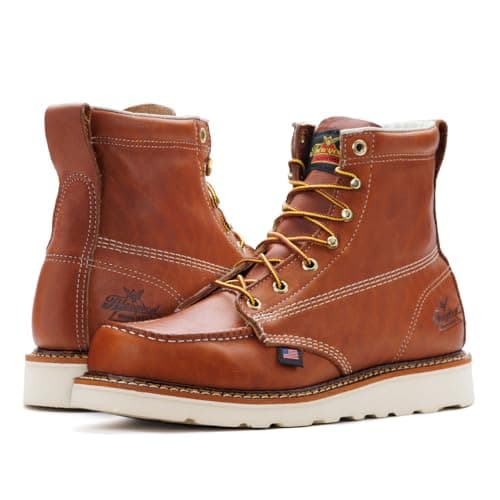
| 1 | Thorogood American Heritage 6" Moc Toe Safety Toe MAXWear Wedge (804-4200) A Goodyear-welted, USA-built wedge with a steel toe and an EH rating — the default answer for anyone who stands on a flat hard floor and wants a boot that can be resoled. | The default welted work boot | Steel safety toe, moc toe shapeASTM F2413-18, EH | |
| 2 | 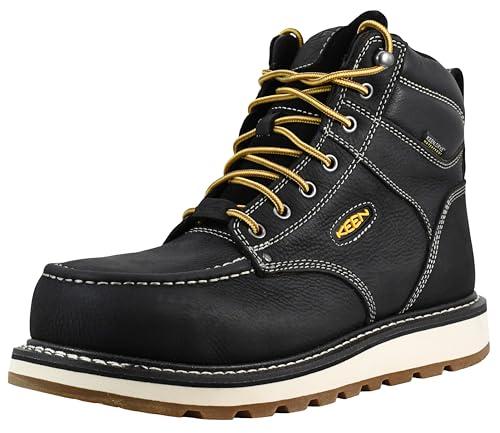 KEEN Utility Cincinnati 6" Composite Toe Waterproof Wedge Work Boot A welted wedge with a waterproof membrane and a non-metallic cap — a combination that barely exists anywhere else, and the pick when the floor is flat and wet. | Budget pick — and the only waterproof welt here | Asymmetrical non-metallic safety toe. KEEN's own page calls it a carbon safety toe and states it weighs 15% less than steel; retailers list the same cap as a composite toeKEEN does not publish a designation string on this model's page. Authorized-retailer listings for the Cincinnati non-metallic toe state it meets or exceeds ASTM F3445-21 and ASTM F2413-18 M I/75 C/75 EH | |
| 3 | 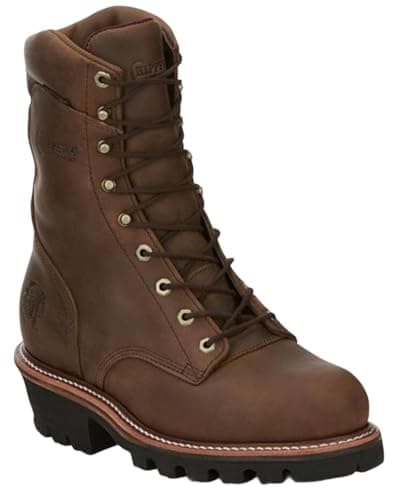 Chippewa Super DNA 9" Waterproof Steel Toe Logger (59407) A Goodyear leather-welted logger on Vibram's Tacoma TC4 Plus — a self-cleaning compound Chippewa specifies for high heat, which is the reason to choose it over a generic lug. | Welt plus a heat-rated Vibram outsole | Steel safety toeSteel toe with EH; Chippewa states it meets ASTM F2413 safety footwear standards | |
| 4 | 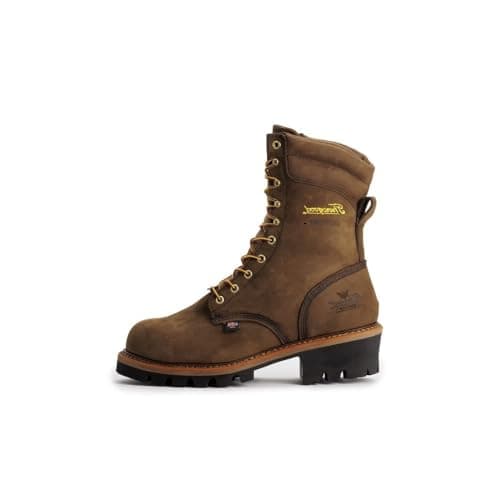 Thorogood Logger Series 9" Waterproof Steel Toe, Stud Horse (804-3555) A USA-built, storm-welted 9-inch logger with a Vibram outsole over a Vibram rubber midsole and a steel shank — the Vibram boot to buy if you intend to have it resoled rather than replaced. | Welted logger with a Vibram midsole | Steel safety toe, round toeASTM F2413-18 safety toe with EH; oil-resisting, slip-resistant outsole | |
| 5 | 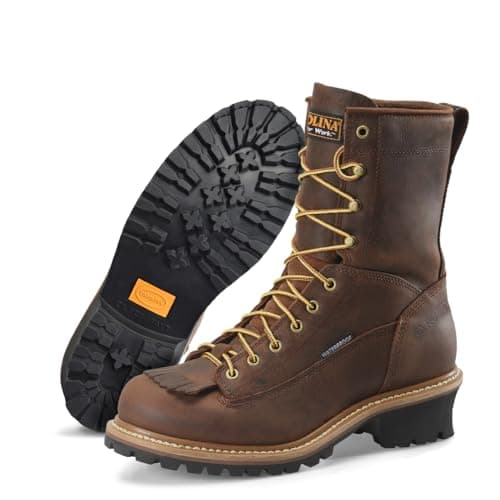 Carolina Spruce 8" Steel Toe Waterproof Logger A waterproof 8-inch logger with a triple-bar steel shank — the stiff underfoot platform that ladder rungs and pole work actually need. | Welted waterproof climbing boot in three widths | Steel safety toe capMeets or exceeds ASTM F2413-18 for compression and impact; electrical hazard protection tested to withstand 18,000 volts at 60Hz for one minute without leakage |
Tap a row to jump to that boot's full write-up. The price column goes straight to Amazon.
What a Goodyear welt actually does
In a Goodyear-welted boot, the upper and a canvas rib on the insole are stitched to a leather strip — the welt — that runs around the edge of the boot. The outsole is then stitched to that welt. The outsole is therefore attached to a replaceable strip rather than glued to the boot, so a cobbler can cut the sole stitching, strip the old sole and stitch a new one on without touching the upper.
A storm welt is the same thing with the welt turned up against the upper to form a lip, which closes the seam against water running down the boot. Thorogood uses storm welts on most of its American Heritage line; that lip is why.
Cemented and direct-attach boots glue or mould the sole directly to the upper. When the sole goes, the boot goes. Goodyear welt vs stitchdown covers the other rebuildable construction and where it is actually better.
How these five were chosen
1. The maker publishes a welt. Not "welt-look stitching," not a "bond welt" — which is a cemented construction with decorative stitching and cannot be resoled — and not silence. Georgia's Carbon Flex, for example, publishes a bond welt and is therefore not on this page.
2. A live price. Welted boots are the part of the market with the most discontinued models; every pick here had a buyable offer at the last refresh.
3. The upper is worth rebuilding. A resoleable boot only pays off if the upper outlasts two or three soles, so full-grain leather was a requirement.
4. Widths, where published. You will own a welted boot for years. The fit has to be right on day one.
The five, on what each maker publishes
| Welt | Upper | Waterproof | Widths | |
|---|---|---|---|---|
| Thorogood 804-4200 6" | Goodyear storm welt | Tobacco full-grain American leather, unlined | No, and none claimed | D and EE, 7-14 |
| KEEN Cincinnati 6" | Goodyear welt | Barnyard-resistant leather | KEEN.DRY membrane | Not published |
| Chippewa Super DNA 9" | Goodyear leather welt | Premium waterproof full-grain leather | Breathable membrane, Dri-Lex lining | E and EEE |
| Thorogood Logger 804-3555 9" | Goodyear storm welt | Stud Horse full-grain American leather | Waterproof membrane | D and EEE, 8-15 |
| Carolina Spruce 8" Logger | Welt construction | Leather with SCUBALINER lining | SCUBALINER | D, 2E and 4E |
Thorogood 804-4200 — the default
This is the boot this site recommends more than any other, and the reason is the combination rather than any single spec: a Goodyear storm welt, a MAXWear wedge outsole, a rubber midsole over a composite shank, a removable shock-absorbing footbed, ASTM F2413-18 with EH, D and EE in every size from 7 to 14, and Thorogood's published origin wording — made in USA with USA and globally sourced components.
The honest cons. Not waterproof and Thorogood does not claim it is. The flat wedge has no lugs, so it is the wrong boot the moment you leave a hard flat surface. No published weight, and a welted boot with a leather midsole is not a light one. It needs real break-in — how to break in work boots is the method that does not wreck the leather.
Wrong for: wet ground, uneven ground, and anyone who needs a comfortable boot tomorrow morning.
KEEN Cincinnati — the budget pick, and the wet one
Normally the welt is the thing you pay extra for, which makes this boot genuinely odd: it was the cheapest boot in this group at the last price refresh and it is the only one that is both welted and membraned. A Goodyear welt, the KEEN.DRY waterproof breathable membrane, a barnyard-resistant upper, a Luftcell air-infused midsole and a non-metallic cap KEEN describes as carbon and states is 15% lighter than steel.
Dairies, food plants, wash-down bays and any flat floor that gets hosed at shift end are what this boot is for.
The honest cons. KEEN does not print a model-specific ASTM designation string on this page — the classification rests on authorized-retailer listings quoting ASTM F3445-21 and F2413-18 M I/75 C/75 EH — so if you need a maker-published string for a site induction, the Thorogood gives you one and this does not. No published weight, no published width run, and a membrane in a flat wedge is a hot boot in summer. Also check which Cincinnati you are buying: KEEN sells a 90-degree-heel version that is not a wedge.
Wrong for: hot-weather outdoor work.
Chippewa Super DNA — the welt plus the compound
A Goodyear leather-welted 9-inch logger on Vibram's Tacoma TC4 Plus, which Chippewa specifies as a technical self-cleaning sole for outdoor terrain and high-heat environments. Waterproof membrane, Dri-Lex lining, steel toe with EH, steel shank, orthotic insole, in E and EEE.
The reason to choose it over a generic lug is the compound. A self-cleaning pattern keeps biting when a conventional lug has packed, and the heat rating matters if you walk on anything hot.
The honest cons. The narrowest width offered is an E, so a genuinely narrow foot has nowhere to go. A logger heel belongs on broken ground, not a slab. Chippewa does not publish a weight, and a welted waterproof 9-inch boot is heavy by construction.
Wrong for: narrow feet and flat floors.
Thorogood 804-3555 and Carolina Spruce — the climbing pair
Both are welted, waterproof and built for standing on something narrow. The Thorogood is the one to buy if you intend to have it rebuilt: a storm welt, a Vibram outsole over a Vibram rubber midsole, a steel shank, USA-built, in D and EEE from 8 to 15. The Carolina is substantially cheaper, published with a triple-bar steel shank, EH tested at 18,000 volts for one minute, and three widths including a 4E.
The honest cons on both. They are stiff by design, the raised heel is wrong on level ground, and neither is insulated — Thorogood sells an insulated 400g version of the same logger separately, covered in best insulated work boots.
Wrong for: anyone whose job is walking rather than climbing.
The arithmetic that makes a welt worth it
A welted boot costs roughly double a cemented one and lasts as long as you are willing to keep paying for soles. If a resole costs less than a new pair of cemented boots and you get two or three of them out of one upper, the welted boot wins on cost per year — and it wins by more if your feet have already adapted to that last. Resoling work boots has the real numbers and the questions to ask a cobbler.
Where it does not win: if your boots are destroyed from the upper in rather than the sole up. Welders burning holes in uppers, demolition crews, anyone in chemicals — a rebuildable sole is no use under a ruined upper, and a cheap replaceable boot is the honest answer.
Welted boots need the upper kept alive
The point of a welt is that the upper outlives several soles, which only happens if the leather is conditioned. Dry leather cracks at the flex point and a cracked vamp is not repairable. How to condition leather work boots covers the schedule; work boot care and cleaning covers the rest, including why heat-drying a welted boot is the fastest way to destroy one.
The picks in full
#1 — The default welted work boot
Thorogood American Heritage 6" Moc Toe Safety Toe MAXWear Wedge (804-4200)
A Goodyear-welted, USA-built wedge with a steel toe and an EH rating — the default answer for anyone who stands on a flat hard floor and wants a boot that can be resoled.
Published specifications
- Toe
- Steel safety toe, moc toe shape
- Safety rating
- ASTM F2413-18, EH
- Upper
- Tobacco full-grain American leather, unlined
- Outsole
- MAXWear Wedge slip-resistant outsole
- Midsole / shank
- Rubber midsole with composite shank
- Construction
- Goodyear storm welt
- Waterproof
- Not waterproof
- Insulation
- Not insulated
- Widths
- D and EE, sizes 7-14 in both widths
- Weight
- Not published on the manufacturer page
- Made in
- Made in USA with USA and globally sourced components
Specifications read from Thorogood product page (804-4200) on 2026-09-27. We have not worn this boot.
What works
- Goodyear storm welt is a resoleable construction, not a disposable one
- Flat wedge spreads load evenly on concrete instead of concentrating it under a heel
- Unlined upper breaks in to the foot rather than around a liner
- EE width is stocked across the whole size run, not just the middle
What doesn't
- Not waterproof and not insulated — the unlined upper soaks
- A flat wedge gives up bite on mud, gravel and ladder rungs
- Manufacturer publishes no weight figure, so weight comparisons are guesswork
Who this is wrong for
Anyone working outdoors on soft or uneven ground, or in standing water. The wedge has no lugs to bite and the unlined upper is not waterproof.
Sizing
Thorogood's moc-toe last is widely reported to run large; owner reviews consistently suggest going a half size down from a measured Brannock length. D and EE are both stocked, so take the width rather than sizing up for room.
#2 — Budget pick — and the only waterproof welt here
KEEN Utility Cincinnati 6" Composite Toe Waterproof Wedge Work Boot
A welted wedge with a waterproof membrane and a non-metallic cap — a combination that barely exists anywhere else, and the pick when the floor is flat and wet.
Published specifications
- Toe
- Asymmetrical non-metallic safety toe. KEEN's own page calls it a carbon safety toe and states it weighs 15% less than steel; retailers list the same cap as a composite toe
- Safety rating
- KEEN does not publish a designation string on this model's page. Authorized-retailer listings for the Cincinnati non-metallic toe state it meets or exceeds ASTM F3445-21 and ASTM F2413-18 M I/75 C/75 EH
- Upper
- Barnyard-resistant leather upper
- Outsole
- Oil- and slip-resistant rubber wedge outsole
- Midsole / shank
- KEEN Luftcell air-infused midsole, stated at nearly 100,000 micro air bubbles per cubic centimeter, over a removable dual-density PolyAer insole
- Construction
- Goodyear welt
- Waterproof
- Waterproof — KEEN.DRY breathable membrane
- Insulation
- Not published on this model's page — treat as uninsulated
Specifications read from KEEN product page (Men's Cincinnati 6-inch Waterproof, carbon safety toe), with the Cincinnati collection page for the wedge sole and welt on 2026-11-09. We have not worn this boot.
What works
- Waterproof and resoleable in one wedge, which is close to unique
- KEEN's roomy toe box suits feet that spread by mid-shift
- Barnyard-resistant leather holds up to the chemistry a farm floor throws at it
What doesn't
- KEEN publishes no ASTM designation string on the model page, so the exact classification rests on retailer listings
- No published weight, and a welted waterproof boot is not light
- No insulation, so this is a three-season wedge
Who this is wrong for
Anyone who needs a published, model-specific ASTM string on file for a site induction. The Thorogood and the Carhartt both publish theirs.
Sizing
KEEN lasts run wide through the forefoot and short in the heel. With a narrow heel, lace a heel lock through the top two eyelet pairs rather than sizing down.
#3 — Welt plus a heat-rated Vibram outsole
Chippewa Super DNA 9" Waterproof Steel Toe Logger (59407)
A Goodyear leather-welted logger on Vibram's Tacoma TC4 Plus — a self-cleaning compound Chippewa specifies for high heat, which is the reason to choose it over a generic lug.
Published specifications
- Toe
- Steel safety toe
- Safety rating
- Steel toe with EH; Chippewa states it meets ASTM F2413 safety footwear standards
- Upper
- Premium waterproof full-grain leather
- Outsole
- Vibram Tacoma TC4 Plus — a technical, self-cleaning sole Chippewa specifies for outdoor terrain and high-heat environments; oil- and slip-resisting
- Midsole / shank
- Steel shank with an orthotic insole
- Construction
- Goodyear leather welt
- Waterproof
- Breathable waterproof membrane with a Dri-Lex lining
- Insulation
- Not published on this version; insulated Super DNA models are listed separately
- Widths
- E and EEE
- Weight
- Not published on the manufacturer page
Specifications read from Chippewa product page (Super DNA 9" waterproof steel toe logger, 59407) on 2026-09-29. We have not worn this boot.
What works
- A named Vibram compound with a stated purpose, not just the logo
- Self-cleaning tread genuinely sheds mud instead of packing it
- A leather welt is the most repairable construction here short of handmade
What doesn't
- No D width — a narrow foot has nothing to buy
- No published weight, and 9-inch loggers are never light
- Heat resistance is irrelevant to most trades and you pay for it anyway
Who this is wrong for
Narrow feet and flat floors. The narrowest width offered is an E, and a logger heel belongs on broken ground, not a slab.
Sizing
Chippewa's logger sizing runs wide by design — an E here is closer to another brand's EE. If you normally wear a D, try a half size down before assuming the width is wrong.
#4 — Welted logger with a Vibram midsole
Thorogood Logger Series 9" Waterproof Steel Toe, Stud Horse (804-3555)
A USA-built, storm-welted 9-inch logger with a Vibram outsole over a Vibram rubber midsole and a steel shank — the Vibram boot to buy if you intend to have it resoled rather than replaced.
Published specifications
- Toe
- Steel safety toe, round toe
- Safety rating
- ASTM F2413-18 safety toe with EH; oil-resisting, slip-resistant outsole
- Upper
- Stud Horse full-grain American leather
- Outsole
- Vibram outsole with a reinforced tip stitch
- Midsole / shank
- Vibram rubber midsole with a steel shank and a removable Ultimate Shock Absorption footbed
- Construction
- Goodyear storm welt
- Waterproof
- Waterproof membrane
- Insulation
- Not published on this model; an insulated 400g version (804-3554) is listed separately
- Widths
- D and EEE, sizes 8-15
- Weight
- Not published on the manufacturer page
- Made in
- Made in USA with USA and globally sourced components
Specifications read from Thorogood product page (Logger Series 9" steel toe, 804-3555) on 2026-09-29. We have not worn this boot.
What works
- Storm welt plus a Vibram sole is the combination that actually justifies paying for Vibram
- EEE width across the whole size run
- A steel shank under a raised heel is the right structure for rungs and pitches
- USA built at a price well under the handmade makers
What doesn't
- A 9-inch logger is heavy and slow to put on
- Thorogood publishes no weight figure
- Logger tread is wrong on finished floors and carries grit indoors
Who this is wrong for
Flat indoor floors. A raised logger heel on a slab concentrates load exactly where you do not want it — take the wedge instead.
Sizing
Thorogood's logger last is less generous than its moc last. Take your measured length here rather than the half size down people recommend for the 804-4200.
#5 — Welted waterproof climbing boot in three widths
Carolina Spruce 8" Steel Toe Waterproof Logger
A waterproof 8-inch logger with a triple-bar steel shank — the stiff underfoot platform that ladder rungs and pole work actually need.
Published specifications
- Toe
- Steel safety toe cap
- Safety rating
- Meets or exceeds ASTM F2413-18 for compression and impact; electrical hazard protection tested to withstand 18,000 volts at 60Hz for one minute without leakage
- Upper
- Leather upper with the SCUBALINER waterproof lining
- Outsole
- Oil- and slip-resisting rubber logger outsole
- Midsole / shank
- Triple-bar steel shank with a Pillow Cushion footbed
- Construction
- Welt construction
- Waterproof
- Waterproof — SCUBALINER
- Insulation
- Not insulated in this model; Carolina lists an insulated version
- Widths
- D, 2E and 4E
Specifications read from Carolina Shoe product page (Spruce 8" steel toe waterproof logger, CA9825) on 2026-10-01. We have not worn this boot.
What works
- States the EH test conditions, which most brands summarize away
- The triple-bar shank is the real reason to buy a logger
- Waterproof at a working price
What doesn't
- A rigid shank is punishing on flat concrete
- Heavy
- Steel shank and steel toe: fully metallic underfoot
Who this is wrong for
Warehouse and flat-floor work. A logger's stiffness is a feature on a rung and a liability on level ground.
Sizing
Loggers fit tighter through the arch because the shank does not flex. Fit it laced fully and stand on a step edge before you commit.
Frequently asked questions
How many times can a Goodyear welted boot be resoled?
As many times as the upper and the welt stitching survive — typically two or three on a work boot before the welt itself needs replacing, which a good cobbler can also do. The limit is the upper, not the construction.
Is a storm welt better than a standard Goodyear welt?
For wet work, yes. A storm welt turns the welt lip up against the upper to close the seam against water running down the boot. For dry indoor work it makes no practical difference.
Is a bond welt a Goodyear welt?
No. A bond welt is a cemented construction with welt-style stitching on the outside. It cannot be resoled. Any boot described as a bond welt belongs in the replace-rather-than-rebuild category.
Are Goodyear welted boots waterproof?
The construction itself is not a waterproofing system — it is a lot of stitch holes around the edge of the boot. Waterproof welted boots get there with a membrane inside, as the KEEN Cincinnati, Chippewa Super DNA, Thorogood 804-3555 and Carolina Spruce all do. The unlined Thorogood 804-4200 is not waterproof and does not claim to be.
Why do Goodyear welted boots need more break-in?
There is a leather or rubber midsole and a welt rib between your foot and the outsole, and that stack has to compress and mould to your foot before the boot feels like yours. A cemented boot with a foam midsole arrives pre-softened, which is comfortable immediately and offers nothing in year three.
Sources
- Red Wing Shoes — repairs and resoling — Red Wing's own factory repair service
- Nicks Boots — resoling vs rebuilding — A maker explaining the difference, with its own published service prices
- ASTM F2413 protective footwear standard — technical summary — Label format, the mandatory I and C designations, and each optional code
Read next
Goodyear Welt vs Stitchdown
The other rebuildable construction, and where it is better.
Resoling Work Boots
What a rebuild actually costs, and when it stops being worth it.
Best American-Made Work Boots
Most of the welted field is also the USA-built field.
Why Work Boots Are So Expensive
Construction is most of the answer.