Safety Toes
Dielectric Boots vs EH-Rated Boots
One is a feature on a work boot. The other is electrical equipment.
Disclosure: product links on this page go to Amazon. As an Amazon Associate we earn from qualifying purchases, at no extra cost to you. It does not change which boots we recommend or the order they appear in — here is the full disclosure.
Quick picks
| # | Product | Best for | Toe & rating | Price |
|---|---|---|---|---|
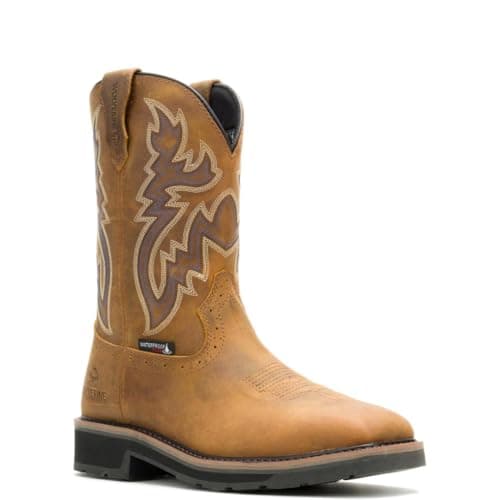
| 1 | Wolverine Rancher Pull-On Steel-Toe Work Wellington A waterproof pull-on with a steel toe, EH and SR rating — no laces to tie, no laces to catch, and the current ASTM F2413-24 designation. | A published EH and SR designation | Steel safety toeASTM F2413-24 I/C EH SR | |
| 2 | 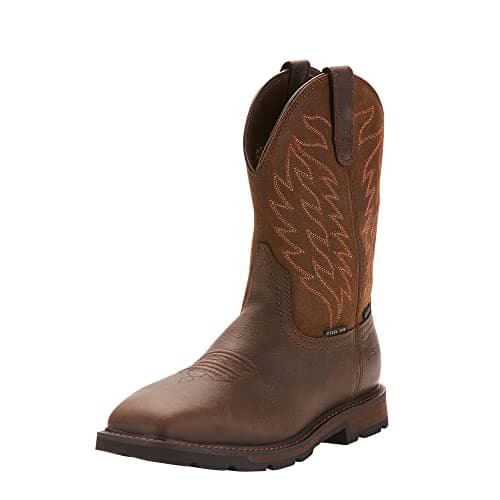 Ariat Groundbreaker H2O EH Steel Toe Wellington Work Boot Waterproof, EH-rated, steel-toe pull-on at the bottom of Ariat's range — the low-cost way into a lace-free waterproof boot. | EH at the lowest price here | Steel safety toeEH rated with steel safety toe | |
| 3 | 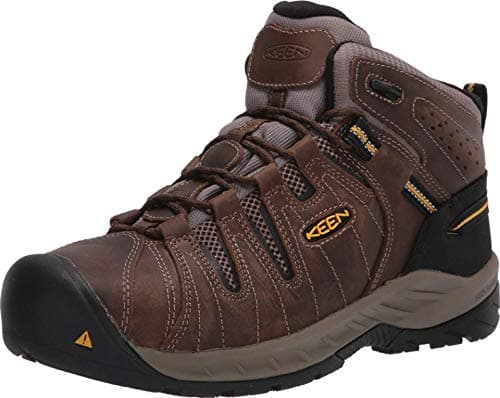 KEEN Utility Flint II Steel Toe Work Boot KEEN's work-hiker with a steel toe, EH-rated outsole and siping cut specifically for slick surfaces — a light boot for trades that walk all day. | A published full ASTM designation string | Steel safety toeASTM F2413-18 M/I/75/C/75 with EH (KEEN Utility safety-toe standard); EH-rated outsole with siping for traction on slick or wet surfaces | |
| 4 |  Hoffman 16" Unlined 9017 Lineman Boot Sixteen inches of upper, dual steel shanks and a rebuildable outsole — a purpose-built climbing boot rather than a work boot with a tall shaft. | A purpose-built climbing boot | Unlined build; safety-toe options vary by model — confirm before orderingLineman boots in this class are built to ASTM F2413 with an EH rating; confirm the designation for the exact model |
Tap a row to jump to that boot's full write-up. The price column goes straight to Amazon.
What EH actually certifies
The EH designation applies to the sole and heel of a finished boot. The test condition is published and specific — Carolina states it plainly on its own product pages: 18,000 volts at 60 Hz for one minute without leakage. A boot that passes gets EH added to its designation line, which looks something like ASTM F2413-24 M I/C EH.
Three limits come with it, and all three are part of the standard rather than fine print someone invented:
- It is secondary protection. It is a backup for incidental contact with an energized conductor, not a reason to work on one. De-energizing and lockout remain the primary control.
- It is tested dry. Water on and in the boot defeats it. On most outdoor work that is most of the time.
- It degrades with wear. The protection lives in the outsole. As that outsole thins, embeds grit, or picks up a metal fragment, the property you paid for erodes — and nothing on the boot tells you when.
A steel cap does not conflict with any of this. The cap is enclosed in the upper and insulated from both your foot and the ground, which is why EH-rated steel-toe boots are sold by the thousand — are steel toe boots an electrical hazard takes that apart in detail.
What dielectric footwear is
Dielectric footwear is electrical protective equipment: overboots and purpose-built boots rated for defined voltage exposure, specified in classes, and governed by their own test and in-service inspection regimes rather than by the EH clause of a footwear standard. It is bought for a named task by a safety department, inspected on a schedule, and retired on a schedule.
That is the practical difference. EH is a property your work boots happen to have. Dielectric equipment is something you are issued, told the class of, and expected to inspect. Nothing in this site's product registry publishes a dielectric class rating, and we do not list anything as dielectric on that basis.
| EH designation | Dielectric footwear | |
|---|---|---|
| What it is | An optional code on an ordinary work boot | Electrical protective equipment |
| How it is sold | A feature line on a boot's spec page | Specified by class for a voltage exposure |
| Role | Secondary protection, incidental contact | Task-specific protection |
| Condition assumed | Dry | Per the equipment's own standard |
| Who decides you need it | You, or a general site PPE policy | A hazard analysis for a named task |
| Inspection | None published — you watch the outsole | Scheduled inspection and retirement |
Where this comes up: utility work
The question is mostly asked by linemen and by people buying for them, because the trade uses purpose-built boots and sits closest to the dielectric category. A lineman boot is defined by its shank stiffness, shaft height and heel geometry for working on hooks and gaffs — the Hoffman 9017 publishes dual steel shanks and a 16-inch upper — rather than by an electrical rating.
Those boots are built to ASTM F2413 with an EH rating in this class, but the designation varies by model and the honest instruction is to confirm it for the exact model you are ordering rather than to assume it from the category. Work boots for linemen covers what the trade actually requires, and best EH-rated work boots collects the models that publish the designation clearly.
What to do with all this
If your work is near energized equipment as an incidental condition — HVAC at a disconnect, an electrician at a panel, maintenance in a plant — buy an EH-designated boot, understand it as a backup, and replace it when the outsole is worn rather than when the upper fails. Check the designation string, not the hangtag adjective.
If your work involves a defined high-voltage exposure, that is a task hazard analysis and an equipment question for your employer, and footwear is only one part of a system that includes gloves, sleeves and procedure. An EH work boot is the wrong tool for it, and buying a better work boot does not make it the right one. ASTM F2413 explained decodes the rest of the designation line while you are reading labels.
The picks in full
#1 — A published EH and SR designation
Wolverine Rancher Pull-On Steel-Toe Work Wellington
A waterproof pull-on with a steel toe, EH and SR rating — no laces to tie, no laces to catch, and the current ASTM F2413-24 designation.
Published specifications
- Toe
- Steel safety toe
- Safety rating
- ASTM F2413-24 I/C EH SR
- Upper
- Premium waterproof full-grain leather
- Outsole
- Slip-resistant work outsole
- Midsole / shank
- Not published on the manufacturer page
- Construction
- Not published as a welt construction
- Waterproof
- Waterproof full-grain leather upper
- Insulation
- Not insulated
Specifications read from Wolverine product page (Rancher pull-on steel toe wellington) on 2026-09-27. We have not worn this boot.
What works
- Carries the SR slip-resistance designation as well as EH
- On and off in seconds, which matters if you are in and out of a cab
- No laces to catch in machinery or on rungs
What doesn't
- No lacing means no way to fine-tune fit or lock the heel
- Pull-on shafts let debris in at the top
- Harder to get a precise fit than a lace-up
Who this is wrong for
Anyone with a narrow heel or a hard-to-fit foot. Without laces, you cannot correct heel slip, and heel slip is what causes blisters.
Sizing
Pull-ons must be sized for the widest part of your foot to get past the instep, which often means a slightly loose heel. Size for the instep, then fix the heel with a thicker sock or a heel-grip insole.
#2 — EH at the lowest price here
Ariat Groundbreaker H2O EH Steel Toe Wellington Work Boot
Waterproof, EH-rated, steel-toe pull-on at the bottom of Ariat's range — the low-cost way into a lace-free waterproof boot.
Published specifications
- Toe
- Steel safety toe
- Safety rating
- EH rated with steel safety toe
- Upper
- Leather upper with waterproof PRO construction
- Outsole
- Ariat work outsole
- Midsole / shank
- 4LR footbed technology for cushioning and support
- Construction
- Not published as a welt construction
- Waterproof
- Waterproof — Ariat PRO construction
- Insulation
- Not insulated
- Widths
- A wide (EE) version is listed
Specifications read from Authorized retailer spec page (Academy) — Ariat Groundbreaker Wide H2O EH steel toe wellington on 2026-09-27. We have not worn this boot.
What works
- Cheapest waterproof EH pull-on here
- Wide version genuinely stocked
- No laces to deal with in mud
What doesn't
- Entry-tier materials — expect a shorter life than the WorkHog XT
- Steel toe conducts cold
- Retailer page publishes less detail than Ariat's own pages
Who this is wrong for
Anyone in real cold. A steel cap with no insulation is the worst toe-temperature combination available.
Sizing
Groundbreaker pull-ons need room at the instep to get on. If your foot is high-volume, take the EE before you take a longer size.
#3 — A published full ASTM designation string
KEEN Utility Flint II Steel Toe Work Boot
KEEN's work-hiker with a steel toe, EH-rated outsole and siping cut specifically for slick surfaces — a light boot for trades that walk all day.
Published specifications
- Toe
- Steel safety toe
- Safety rating
- ASTM F2413-18 M/I/75/C/75 with EH (KEEN Utility safety-toe standard); EH-rated outsole with siping for traction on slick or wet surfaces
- Upper
- Leather and textile upper
- Outsole
- EH-rated outsole with strategically placed siping
- Midsole / shank
- KEEN.ReGEN cushioning with an ergonomic insole
- Construction
- Not published as a welt construction
- Waterproof
- Not waterproof in the base Flint II
- Insulation
- Not insulated
Specifications read from KEEN Utility product page (Flint II steel toe) on 2026-09-27. We have not worn this boot.
What works
- Siping is a specific traction feature, not a generic tread claim
- Light enough to walk a full shift in
- ReGEN cushioning holds up better than plain EVA
What doesn't
- Not waterproof in the base model
- Low-cut versions offer no ankle support
- Not resoleable
Who this is wrong for
Wet trades. If your feet get soaked regularly, start with a membrane boot instead — the Flint II's virtue is low weight, not water resistance.
Sizing
Standard KEEN Original Fit: generous forefoot, normal heel. Take your usual size and use the lacing to lock the heel.
Illustrative category photo — not this model#4 — A purpose-built climbing boot
Hoffman 16" Unlined 9017 Lineman Boot
Sixteen inches of upper, dual steel shanks and a rebuildable outsole — a purpose-built climbing boot rather than a work boot with a tall shaft.
Published specifications
- Toe
- Unlined build; safety-toe options vary by model — confirm before ordering
- Safety rating
- Lineman boots in this class are built to ASTM F2413 with an EH rating; confirm the designation for the exact model
- Upper
- 16" leather upper, unlined
- Outsole
- Rebuildable outsole
- Midsole / shank
- Dual steel shanks
- Construction
- Rebuildable — solid hardware
- Waterproof
- Unlined leather; no membrane
- Insulation
- Unlined — not insulated
- Made in
- Made in the USA
Specifications read from Hoffman Boots product page (Unlined 9017 Lineman) on 2026-09-27. We have not worn this boot.
What works
- Dual shanks are the stiffest platform here
- Sixteen inches of upper genuinely protects the lower leg
- Rebuildable rather than replaceable
What doesn't
- Absurd for any job that is not climbing
- Unlined means no waterproofing
- Heavy and hot
Who this is wrong for
Every trade except pole and tree work. Do not buy a 16-inch dual-shank boot to stand on a warehouse floor.
Sizing
Sized for a climbing fit, which is tighter than a walking fit — the foot must not move inside the boot on a rung. Fit it with the sock and any insole you will actually climb in.
Frequently asked questions
What is the difference between dielectric and EH rated boots?
EH is an optional designation under ASTM F2413 printed on ordinary work boots: the sole and heel are tested at 18,000 volts, 60 Hz for one minute in dry conditions with leakage under 1.0 mA, certifying the boot as secondary protection against incidental contact. Dielectric footwear is a separate class of electrical protective equipment, specified by class for a defined voltage exposure and managed under its own inspection regime.
What does EH rated mean on work boots?
That the finished boot's sole and heel passed an 18,000-volt, 60 Hz, one-minute dry test with leakage under 1.0 milliamp. It is secondary protection — a backup for incidental contact, never a licence to work energized. It is tested dry, so water defeats it, and it degrades as the outsole wears.
Are EH rated boots enough for electrical work?
For incidental exposure around panels, disconnects and plant equipment, EH is the right designation to buy. For a defined high-voltage task, it is not the control: that requires a task hazard analysis and a system of rated equipment and procedure, with footwear as one part. Buying a more expensive work boot does not change which category you are in.
Do steel toe boots cancel out an EH rating?
No. The cap is enclosed in the upper and insulated from both the foot and the ground, which is why EH-rated steel-toe boots are sold routinely. The EH property lives in the sole and heel, not in the toe.
Sources
- ASTM F2413 safety footwear ratings explained — The 18,000-volt / 60 Hz / one-minute EH test condition, stated in full
- Carolina Shoe — electrical hazard test conditions — A manufacturer stating the EH test in full: 18,000 volts at 60 Hz for one minute without leakage
- ASTM F2413 protective footwear standard — technical summary — Label format, the mandatory I and C designations, and each optional code
- OSHA 29 CFR 1910.136 — Foot protection — The federal rule itself: when protective footwear is required, and which consensus standards it accepts
- Nicks Boots — what lineman boots are — Shank stiffness, shaft height and heel geometry for pole work
Read next
Best EH-Rated Work Boots
The models that publish the designation clearly.
Are Steel Toe Boots an Electrical Hazard?
Why the cap is not the problem people think it is.
Work Boots for Linemen
Where this question is actually asked, and what the trade requires.
ASTM F2413 Explained
The rest of the designation line, code by code.