Trades
Best Work Boots for Oil Field Work
The only trade where the top of your foot is as exposed as the front of it.
Disclosure: product links on this page go to Amazon. As an Amazon Associate we earn from qualifying purchases, at no extra cost to you. It does not change which boots we recommend or the order they appear in — here is the full disclosure.
Quick picks
| # | Product | Best for | Toe & rating | Price |
|---|---|---|---|---|
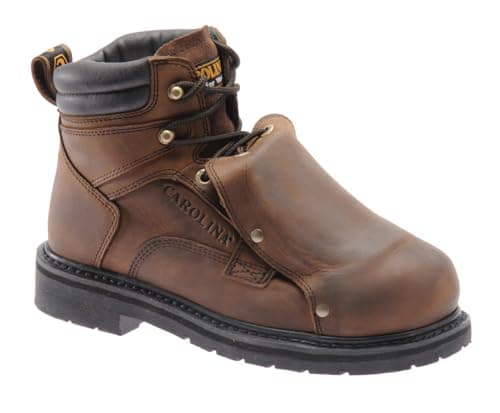
| 1 | Carolina Metpro 6" Wide Steel Toe External Met Guard (599) A welted steel toe with a leather-wrapped external met guard on a heat-resisting Vibram outsole — the heaviest-duty combination here, and one of the few met-guard boots that publishes the Mt class, the EH test and the outsole's heat rating together. | Pipe, tongs and repeated heavy impact | Steel safety toe cap behind a heavy plastic, dense-foam-lined external metatarsal guardASTM F2413-18 safety toe; ASTM F2413-18 Class Mt75 metatarsal impact resistance; electrical-hazard rated, tested to withstand 18,000 volts at 60Hz for one minute | |
| 2 | 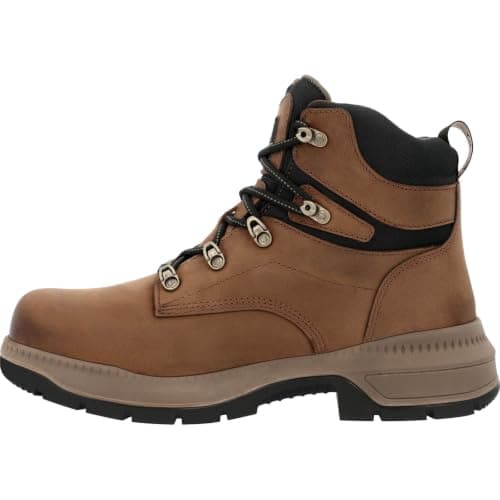 Rocky Worksmart Composite Toe Internal MET Guard Waterproof Work Boot An internal metatarsal guard inside a waterproof composite-toe boot — Mt-class protection without the external bulge that catches on everything. | Met protection you can still climb in | Composite safety toe with an internal metatarsal guardComposite safety toe with internal metatarsal protection; Rocky lists ASTM F2413 compliance on the Worksmart line | |
| 3 | 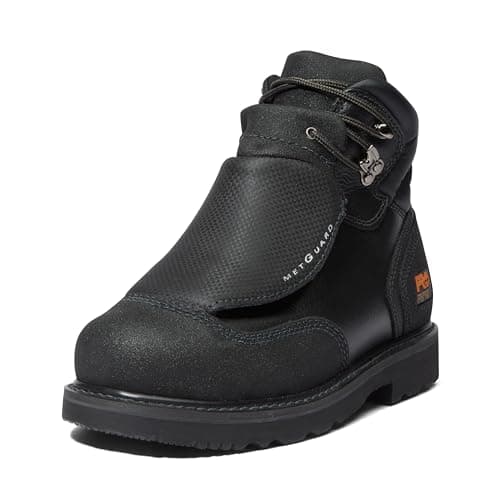 Timberland PRO External Met Guard 6" Steel Toe Work Boot A six-inch steel toe with a visible external metatarsal guard, and the only boot here that publishes the Mt designation as plainly as the toe rating — the boot to buy when the hazard assessment says something can land on the top of your foot. | Sites that want the guard visible | Metallic, asymmetrical-shaped steel safety toe capSteel safety toe meets ASTM F2412-18a and ASTM F2413-18 for impact (I) and compression (C); the metatarsal guard meets ASTM F2412-18a and ASTM F2413-18 for metatarsal impact resistance | |
| 4 | 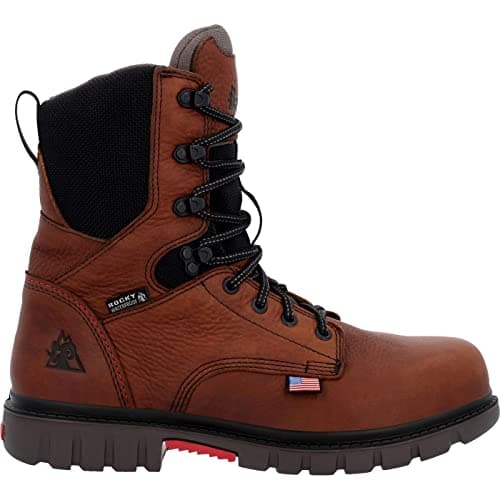 Rocky Worksmart 8" Waterproof Composite Toe Work Boot (RKK0403) An 8-inch waterproof composite toe from Rocky's work line — shaft height and a non-metallic cap in one boot. | A tall shaft without a met guard | Composite safety toe, non-metallicSafety toe meeting ASTM F2413; Rocky lists electrical hazard protection on the Worksmart line | |
| 5 | 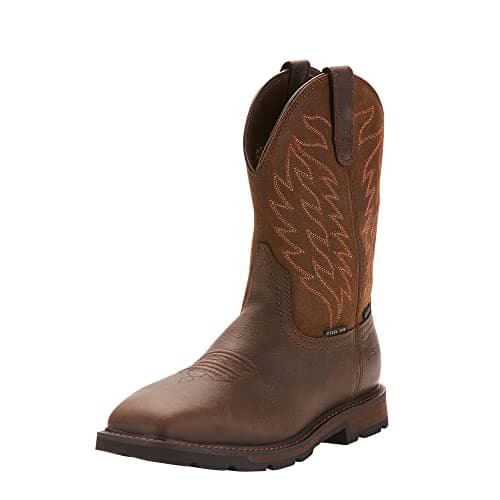 Ariat Groundbreaker H2O EH Steel Toe Wellington Work Boot Waterproof, EH-rated, steel-toe pull-on at the bottom of Ariat's range — the low-cost way into a lace-free waterproof boot. | Mud, and boots off at the gate | Steel safety toeEH rated with steel safety toe |
Tap a row to jump to that boot's full write-up. The price column goes straight to Amazon.
Why a safety toe is only half the boot here
A safety toe is certified to stop 75 foot-pounds of impact across the front of the boot. It covers roughly the first inch and a half. Every heavy object on a rig floor that gets dropped — a section of pipe, a set of tongs, a valve body, a wrench — lands flat, and flat means it lands on the instep. Metatarsal protection is a separate optional designation under the same standard, marked Mt on the label, and it is the designation that matters most in this trade.
OSHA 29 CFR 1910.136 does not name oil and gas, and it does not name steel. It requires protective footwear wherever the employer's own hazard assessment finds a foot hazard, and it accepts any boot certified to ASTM F2412/F2413. That is why your site's PPE matrix, not the federal rule, is the document that tells you whether you need Mt — and on most drilling and workover crews it does. ASTM F2413 explained decodes every code on the label, and metatarsal guard boots covers the internal-versus-external decision in full.
| What is happening | The feature that answers it | What it costs you |
|---|---|---|
| Pipe and tools dropped onto the instep | Mt-designated metatarsal protection | Instep volume, and some weight |
| Crude, hydraulic fluid and diesel on steel decking | An outsole specified as oil-resisting, not just lugged | Softer compounds wear faster on gravel |
| Mud at the pad and in the cellar | A sealed upper, or a pull-on you can hose off | A membrane traps heat for the rest of the shift |
| Climbing stairs, ladders and the derrick | An internal guard and a defined heel | An external guard catches on rungs |
| Energized equipment on the pad | An EH designation on the outsole | Secondary protection only, and it degrades as the sole wears |
| Boots off before the truck or the man camp | Pull-on entry with no laces to clog | You lose heel-lock and fine fit control |
Internal or external met guard
Both carry the same Mt designation. The difference is where the plate sits. An external guard — the Carolina Metpro and the Timberland PRO External Met Guard here — is a visible shield over the laces, and some operators specify it precisely because a supervisor can confirm compliance from ten feet away. The cost is that it catches on ladder rungs and is awkward to kneel in.
An internal guard, as on the Rocky Worksmart met model, is built into the tongue and flexes with the foot. You can climb and kneel in it normally. The trade-off is instep volume: between a cap at the front and a guard over the top, the Metpro has the least spare room of anything on this list. Fit it in the afternoon, when your feet are at their largest, and lace the instep loosely for the first week — a guard cinched down on the instep is the real cause of the numbness people blame on met guards in general.
The outsole spec is the one most people skip
Oil on painted steel decking is a harder traction problem than wet concrete, and an aggressive-looking lug pattern tells you nothing about it. What matters is whether the maker publishes oil resistance as a property of the compound. Carolina publishes a Vibram outsole rated heat-resistant to a minimum of 500°F for the Metpro; the Worksmart line is listed as oil- and slip-resisting. Where a boot carries the separate ASTM F3445 SR designation it has been measured against a named test rather than described in marketing language — best slip-resistant work boots explains the thresholds.
Shaft height, mud and heat
Most oilfield crews end up in an 8-inch boot or a pull-on, for the same reason: the cellar, the pad and the mud pits all put water and solids above the ankle of a 6-inch boot. The Worksmart 8-inch waterproof composite toe is the straightforward version of that — tall, sealed, non-metallic cap — and the Ariat Groundbreaker wellington is the lace-free version for anyone who has to get boots off before they get into a vehicle.
Both choices are hot. A tall waterproof shaft is the warmest combination in work footwear, and nothing in the category fixes that; you manage it with socks and by drying the boots properly between shifts rather than by buying a cooler boot that leaks. If you work a summer in West Texas and a winter in North Dakota, two pairs is the honest answer, and 6-inch vs 8-inch work boots sets out where the line falls.
Steel or composite for this trade
Steel takes repeated heavy impact better than any non-metallic cap, and an oilfield is one of the few places where repeated impact on the same boot is a realistic expectation rather than a hypothetical. That is the case for the Metpro. Against it: steel conducts cold, it is heavier, and it sets off the detectors some facilities use. A composite Mt boot gives up a margin of repeat-impact tolerance for a lighter, warmer, non-metallic build — steel toe vs composite toe has the full comparison. Neither is non-compliant; both meet the same certified thresholds.
The picks in full
#1 — Pipe, tongs and repeated heavy impact
Carolina Metpro 6" Wide Steel Toe External Met Guard (599)
A welted steel toe with a leather-wrapped external met guard on a heat-resisting Vibram outsole — the heaviest-duty combination here, and one of the few met-guard boots that publishes the Mt class, the EH test and the outsole's heat rating together.
Published specifications
- Toe
- Steel safety toe cap behind a heavy plastic, dense-foam-lined external metatarsal guard
- Safety rating
- ASTM F2413-18 safety toe; ASTM F2413-18 Class Mt75 metatarsal impact resistance; electrical-hazard rated, tested to withstand 18,000 volts at 60Hz for one minute
- Upper
- Dark brown Crazy Horse leather upper, Taibrelle lined
- Outsole
- Vibram heat-resisting rubber outsole, rated heat-resistant to a minimum of 500°F
- Midsole / shank
- Steel shank; removable AG7 polyurethane footbed
- Construction
- Welt construction
- Waterproof
- Not published on the product page — treat this model as not waterproof
- Insulation
- Not published on the product page — treat as uninsulated
- Widths
- D and 2E, sizes 7-14
Specifications read from Carolina Shoe product page (Metpro 6" wide steel toe external met guard, 599) on 2026-10-16. We have not worn this boot.
What works
- Steel handles repeated heavy impact better than any composite
- Publishes the Mt class, the EH test condition and the outsole heat rating — most met-guard listings publish none of the three
- Welt construction, so the heaviest-duty boot here is also the one you can have resoled
What doesn't
- Heavy, and it feels it by hour ten
- An external guard catches on ladder rungs and is awkward to kneel in
- No waterproof membrane published, so this is a dry-site boot
Who this is wrong for
Anyone who walks long distances or works in standing water. This is a boot for standing in one hazardous dry place, not covering ground.
Sizing
Between the steel cap and the guard, the front half of this boot has the least spare volume of anything here, and the guard changes how the instep laces: loose over the guard, tight at the ankle. Take the 2E before you take a longer size. Fit it in the afternoon, when your feet are at their largest.
#2 — Met protection you can still climb in
Rocky Worksmart Composite Toe Internal MET Guard Waterproof Work Boot
An internal metatarsal guard inside a waterproof composite-toe boot — Mt-class protection without the external bulge that catches on everything.
Published specifications
- Toe
- Composite safety toe with an internal metatarsal guard
- Safety rating
- Composite safety toe with internal metatarsal protection; Rocky lists ASTM F2413 compliance on the Worksmart line
- Upper
- Leather upper with a waterproof membrane
- Outsole
- Rocky work outsole
- Midsole / shank
- Not published on the manufacturer page
- Construction
- Not published as a welt construction
- Waterproof
- Waterproof
- Insulation
- Not insulated
Specifications read from Rocky Boots product page (Worksmart comp toe internal MET guard waterproof) on 2026-09-27. We have not worn this boot.
What works
- Internal guard flexes with the foot — you can kneel and climb in it
- Nothing external to catch on a rung
- Non-metallic cap
What doesn't
- Harder for a supervisor to verify at a glance than an external guard
- The guard takes up instep volume
- Limited published spec detail
Who this is wrong for
Sites that require visible met protection. Some employers specify an external guard precisely because it can be seen.
Sizing
An internal met guard fills the instep. If you have a high-volume foot, expect to need a wide — and lace the instep loosely for the first week.
#3 — Sites that want the guard visible
Timberland PRO External Met Guard 6" Steel Toe Work Boot
A six-inch steel toe with a visible external metatarsal guard, and the only boot here that publishes the Mt designation as plainly as the toe rating — the boot to buy when the hazard assessment says something can land on the top of your foot.
Published specifications
- Toe
- Metallic, asymmetrical-shaped steel safety toe cap
- Safety rating
- Steel safety toe meets ASTM F2412-18a and ASTM F2413-18 for impact (I) and compression (C); the metatarsal guard meets ASTM F2412-18a and ASTM F2413-18 for metatarsal impact resistance
- Upper
- Leather upper with Ever-Guard abrasion-resistant leather
- Outsole
- Timberland PRO rubber outsole — heat-resistant, with slip, oil and abrasion resistance
- Midsole / shank
- Timberland PRO 24/7 Comfort System suspension; shank material not published on the listing
- Construction
- Not published as a welt construction
- Waterproof
- Not stated on the listing — treat this model as not waterproof
- Insulation
- Not stated on the listing — treat as uninsulated
Specifications read from Timberland PRO published listing (External Met Guard 6" steel toe, ASIN B0D2K6GVL5) on 2026-10-16. We have not worn this boot.
What works
- An external guard is visibly there — a supervisor can confirm compliance at a glance
- Publishes the metatarsal designation as explicitly as the toe rating, which most met-guard listings do not
- Heat-resistant outsole suits the hot-surface work that usually comes with instep hazards
What doesn't
- An external guard catches on ladder rungs and is awkward to kneel in
- No waterproof membrane, so this is a dry-site boot
- No shank material or weight published on the listing
Who this is wrong for
Anyone who kneels constantly or climbs a lot. An internal met guard flexes better for both — look at the Rocky Worksmart internal-met model.
Sizing
Met-guard boots change how the instep laces. Lace it loosely over the guard and tight at the ankle; a guard cinched down on the instep is what causes the numbness people blame on met guards generally.
#4 — A tall shaft without a met guard
Rocky Worksmart 8" Waterproof Composite Toe Work Boot (RKK0403)
An 8-inch waterproof composite toe from Rocky's work line — shaft height and a non-metallic cap in one boot.
Published specifications
- Toe
- Composite safety toe, non-metallic
- Safety rating
- Safety toe meeting ASTM F2413; Rocky lists electrical hazard protection on the Worksmart line
- Upper
- Leather upper with a waterproof membrane
- Outsole
- Rocky work outsole, oil- and slip-resisting
- Midsole / shank
- Not published on the manufacturer page
- Construction
- Not published as a welt construction
- Waterproof
- Waterproof
- Insulation
- Not insulated in this model
Specifications read from Rocky Boots product page (Worksmart 8" waterproof comp toe) on 2026-09-27. We have not worn this boot.
What works
- Tall shaft keeps water and debris out
- Non-metallic cap
- Rocky also offers internal-met and pull-on versions on the same platform
What doesn't
- Rocky publishes limited spec detail per model
- 8-inch shaft is hot and slow
- Not resoleable
Who this is wrong for
Summer work. An 8-inch waterproof boot is the hottest combination on this list.
Sizing
Rocky's Worksmart last is medium. Check ankle flex specifically — an 8-inch shaft that creases in the wrong place will rub for the life of the boot.
#5 — Mud, and boots off at the gate
Ariat Groundbreaker H2O EH Steel Toe Wellington Work Boot
Waterproof, EH-rated, steel-toe pull-on at the bottom of Ariat's range — the low-cost way into a lace-free waterproof boot.
Published specifications
- Toe
- Steel safety toe
- Safety rating
- EH rated with steel safety toe
- Upper
- Leather upper with waterproof PRO construction
- Outsole
- Ariat work outsole
- Midsole / shank
- 4LR footbed technology for cushioning and support
- Construction
- Not published as a welt construction
- Waterproof
- Waterproof — Ariat PRO construction
- Insulation
- Not insulated
- Widths
- A wide (EE) version is listed
Specifications read from Authorized retailer spec page (Academy) — Ariat Groundbreaker Wide H2O EH steel toe wellington on 2026-09-27. We have not worn this boot.
What works
- Cheapest waterproof EH pull-on here
- Wide version genuinely stocked
- No laces to deal with in mud
What doesn't
- Entry-tier materials — expect a shorter life than the WorkHog XT
- Steel toe conducts cold
- Retailer page publishes less detail than Ariat's own pages
Who this is wrong for
Anyone in real cold. A steel cap with no insulation is the worst toe-temperature combination available.
Sizing
Groundbreaker pull-ons need room at the instep to get on. If your foot is high-volume, take the EE before you take a longer size.
Frequently asked questions
Do oil field workers need metatarsal boots?
Most drilling and workover crews do, because the common dropped objects on a rig floor land flat on the instep rather than on the front of the toe. OSHA does not name the industry or the designation — 29 CFR 1910.136 requires protective footwear where the employer's hazard assessment finds a hazard — so the site PPE matrix is the document that decides. Where it calls for Mt, a safety toe alone does not comply.
Are steel toe or composite toe boots better for oilfield work?
Both meet the same ASTM F2413 impact and compression thresholds. Steel handles repeated heavy impact better, which is the realistic failure mode around pipe and tongs, and it is the reason to take a steel Mt boot. Composite is lighter, warmer in cold, and passes metal detectors — worth it if you climb constantly or work a winter pad.
What boots are best for oil on steel decking?
Look for an outsole the maker specifies as oil-resisting, or better, one carrying the separate ASTM F3445 SR designation, which means it was measured against a named coefficient-of-friction test. Lug depth is irrelevant to oil on smooth steel; the compound is what grips.
Should oilfield boots be 6-inch or 8-inch?
Eight-inch or a pull-on wellington, for most crews. The cellar, the pad and mud all put water and solids above the ankle of a 6-inch boot. The cost is heat, which you manage with socks and overnight drying rather than by buying a shorter boot.
Sources
- OSHA 29 CFR 1910.136 — Foot protection — The federal rule itself: when protective footwear is required, and which consensus standards it accepts
- ASTM F2413 protective footwear standard — technical summary — Label format, the mandatory I and C designations, and each optional code
- ASTM F2413 safety footwear ratings explained — The 18,000-volt / 60 Hz / one-minute EH test condition, stated in full
- Reebok Work Sublite Cushion — ASTM F3445 slip-resistance rating — Slip resistance stated against a named ASTM test method
Read next
Metatarsal Guard Boots
Internal vs external guards, and what the Mt designation actually certifies.
6-Inch vs 8-Inch Work Boots
Where the extra two inches of shaft earn their heat penalty.
ASTM F2413 Explained
The rating your trade actually needs, and what each code on the label certifies.
Work Boot Sizing Guide
Get the fit right before you spend money — most boot complaints are fit.
How to Break In Work Boots
What to do in the two weeks before your first full shift in a new pair.