Trades
Best Work Boots for Pipefitters
Heavy things at instep height, and a floor with cutting oil on it.
Disclosure: product links on this page go to Amazon. As an Amazon Associate we earn from qualifying purchases, at no extra cost to you. It does not change which boots we recommend or the order they appear in — here is the full disclosure.
Quick picks
| # | Product | Best for | Toe & rating | Price |
|---|---|---|---|---|
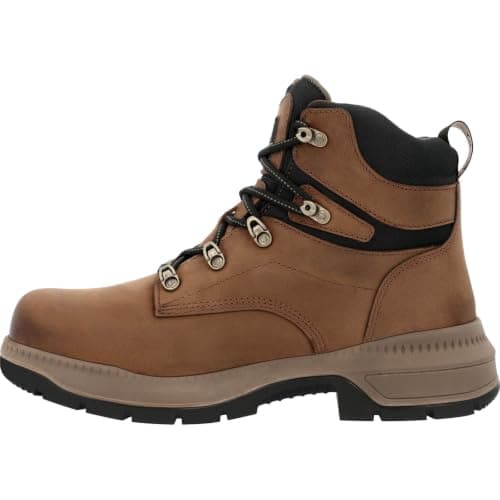
| 1 | Rocky Worksmart Composite Toe Internal MET Guard Waterproof Work Boot An internal metatarsal guard inside a waterproof composite-toe boot — Mt-class protection without the external bulge that catches on everything. | Met protection you can kneel in | Composite safety toe with an internal metatarsal guardComposite safety toe with internal metatarsal protection; Rocky lists ASTM F2413 compliance on the Worksmart line | |
| 2 | 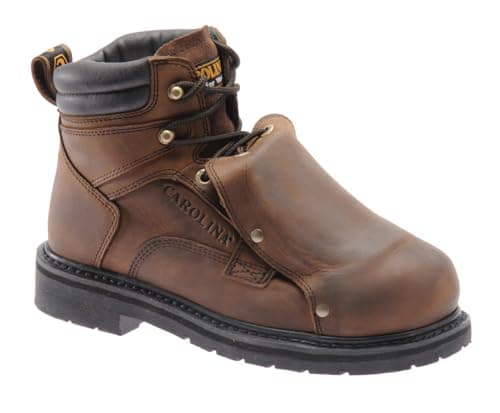 Carolina Metpro 6" Wide Steel Toe External Met Guard (599) A welted steel toe with a leather-wrapped external met guard on a heat-resisting Vibram outsole — the heaviest-duty combination here, and one of the few met-guard boots that publishes the Mt class, the EH test and the outsole's heat rating together. | Heaviest duty, Mt75 published | Steel safety toe cap behind a heavy plastic, dense-foam-lined external metatarsal guardASTM F2413-18 safety toe; ASTM F2413-18 Class Mt75 metatarsal impact resistance; electrical-hazard rated, tested to withstand 18,000 volts at 60Hz for one minute | |
| 3 | 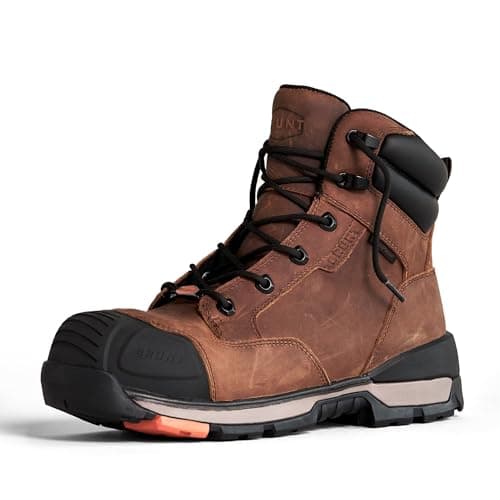 BRUNT The Perkins Waterproof Composite Toe Work Boot The Perkins swaps the Marin's profile for a defined 90-degree heel — the version to buy if you spend the day on ladders, scaffolding or roof edges. | A 90° heel for racks and ladders | Composite safety toe, non-metallicComposite safety toe with electrical hazard (EH) protection; slip- and oil-resistant | |
| 4 | 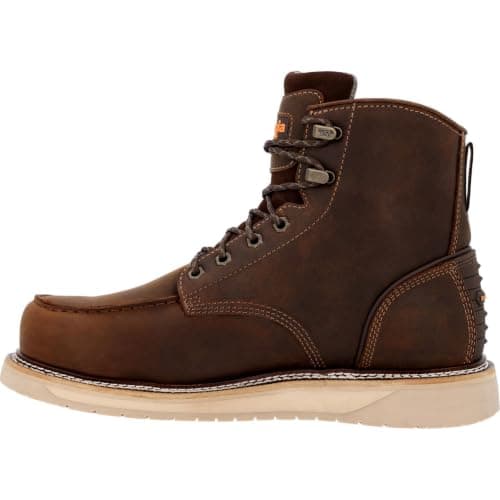 Georgia Boot AMP LT Wedge Composite Toe Waterproof Work Boot (GB00592) A waterproof composite-toe wedge whose SPR leather is specified against named caustics — the pick where the floor is flat and the spills are chemical. | Oil and chemical on a flat floor | Ergo-Fit composite toeMeets ASTM F2413 Protective Toe Classification and ASTM F2413 Electrical Hazard Classification | |
| 5 | 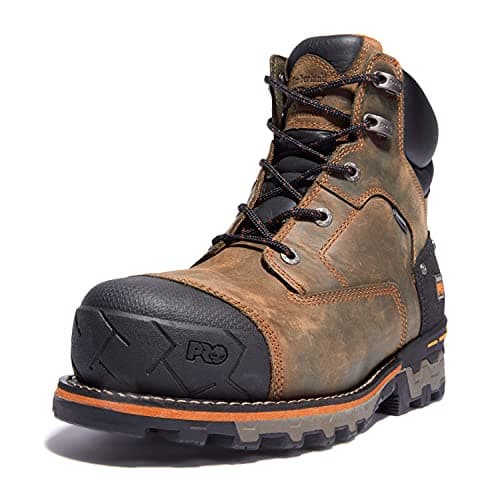 Timberland PRO Boondock 6" Composite Toe Waterproof Work Boot A waterproof composite-toe boot whose all-weather TPU outsole is specifically formulated to stay flexible when it gets cold — which is when most rubber compounds stop gripping. | Outdoor plant work, fullest spec sheet | Asymmetrical composite safety toe, non-metallicMeets ASTM F2412-18a and ASTM F2413-18 for impact (I) and compression (C); EH protection meets ASTM F2413-18 and ASTM F2892-18; waterproof membrane meets ASTM F1671-07 | |
| 6 | 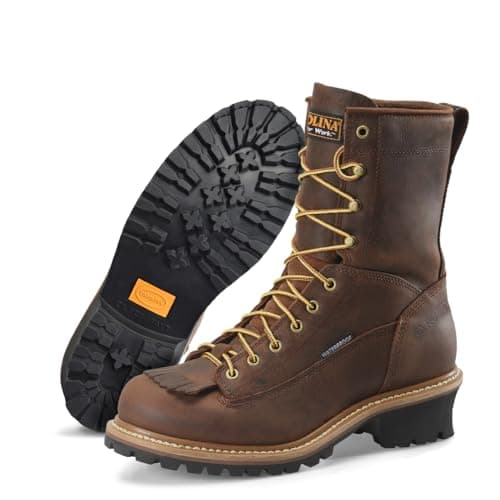 Carolina Spruce 8" Steel Toe Waterproof Logger A waterproof 8-inch logger with a triple-bar steel shank — the stiff underfoot platform that ladder rungs and pole work actually need. | Sustained climbing, up to 4E | Steel safety toe capMeets or exceeds ASTM F2413-18 for compression and impact; electrical hazard protection tested to withstand 18,000 volts at 60Hz for one minute without leakage |
Tap a row to jump to that boot's full write-up. The price column goes straight to Amazon.
The load lands above the toes
This is the thing that makes pipefitting different from the trades it gets grouped with. A toe cap covers roughly the front two inches of your foot. The objects a fitter handles all day — threaded pipe, valve bodies, flanges, fittings, spool pieces — are heavy, awkward and dropped or set down at instep height, which is behind the cap and in front of the ankle.
ASTM F2413 covers that area with a separate optional designation: Mt, metatarsal protection, with its own impact test. It is the single most under-specified feature in industrial work, and for this trade it should be the first thing you look for rather than an afterthought. Metatarsal guard boots covers the designation in detail.
Then there is the floor
Threading and cutting oil goes on the floor. So does pipe dope, so does condensate, and in a plant so does whatever the process leaks. Oily-wet is a harder traction problem than plain wet, and ASTM F3445 reflects that: the minimum coefficient of friction is 0.40 in wet and dry conditions but only 0.33 in oily-wet, because oil is genuinely harder to grip through.
Two consequences. First, buy a boot with a measured slip rating rather than a hangtag phrase — “oil resistant” often describes whether the compound survives oil, not whether it grips through it. Second, deep lugs are not the answer indoors: a lug pattern packs with oily swarf and then you are walking on a smooth plug of it. Best slip-resistant work boots explains how slip performance is actually measured.
The five criteria, in priority order
1. Metatarsal protection, internal or external. Ask your employer which they specify before you buy — some sites require an external guard precisely because it can be seen from across the floor. Internal guards flex better if you kneel and climb, which most fitters do constantly.
2. A named oil-slip rating. ASTM F3445, and ideally the SRO designation that covers the oily-wet case specifically.
3. A heel profile matched to how much you climb. Pipe racks, scaffolds and ladders reward a defined 90-degree heel breast; a flat wedge is better if your work is slab-level. You cannot have both.
4. Heat tolerance if you also weld. A large share of pipefitting work involves welding the joints you have just fitted, and spatter lands on boots. An outsole with a published heat rating is worth seeking out — the welders page covers the rest of that specification, including why laces and spatter do not mix.
5. A shank stiff enough for rungs. If you spend real time standing on round bar, a flexible boot transmits that edge straight into your arch.
The six, on what each maker publishes
| Met guard | Toe | Oil / slip | Heat | Widths | |
|---|---|---|---|---|---|
| Rocky Worksmart MET CT | Internal metatarsal guard | Composite | Rocky work outsole; no ASTM slip tier named | Not published | Not published |
| Carolina Metpro | External, ASTM F2413-18 Class Mt75 | Steel | Oil- and slip-resisting | Vibram rated to a minimum 500°F | D and 2E, sizes 7-14 |
| BRUNT The Perkins | None | Composite with EH | Slip- and oil-resistant | Outsole to 572°F / 300°C | SWITCH-FIT D or EE |
| Georgia AMP LT Wedge | None | Ergo-Fit composite with EH | Carbo-Tec — chemical, abrasion and slip resistant | Heat resistant, no figure published | Not published |
| Timberland PRO Boondock | None | Composite, F2412-18a / F2413-18, EH to F2892-18 | Slip-, oil- and abrasion-resistant all-weather TPU | Not published | Not published |
| Carolina Spruce logger | None | Steel, EH tested at 18,000V for one minute | Oil- and slip-resisting logger outsole | Not published | D, 2E and 4E |
Rocky Worksmart internal MET — the default
An internal metatarsal guard inside a waterproof composite-toe boot is the right default for this trade. You get Mt-class instep cover without the external shell that catches on rack rails, valve handwheels and every edge you squeeze past, and because the guard is inside the upper it flexes when you kneel — which a fitter does dozens of times a shift.
The honest cons. Rocky publishes the least of the six: ASTM F2413 compliance is listed at the Worksmart line level rather than as a full designation string on this model's page, there is no named ASTM slip tier, no published width run and no weight. And no welt, so it is a replace-it boot.
Wrong for: sites that require visible met protection. Some employers specify an external guard precisely so it can be checked at a glance.
Carolina Metpro — the heavy answer
When impacts are routine rather than theoretical, the Metpro is the boot on this list that publishes the most about protecting you from them: an ASTM F2413-18 Class Mt75 external guard, a steel cap, an electrical-hazard rating stated in full at 18,000 volts for one minute, and a Vibram outsole rated heat-resistant to a minimum of 500°F. It is welted, so it can be resoled — see Goodyear welt vs stitchdown for what that is worth — and it comes in D and 2E.
The honest cons. It is the heaviest boot here by some distance, it is not published as waterproof, and the leather-wrapped external guard is exactly the bulge that snags in tight spaces. Carolina is blunt about the use case: this is a boot for standing in one hazardous dry place, not for covering ground.
Wrong for: anyone who walks long distances or works in standing water.
BRUNT The Perkins — if you live on racks
The Perkins has one feature that matters more to a fitter than its spec sheet suggests: a defined 90-degree heel breast that catches a rung or a rack rail instead of letting the foot slide forward. Add a waterproof upper, a composite toe with EH, an outsole heat-rated to 572°F and SWITCH-FIT width adjustment between D and EE, and it covers most of a fitter's day apart from the instep.
The honest cons. No metatarsal guard, which is the headline spec for this trade — so this is the pick for fitters whose hazard assessment does not require Mt. BRUNT does not publish the full ASTM designation line, and it is not a welt construction.
Wrong for: flat-floor work. A heel breast concentrates load where a wedge would spread it.
Georgia AMP LT Wedge — for the oily slab
The pick when your floor is the problem. Georgia specifies the SPR leather against five named caustics — caustic alkali, sulfuric acid, calcium hydroxide, potassium phosphate and caustic potash — which is a different order of claim from “chemical resistant,” and the Carbo-Tec outsole is specified for heat, chemical, abrasion and slip resistance. The wedge spreads load for standing work.
The honest cons. No met guard. Georgia lists it at $205, the most expensive non-logger here. The dual-density EVA midsole stiffens in cold and the boot is uninsulated, so it is wrong for outdoor winter work. No welt.
Wrong for: cold outdoor work, on Georgia's own reasoning.
Timberland PRO Boondock — the documented one
If you have to submit footwear specs to a safety officer, this is the page that answers the questions without a follow-up: ASTM F2412-18a and F2413-18 for impact and compression, F2892-18 for the EH rating, and F1671-07 for the waterproof membrane — three standards named separately for three separate claims. The all-weather TPU outsole is also specifically formulated to stay flexible in cold, which almost no maker addresses.
The honest cons. No met guard and no published width run or weight. Timberland describes the outsole as slip-, oil- and abrasion-resistant without naming an ASTM slip tier, which is a weaker claim than Ariat's SRO. No welt.
Wrong for: anyone counting grams — a composite-toe work hiker is noticeably lighter.
Carolina Spruce logger — for sustained climbing
If a real share of your week is spent standing on round bar, the Spruce is the only pick here built for it: a triple-bar steel shank that keeps the sole from folding over a rung, a waterproof SCUBALINER lining, the EH test published in full, and the widest fit on the page at D, 2E and 4E.
The honest cons. Heavy, and stiff in a way that is actively unpleasant on a slab — Carolina says the stiffness is a feature on a rung and a liability on level ground. No met guard. The defined logger heel is wrong for flat-floor hours. Best logger boots is the category page.
Wrong for: warehouse and flat-floor work.
Two details for confined-space work
Profile matters more than you expect. An external met guard and a deep lug both add bulk in exactly the places that catch when you are working inside a vessel, a pipe chase or under a skid. If most of your work is confined, the internal-guard route is worth the loss of visible protection.
Non-metallic helps in more places than detectors. A composite cap does not conduct heat out of your toes, which matters on cold outdoor plant work, and it removes one conductive path near energized equipment. Note that a composite cap does not make the whole boot non-metallic — Carolina's Poplar logger has a composite cap and a steel shank. What composite toe means covers the distinction, and what EH rated means covers the rating most plants require.
Buying in order
Get the mandatory designations from your employer first — Mt, EH, SD and PR are all optional ASTM codes and only your site knows which apply. Then choose on floor and climbing mix: wedge for slab-level work, 90-degree heel or a stiff shank if you are on racks. Then fit, which decides whether you can stand in them. Then weight. ASTM F2413 explained decodes every code quoted here, and the plumbers page is the one to read instead if your work is residential rather than industrial.
The picks in full
#1 — Met protection you can kneel in
Rocky Worksmart Composite Toe Internal MET Guard Waterproof Work Boot
An internal metatarsal guard inside a waterproof composite-toe boot — Mt-class protection without the external bulge that catches on everything.
Published specifications
- Toe
- Composite safety toe with an internal metatarsal guard
- Safety rating
- Composite safety toe with internal metatarsal protection; Rocky lists ASTM F2413 compliance on the Worksmart line
- Upper
- Leather upper with a waterproof membrane
- Outsole
- Rocky work outsole
- Midsole / shank
- Not published on the manufacturer page
- Construction
- Not published as a welt construction
- Waterproof
- Waterproof
- Insulation
- Not insulated
Specifications read from Rocky Boots product page (Worksmart comp toe internal MET guard waterproof) on 2026-09-27. We have not worn this boot.
What works
- Internal guard flexes with the foot — you can kneel and climb in it
- Nothing external to catch on a rung
- Non-metallic cap
What doesn't
- Harder for a supervisor to verify at a glance than an external guard
- The guard takes up instep volume
- Limited published spec detail
Who this is wrong for
Sites that require visible met protection. Some employers specify an external guard precisely because it can be seen.
Sizing
An internal met guard fills the instep. If you have a high-volume foot, expect to need a wide — and lace the instep loosely for the first week.
#2 — Heaviest duty, Mt75 published
Carolina Metpro 6" Wide Steel Toe External Met Guard (599)
A welted steel toe with a leather-wrapped external met guard on a heat-resisting Vibram outsole — the heaviest-duty combination here, and one of the few met-guard boots that publishes the Mt class, the EH test and the outsole's heat rating together.
Published specifications
- Toe
- Steel safety toe cap behind a heavy plastic, dense-foam-lined external metatarsal guard
- Safety rating
- ASTM F2413-18 safety toe; ASTM F2413-18 Class Mt75 metatarsal impact resistance; electrical-hazard rated, tested to withstand 18,000 volts at 60Hz for one minute
- Upper
- Dark brown Crazy Horse leather upper, Taibrelle lined
- Outsole
- Vibram heat-resisting rubber outsole, rated heat-resistant to a minimum of 500°F
- Midsole / shank
- Steel shank; removable AG7 polyurethane footbed
- Construction
- Welt construction
- Waterproof
- Not published on the product page — treat this model as not waterproof
- Insulation
- Not published on the product page — treat as uninsulated
- Widths
- D and 2E, sizes 7-14
Specifications read from Carolina Shoe product page (Metpro 6" wide steel toe external met guard, 599) on 2026-10-16. We have not worn this boot.
What works
- Steel handles repeated heavy impact better than any composite
- Publishes the Mt class, the EH test condition and the outsole heat rating — most met-guard listings publish none of the three
- Welt construction, so the heaviest-duty boot here is also the one you can have resoled
What doesn't
- Heavy, and it feels it by hour ten
- An external guard catches on ladder rungs and is awkward to kneel in
- No waterproof membrane published, so this is a dry-site boot
Who this is wrong for
Anyone who walks long distances or works in standing water. This is a boot for standing in one hazardous dry place, not covering ground.
Sizing
Between the steel cap and the guard, the front half of this boot has the least spare volume of anything here, and the guard changes how the instep laces: loose over the guard, tight at the ankle. Take the 2E before you take a longer size. Fit it in the afternoon, when your feet are at their largest.
#3 — A 90° heel for racks and ladders
BRUNT The Perkins Waterproof Composite Toe Work Boot
The Perkins swaps the Marin's profile for a defined 90-degree heel — the version to buy if you spend the day on ladders, scaffolding or roof edges.
Published specifications
- Toe
- Composite safety toe, non-metallic
- Safety rating
- Composite safety toe with electrical hazard (EH) protection; slip- and oil-resistant
- Upper
- Waterproof leather upper
- Outsole
- BRUNT rubber outsole with a 90° heel — high-heat resistant to 572°F / 300°C
- Midsole / shank
- BRUNT polyurethane (PU) midsole
- Construction
- Not published as a welt construction on this model
- Waterproof
- Waterproof
- Insulation
- Not insulated
- Widths
- SWITCH-FIT adjustable between regular (D) and relaxed (EE)
Specifications read from BRUNT Workwear product page (The Perkins waterproof comp toe) on 2026-09-27. We have not worn this boot.
What works
- The 90° heel breast is the single most useful feature for climbing work
- Same width-adjustment system as the Marin
- Non-metallic toe, so no cold conduction
What doesn't
- A defined heel is less comfortable than a wedge on flat concrete
- Full ASTM designation string is not published on the page
- Not resoleable
Who this is wrong for
Flat-floor trades. If your day is spent on level concrete, the heel breast concentrates load where a wedge would spread it.
Sizing
Same last and SWITCH-FIT system as the Marin, so size the same. Check heel hold specifically — a defined heel makes heel lift more noticeable.
#4 — Oil and chemical on a flat floor
Georgia Boot AMP LT Wedge Composite Toe Waterproof Work Boot (GB00592)
A waterproof composite-toe wedge whose SPR leather is specified against named caustics — the pick where the floor is flat and the spills are chemical.
Published specifications
- Toe
- Ergo-Fit composite toe
- Safety rating
- Meets ASTM F2413 Protective Toe Classification and ASTM F2413 Electrical Hazard Classification
- Upper
- Abrasion-resistant SPR leather, stated to resist caustic alkali, sulfuric acid, calcium hydroxide, potassium phosphate and caustic potash
- Outsole
- Carbo-Tec rubber outsole over dual-density EVA — heat, chemical, abrasion and slip resistant
- Midsole / shank
- Cushioning EVA midsole with a fiberglass shank
- Construction
- Not published as a welt construction
- Waterproof
- Waterproof — Georgia Waterproof System
- Insulation
- Not insulated
Specifications read from Georgia Boot product page (AMP LT Wedge composite toe, GB00592) on 2026-09-27. We have not worn this boot.
What works
- Names the specific chemicals the upper resists instead of saying chemical-resistant
- Fiberglass shank keeps the whole boot non-metallic underfoot
- Wedge sole plus waterproofing is a rare combination
What doesn't
- Memory-foam insoles pack down faster than PU
- EVA midsole compresses over a year of hard use
- Not resoleable
Who this is wrong for
Cold-weather outdoor work. A dual-density EVA midsole stiffens in the cold and this boot has no insulation.
Sizing
Georgia's AMP LT last is medium-volume. If you swap the memory-foam insole for a firmer orthotic you will gain a little room, which can make a snug pair workable.
#5 — Outdoor plant work, fullest spec sheet
Timberland PRO Boondock 6" Composite Toe Waterproof Work Boot
A waterproof composite-toe boot whose all-weather TPU outsole is specifically formulated to stay flexible when it gets cold — which is when most rubber compounds stop gripping.
Published specifications
- Toe
- Asymmetrical composite safety toe, non-metallic
- Safety rating
- Meets ASTM F2412-18a and ASTM F2413-18 for impact (I) and compression (C); EH protection meets ASTM F2413-18 and ASTM F2892-18; waterproof membrane meets ASTM F1671-07
- Upper
- Leather upper with a waterproof membrane
- Outsole
- All-weather TPU outsole, formulated to stay flexible in variable weather; slip-, oil- and abrasion-resistant
- Midsole / shank
- Not published as a shank specification
- Construction
- Not published as a welt construction
- Waterproof
- Waterproof, membrane meets ASTM F1671-07
- Insulation
- Not insulated in this version; Timberland PRO also lists a 600g insulated Boondock
- Weight
- Not published on the manufacturer page
Specifications read from Timberland PRO Boondock composite toe specifications (Timberland PRO product listing) on 2026-09-27. We have not worn this boot.
What works
- The cold-weather outsole claim is specific and testable, not marketing mush
- Composite toe does not conduct cold into the toes
- Waterproofing is stated against a named ASTM test method
What doesn't
- Well known among owners as a heavy boot for its class
- A membrane plus a thick outsole is a warm combination in summer
- Not a resoleable construction
Who this is wrong for
Anyone counting grams. If weight is your first criterion, a composite-toe work hiker will be noticeably lighter.
Sizing
The Boondock's toe box is generous but the instep is snug; owners with a high instep frequently report needing a wide. Fit it with the insole you intend to use.
#6 — Sustained climbing, up to 4E
Carolina Spruce 8" Steel Toe Waterproof Logger
A waterproof 8-inch logger with a triple-bar steel shank — the stiff underfoot platform that ladder rungs and pole work actually need.
Published specifications
- Toe
- Steel safety toe cap
- Safety rating
- Meets or exceeds ASTM F2413-18 for compression and impact; electrical hazard protection tested to withstand 18,000 volts at 60Hz for one minute without leakage
- Upper
- Leather upper with the SCUBALINER waterproof lining
- Outsole
- Oil- and slip-resisting rubber logger outsole
- Midsole / shank
- Triple-bar steel shank with a Pillow Cushion footbed
- Construction
- Welt construction
- Waterproof
- Waterproof — SCUBALINER
- Insulation
- Not insulated in this model; Carolina lists an insulated version
- Widths
- D, 2E and 4E
Specifications read from Carolina Shoe product page (Spruce 8" steel toe waterproof logger, CA9825) on 2026-10-01. We have not worn this boot.
What works
- States the EH test conditions, which most brands summarize away
- The triple-bar shank is the real reason to buy a logger
- Waterproof at a working price
What doesn't
- A rigid shank is punishing on flat concrete
- Heavy
- Steel shank and steel toe: fully metallic underfoot
Who this is wrong for
Warehouse and flat-floor work. A logger's stiffness is a feature on a rung and a liability on level ground.
Sizing
Loggers fit tighter through the arch because the shank does not flex. Fit it laced fully and stand on a step edge before you commit.
Frequently asked questions
What boots do pipefitters need?
An ASTM F2413 safety toe plus, in most industrial settings, a metatarsal (Mt) guard — because pipe, valves and flanges land on the instep rather than the toes, which the cap does not cover. Add a measured oil-slip rating for threading-oil floors, and a heel profile matched to how much rack and ladder work you do.
Do pipefitters need metatarsal boots?
Often yes, and it is the spec most worth checking with your employer before you buy. The hazard a fitter faces most is a heavy awkward object landing above the toe cap, which is exactly what the Mt designation tests for. Ask whether your site requires an internal or an external guard — some specify external so it can be seen.
Internal or external metatarsal guard for pipefitting?
Internal if you kneel, climb and work in confined spaces, because it flexes and does not catch on rack rails and handwheels. External if your employer requires visible protection or impacts are routine and heavy — the Carolina Metpro publishes a Class Mt75 external guard and a 500°F-rated outsole.
What does SRO mean and do I need it?
SRO is the oily-wet slip designation under ASTM F3445, which sets a minimum coefficient of friction of 0.33 oily-wet against 0.40 wet and dry. If your floor has threading or cutting oil on it, that named tier is a measured claim, unlike the phrase 'oil resistant' which may only describe whether the compound survives oil contact.
Are pipefitter boots the same as welder boots?
They overlap, because plenty of fitters weld the joints they fit, but they lead with different specs. A welding boot prioritizes heat and spatter — a heat-rated outsole and no exposed laces. A fitter's boot leads with metatarsal protection and oil traction. If you do both, look for a met guard plus a published outsole heat rating.
Sources
- OSHA 29 CFR 1910.136 — Foot protection — The federal rule itself: when protective footwear is required, and which consensus standards it accepts
- ASTM F2413 protective footwear standard — technical summary — Label format, the mandatory I and C designations, and each optional code
- Reebok Work Sublite Cushion — ASTM F3445 slip-resistance rating — Slip resistance stated against a named ASTM test method
- Carolina Shoe — electrical hazard test conditions — A manufacturer stating the EH test in full: 18,000 volts at 60 Hz for one minute without leakage
Read next
Metatarsal Guard Boots
The Mt designation, and internal versus external guards.
Best Work Boots for Welders
The other half of the job for a lot of fitters.
Best Work Boots for Plumbers
The residential equivalent, which wants a different boot.
ASTM F2413 Explained
The rating your trade actually needs, and what each code on the label certifies.
Work Boot Sizing Guide
Get the fit right before you spend money — most boot complaints are fit.
How to Break In Work Boots
What to do in the two weeks before your first full shift in a new pair.