Weatherproof
800 Gram Insulation Boots: The Temperature Question
A huge hunting tier, a near-empty work-boot one — and the reason is worth knowing.
Disclosure: product links on this page go to Amazon. As an Amazon Associate we earn from qualifying purchases, at no extra cost to you. It does not change which boots we recommend or the order they appear in — here is the full disclosure.
Quick picks
| # | Product | Best for | Toe & rating | Price |
|---|---|---|---|---|
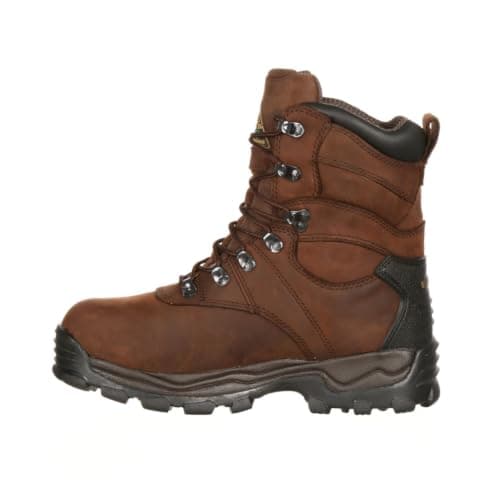
| 1 | Rocky Sport Utility 600G Insulated Waterproof Boot 600 grams of 3M Thinsulate Ultra in a waterproof boot — Rocky's own framing is lightweight warmth for less accommodating conditions, which is a fair description. | The tier below: 600g, steady movement | Available in safety-toe and non-safety-toe versions — check the variantCheck the specific variant; Rocky lists both safety and non-safety builds | |
| 2 | 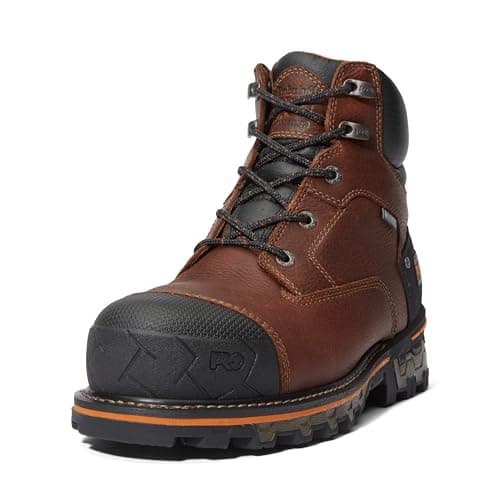 Timberland PRO Boondock 6" Composite Toe Insulated Waterproof Work Boot The Boondock platform with insulation added — the right tier for a full winter shift outdoors where you are moving but not sprinting, on the same waterproof membrane and all-weather outsole as the uninsulated version. | 600g with a published safety toe | Composite safety toe, non-metallicComposite safety toe with electrical hazard protection per ASTM F2413 | |
| 3 | 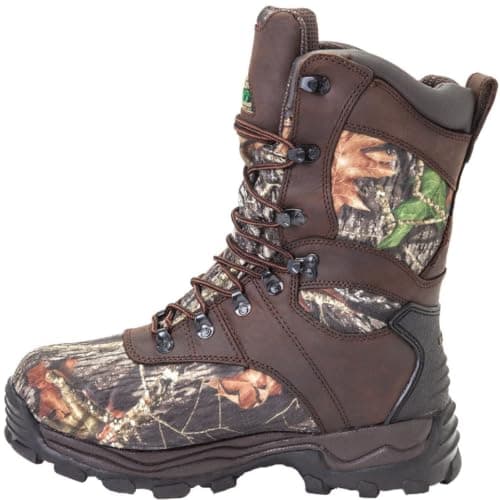 Rocky Sport Utility 1000G Insulated Waterproof Boot (FQ0007481) A 9-inch waterproof boot carrying a published 1,000 grams of 3M Thinsulate Ultra and no temperature rating anywhere on the page — which is the whole point of this category. | The tier above: the 1000g benchmark | Not published on the manufacturer page — confirm the variant before buying for a job siteNo ASTM F2413 designation published on this product page | |
| 4 | 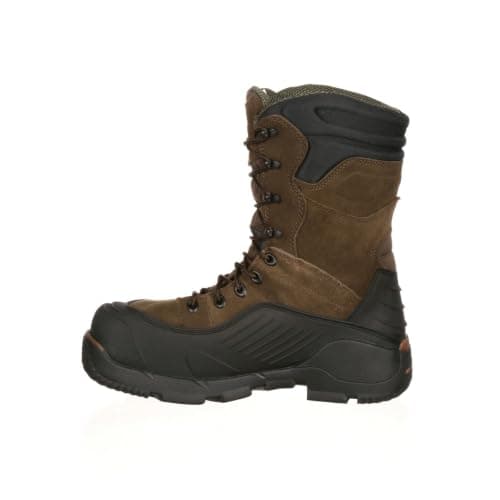 Rocky Blizzard Stalker Steel Toe Waterproof 1200G Insulated Work Boot (FQ0007465) The tier above 1,000 grams, and the only boot here that pairs that much insulation with a published ASTM F2413 steel toe and an EH rating — built for a gate, a yard or a cold-store floor, not for walking. | The work-boot ceiling, with a rated toe | Steel toe, meeting the ASTM F2413 protective toe classificationASTM F2413 protective toe classification with the electrical hazard standard |
Tap a row to jump to that boot's full write-up. The price column goes straight to Amazon.
What the number is
The gram figure is a weight of insulating material per square meter of fabric. 3M specifies Thinsulate exactly that way, and Thermolite, Primaloft and in-house equivalents follow the same convention. An 800g boot carries a third more insulation than a 600g boot in the same area, and a fifth less than a 1,000g one.
It is not a temperature and no maker claims it is. Rocky publishes 1,000 grams of 3M Thinsulate Ultra on the Sport Utility and 1,200 grams on the Blizzard Stalker, with no temperature anywhere on either page. That is the honest position: the maker controls the insulation and none of the other things that decide whether your feet are warm — your work rate, how wet the boot is inside, how well it fits, your sock, and how long you stand still.
Why work boots skip 800 grams
This is the part worth understanding, because it tells you what to buy instead.
Insulation tiers exist to match activity levels, and the useful steps between those levels are coarse. 600g is specified for a full cold shift with steady movement; 1000g is specified for being essentially stationary in cold. Those are genuinely different jobs. 800g sits between two use cases that are not really adjacent — it is too much for a worker who keeps moving and not quite enough for a fixed outdoor post in severe cold, so a maker gains little by tooling a third option into the gap.
Hunting is different, and that is where 800g thrives. A hunter walks in, then sits still for hours, then walks out — one boot has to cover both halves of the day. 800g is a reasonable compromise for exactly that pattern, which is why you find it across rubber boots, pac boots and insulated hunting footwear and almost nowhere in ASTM-rated work boots.
There is a structural reason too. A safety cap takes internal volume and so does insulation, and the more of both you add the larger the boot has to grow before the foot inside can still move. Work-boot makers spend that volume budget on the cap; hunting-boot makers spend it on insulation.
The work-boot ladder, with the gap shown
| Tier | Activity it assumes | In this registry |
|---|---|---|
| 200g | Active work in cool rather than cold conditions | Timberland PRO women's Direct Attach ST |
| 400g | Continuous activity in real cold | Rocky Mountain Stalker Pro 400G |
| 600g | A full cold shift with steady movement and unavoidable stops | Rocky Sport Utility 600G; Timberland PRO Boondock 600g |
| 800g | Walk in, sit still, walk out — a hunting pattern | Nothing — no safety-rated 800g boot here |
| 1000g | Mostly stationary in cold | Rocky Sport Utility 1000G |
| 1200g | Essentially stationary in severe cold, still job-site rated | Rocky Blizzard Stalker 1200G |
Which way to jump
Four questions settle it, and none of them is the forecast.
Do you keep moving? If you walk, climb, lift or carry for most of the shift, take 600g. Active work generates far more heat than people account for, and the commonest cold-feet failure is over-insulating, sweating by mid-morning and being colder at 3pm than a lighter boot would have left you. Damp insulation does not insulate.
Do you stand at a fixed post? Then go up to 1000g or 1200g. A gate, a yard station, a cold-store line — static outdoor work in genuine cold is the one condition the heavy tiers exist for, and no sock closes that gap. The 1000 gram page covers that end in detail.
Are you indoors part of the day? Take the lower tier, every time. Insulation you cannot remove is a liability the moment you walk into a heated building, and Timberland says as much about its own insulated Boondock.
Is your cap metal? If so, fix that before you fix the grams. Steel and alloy caps conduct heat out of the toes continuously, and switching to composite or carbon does more for toe temperature than a tier step — steel toe vs composite toe has the reasoning, and the alloy-toe roundup is blunt about the same limitation in aluminum.
If you buy an 800g boot anyway
The second check is the width run. The heavy tiers are frequently sold in a single medium width — the Blizzard Stalker publishes a D and nothing else — and that is a real problem when you need room for a thick winter sock. An insulated boot only insulates uncompressed, so a tight heavy boot is a cold heavy boot.
Sealing matters more than the tier
Wet insulation of any weight is close to useless, which is why every serious insulated boot is also a waterproof one. A sealed 600g boot beats an unsealed 800g boot in slush every time, and it stays ahead because it dries faster. Timberland states the Boondock membrane meets ASTM F1671-07; Rocky guarantees the Sport Utility's waterproof construction.
Then dry them properly. The footbed is where moisture collects, so pull the insoles every night and dry the boot without heat — a radiator cooks leather and attacks adhesives. How to condition leather work boots covers the drying rules, and the insulation ratings explainer has the full ladder and the rest of the buying checks.
The picks in full
#1 — The tier below: 600g, steady movement
Rocky Sport Utility 600G Insulated Waterproof Boot
600 grams of 3M Thinsulate Ultra in a waterproof boot — Rocky's own framing is lightweight warmth for less accommodating conditions, which is a fair description.
Published specifications
- Toe
- Available in safety-toe and non-safety-toe versions — check the variant
- Safety rating
- Check the specific variant; Rocky lists both safety and non-safety builds
- Upper
- Leather upper with a waterproof membrane
- Outsole
- Rocky outdoor outsole
- Midsole / shank
- Not published on the manufacturer page
- Construction
- Not published as a welt construction
- Waterproof
- Waterproof
- Insulation
- 600g 3M Thinsulate Ultra Insulation
Specifications read from Rocky Boots product page (Sport Utility 600G insulated waterproof) on 2026-09-27. We have not worn this boot.
What works
- 600g is the right tier for a cold shift where you keep moving
- Thinsulate is named and quantified rather than described as warm
- Waterproof, which matters more than insulation in wet cold
What doesn't
- Safety-toe status varies by variant — read the listing carefully
- Too warm above freezing
- Not resoleable
Who this is wrong for
Anyone who needs a safety toe and will not check which variant they are buying. Some Sport Utility builds have no protective toe at all.
Sizing
Insulated boots need room for a thicker sock and for air — insulation only works if it is not compressed. Try it on with the sock you will wear in January.
#2 — 600g with a published safety toe
Timberland PRO Boondock 6" Composite Toe Insulated Waterproof Work Boot
The Boondock platform with insulation added — the right tier for a full winter shift outdoors where you are moving but not sprinting, on the same waterproof membrane and all-weather outsole as the uninsulated version.
Published specifications
- Toe
- Composite safety toe, non-metallic
- Safety rating
- Composite safety toe with electrical hazard protection per ASTM F2413
- Upper
- Waterproof leather upper
- Outsole
- All-weather TPU outsole
- Midsole / shank
- Not published as a shank specification
- Construction
- Not published as a welt construction
- Waterproof
- Waterproof — membrane meets ASTM F1671-07
- Insulation
- Insulated; the listing states insulated protection without publishing a gram weight
- Weight
- Not published on the retailer page
Specifications read from Authorized retailer spec page (Lehigh Safety Shoes) — Boondock 600G insulated on 2026-09-27. We have not worn this boot.
What works
- A moderate insulated tier, which is what a moving winter worker actually wants
- Composite toe avoids the cold-conduction problem steel has
- Same outsole logic as the uninsulated Boondock
What doesn't
- Too warm for anything much above freezing
- Heavy
- Insulation cannot be removed when the weather turns, and no gram weight is published to judge it by
Who this is wrong for
Indoor work, or any shift where you will be inside part of the day. Insulation you cannot take out is a liability in a heated building.
Sizing
Insulation eats volume. If you are buying an insulated boot to wear over a heavy wool sock, try a half size up from your uninsulated size — but try it, don't assume it.
#3 — The tier above: the 1000g benchmark
Rocky Sport Utility 1000G Insulated Waterproof Boot (FQ0007481)
A 9-inch waterproof boot carrying a published 1,000 grams of 3M Thinsulate Ultra and no temperature rating anywhere on the page — which is the whole point of this category.
Published specifications
- Toe
- Not published on the manufacturer page — confirm the variant before buying for a job site
- Safety rating
- No ASTM F2413 designation published on this product page
- Upper
- Full-grain leather and nylon
- Outsole
- Sport Utility outsole for traction and stable footing
- Midsole / shank
- Not published
- Construction
- Lace-up; Rocky does not publish a welt construction for this model
- Waterproof
- Guaranteed Rocky Waterproof construction
- Insulation
- 1,000 grams of 3M Thinsulate Ultra Insulation
- Widths
- Medium (D) and Wide (EE)
- Weight
- 6.1 pounds per pair for a size 10
- Made in
- Not published
Specifications read from Rocky product page (Sport Utility 1000G, FQ0007481) on 2026-10-04. We have not worn this boot.
What works
- A real 1,000-gram boot at a mid-range price, where most 1,000g builds are hunting-specific
- Offered in a wide (EE), which matters because insulation eats volume
- Waterproof construction is guaranteed by the maker rather than implied
What doesn't
- No safety toe published on this page, so it is not a drop-in replacement for a rated work boot
- 6.1 lb per pair is heavy, and you lift it every step
- No published shank, midsole or ASTM detail at all
Who this is wrong for
Any job that requires protective footwear, and any job where you keep moving — 1,000 grams is insulation for standing still in severe cold.
Sizing
Fit it in the thick sock you will actually wear. A 1,000-gram boot sized in a thin sock becomes a tight boot in January, and a tight insulated boot is a cold boot.
#4 — The work-boot ceiling, with a rated toe
Rocky Blizzard Stalker Steel Toe Waterproof 1200G Insulated Work Boot (FQ0007465)
The tier above 1,000 grams, and the only boot here that pairs that much insulation with a published ASTM F2413 steel toe and an EH rating — built for a gate, a yard or a cold-store floor, not for walking.
Published specifications
- Toe
- Steel toe, meeting the ASTM F2413 protective toe classification
- Safety rating
- ASTM F2413 protective toe classification with the electrical hazard standard
- Upper
- Split suede with a 900 Denier waterproof upper
- Outsole
- Multi-directional Blizzard Max outsole
- Midsole / shank
- Nylon shank with a removable mesh PU footbed over a TPU heel stabilizer
- Construction
- Lace-up; no welt construction published
- Waterproof
- Guaranteed Rocky Waterproof construction
- Insulation
- 1,200 grams of 3M Thinsulate Ultra Insulation
- Widths
- Medium (D); no other width published
- Weight
- 6.1 pounds per pair for a size 10
- Made in
- Not published
Specifications read from Rocky product page (Blizzard Stalker steel toe 1200G, FQ0007465) on 2026-10-04. We have not worn this boot.
What works
- One of the few boots at this insulation weight with a published safety-toe certification
- Removable footbed, so the cushioning is replaceable rather than permanent
- Multi-directional outsole rather than a single-direction hunting lug
What doesn't
- A steel cap conducts cold out of your toes, which fights the insulation you paid for
- Medium width only — and 1,200 grams of insulation needs room
- Far too warm for anything but a stationary shift in severe cold
Who this is wrong for
Anyone who walks for a living, works indoors part of the day, or lives somewhere with a mild winter. This is specialist cold-weather footwear.
Sizing
Size for the sock and nothing else. With one width available and 1,200 grams of loft inside, compressing the insulation with a tight fit will make your feet colder than a thinner boot would.
Frequently asked questions
What temperature are 800 gram insulation boots rated for?
No maker publishes a temperature rating for 800 gram insulation. The figure measures grams of insulating material per square meter, which describes the boot rather than the conditions — warmth at your foot also depends on your activity level, the fit, how wet the boot is inside and your sock. Any degree figure attached to it came from a retailer, not the maker.
Do work boots come in 800 gram insulation?
Very rarely. 800g is a major tier in hunting, pac and rubber boots, where one boot has to cover walking in and then sitting still for hours. Safety-rated work boots are specified around activity levels instead, so the ladder runs 600g for steady movement and 1000g for mostly stationary work, with little reason to tool a tier between them.
Is 800g warmer than 600g insulation?
It holds a third more insulating material per square meter, so in identical boots with identical fit and moisture, yes. In practice the comparison is rarely that clean — the 800g boot is usually a different category of footwear, often without a safety toe, and fit, sealing and sock choice matter as much as the gram difference.
Should I buy 600g or 1000g if I can't find 800g?
Take 600g if you keep moving through the shift or spend part of the day indoors, and 1000g if you work at a fixed outdoor post in cold. Over-insulating causes sweating, and damp insulation stops insulating, so the lower tier is the safer mistake for anyone who is active.
Sources
- 3M Thinsulate insulation — What the gram figure on an insulated boot actually measures
- Rocky Sport Utility 1000G — manufacturer spec page — A maker publishing a 1,000-gram 3M Thinsulate Ultra figure and no temperature rating anywhere on the page
- Rocky Blizzard Stalker Steel Toe 1200G — manufacturer spec page — The tier above 1,000g, with a published ASTM F2413 steel toe and EH rating and still no temperature claim
Read next
Boot Insulation Ratings Explained
The whole ladder and the buying checks in one place.
600 Gram Insulation Temperature Rating
The tier below, and the one most winter trades should buy.
1000 Gram Thinsulate Temperature Rating
The tier above, for standing still in cold.
Best Insulated Work Boots
The boots themselves, tier by tier.